• Old Pete likes to hit hard.

    Let me back up.

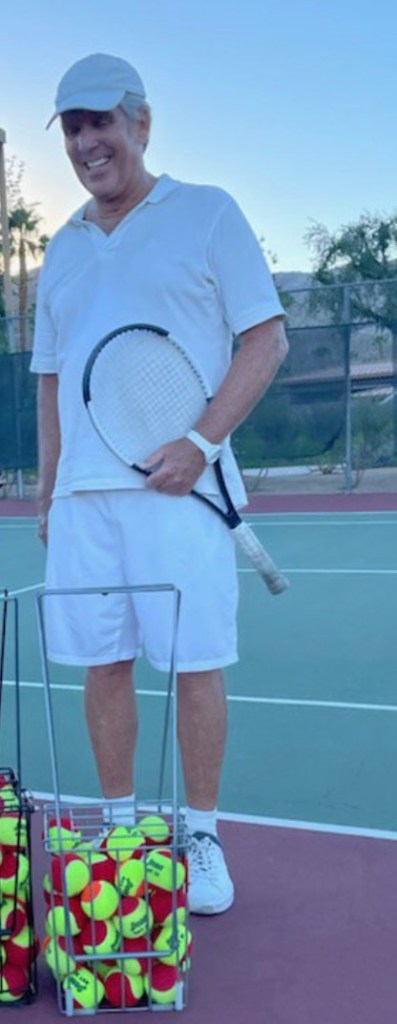
    Right around New Years I took a lesson from Chris Phelan, aka, Pro-To-Go in Palm Springs. At one point Chris met me at the net and said, “Look, you hit the ball great. You move Ok. But, you work too hard.”

    I admit it. I didn’t get it. In fact, I thought about it a great deal for the rest of our trip and after we got home. Gradually, very gradually, I came to understand. The point Chris was trying to make was, that at my level, what I needed to do is hit the ball deep, with top spin rather than always, or at least usually, putting great value on simply hitting the ball hard.

    Today I hit with Old Pete, an off and on student of Caesar.

    As we walked onto the court he said. “Listen, I like to hit hard.”

    I said, “Rock on, dude. Hit it as hard as you like.”

    And, he did.

    Chris Phelan in
    Palm Springs

    It took me about five minutes to find myself wondering what, exactly, was the point of relentlessly trying to hit the ball as Old Pete? I still do not have an answer but when I shared my experience with Chris he said: “Sad, but his loss. In the bigger picture, consistency equals a longer tennis life. Since no one enjoys self-destruction, the real fun is in developing a more versatile toolbox—one that includes a soft grip and relaxed wrist to get you out of trouble and make your opponent play one more ball, maybe one more than he’s able to return.”

    Sure, I am pointing the finger at Old Pete, and he deserves it. His style of play is neither effective nor enjoyable but if I am being honest, I’ve been guilty of something similar. It says something about me and my development as a tennis player that I didn’t get what Chris Phelan said when he said what he said back in January, in a sincere effort to help me play better tennis for longer.

    But now I do, and I’m happy about that and endlessly thankful to Chris Phelan. I can’t wait to get onto the tennis court with him again — maybe this fall. Maybe over the winter, it doesn’t matter.

    This time, I’m gonna get what he’s telling me without having to mull it over for a few weeks or a month.

    This time I will pay attention, Chris.

    I promise! Tt

  • More — always more — on rackets.

    As most of you know, I have only been playing tennis for three years. And, I didn’t start playing tennis until I was 62. I’ll be 65 later this month and I have been through a pretty good number of tennis rackets over that time. Honestly, my early preferences were based on brand and later on color and graphics. If you skip to the end you might conclude they still do.

    After a year or so I noticed I liked the look of 98 square inch heads. 98 square inches is a preference that has stood the test of time. Later, I noted a preference for rackets with a strung weight north of 320g that weren’t too stiff. Still later, I started to play more (currently four to five days a week) and in longer sessions with players who hit the ball harder. I remained dedicated to heavier rackets, which I found I swung more smoothly. 

    I have used rackets with grips sizes ranging from 1/4 to 3/8 and as small as 1/8. When confronted with the ubiquitous and simplistic ring finger measurement tool I measure at 3/8 but my palm is somewhat large for the length of my fingers so 1/4 is closer to ideal. I forgot, the first racket I bought was a Wilson Six.One One Hundred that was 1/2. My coach — taking pity on me for my unwise $35 purchase — expertly peeled off the original leather grip and put on two of his Tecnifibre over grips. He said of the leather grip, “Keep this. It’s in perfect shape.” Ah, the two over grips felt lots better!

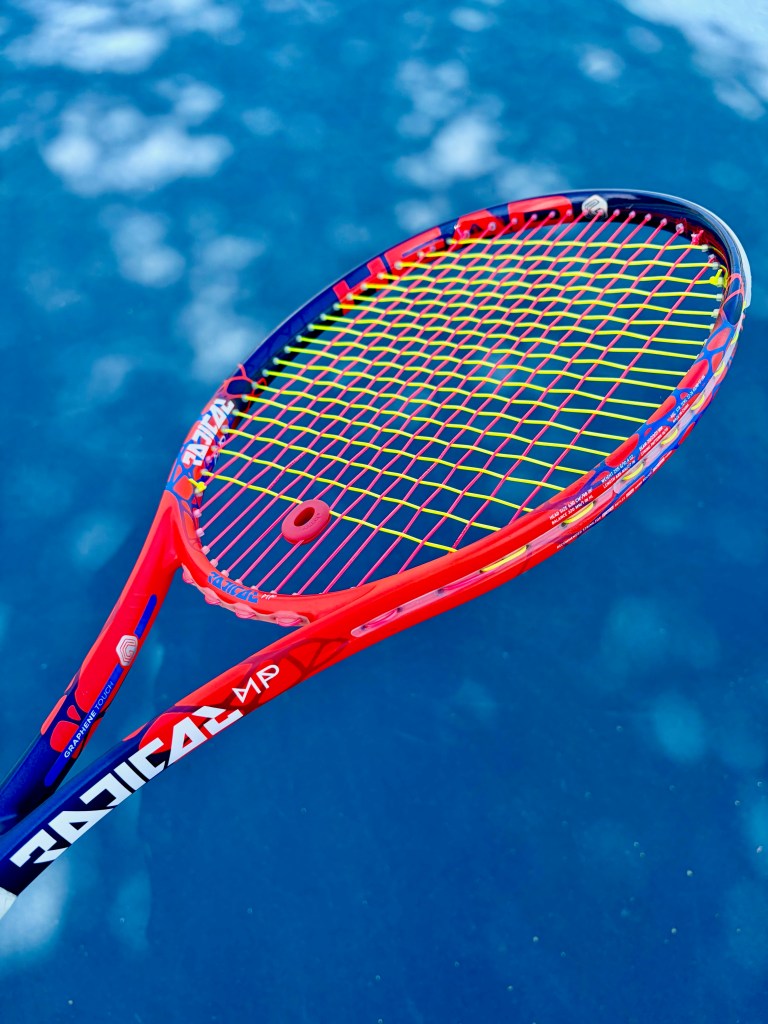
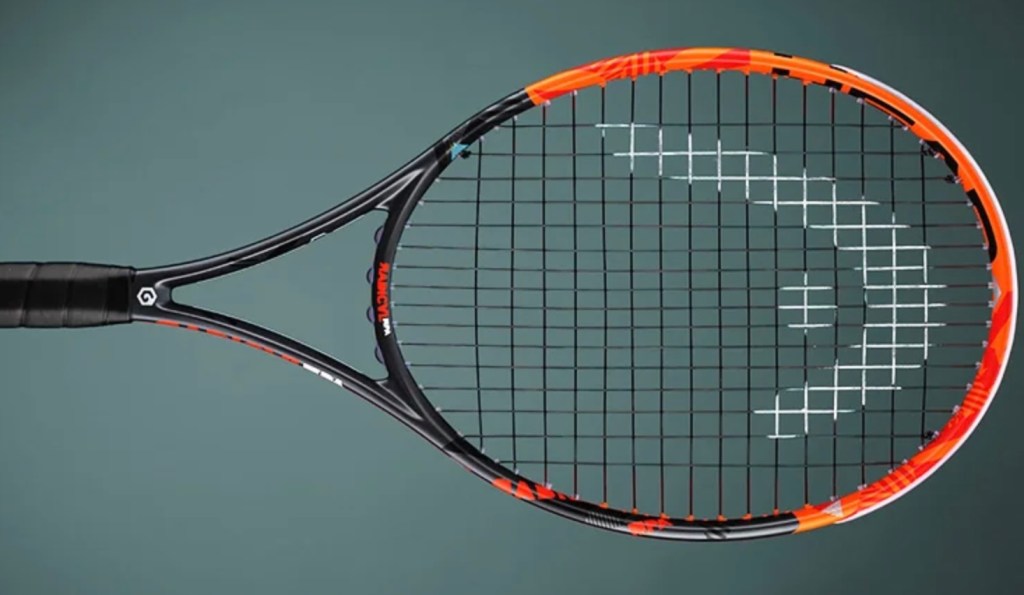
    I wrote recently about MIB’s Wilson Shift — the one I put on a weight reduction program — and then found I liked. The Shift got me thinking of finding a racket of similar weight and stiffness but with a correct 1/4 grip size, preferably with a 98 square inch head. I found a cache of NOS Head Radical MP from God knows how long ago. Said to have a strung weight of 310g, it was promising and cost less than a $100 bucks delivered. It arrived strung with black Head SynGut. My initial thought was to have it immediately restrung with my second set of Head Lynx Power Soft Proto I picked up from TW for a buck a set. Then I reconsidered and I took the Radical out to hit a few serves. It feels just dandy, pretty much like every racket I’ve tried save an unfortunate few that shall remain nameless.

    I confess I may be largely insensitive to racket variations but I still have some favorites, spec wise, and I believe I’ve settled on a workable weight range. I think my ability or lack of same means I can play with a wide variety of rackets and be happy. That said, I enjoy trying different rackets in the same way I enjoy tasting different craft beers rather than continually ordering the same beers from the same breweries. Sometimes a different racket is simply enjoyable to look at. I could say the same about some beers, come to think of it.

    My age even more than my basic ability limits my top end in tennis, no matter how much I play or practice or learn about the tactics and strategy of the game. Or, even how much I love and enjoy the game. Still, I think it’s a good thing my rackets have started to measure and play more like each other. Plus, I dig my new Head’s paint job.

    NOS Radical MP

  • El Shifto: Saying goodbye to the Wilson Shift. We hardly knew you!

    My experience with the Wilson Shift started when I flew home from Detroit with MIB’s personal racket. I guess it wasn’t his personal racket if we are defining personal as the racket he was using at the time. Long story short, Jonas at tennisnerd steered MIB toward the Shift 99. I found it a rather odd suggestion, knowing MIB’s game first hand. At the same time, I was somewhat heartened MIB had reached out to someone for racket help when he already owned a fantastic tennis game, especially in doubles. As good as he is, MIB was still striving for improvement!

    By the time El Shifto (300G / 16×20) was in my hands it had been through some changes, courtesy of the MIB. It had a leather grip and a Tourna overgrip as well as significant quantities of lead tape at 3 and 9. It felt a little like the tennis racket equivalent of Manny Sanguillén’s bat from the 70s. If you don’t get the reference, oh well. The point is that MIB’s Shift was heavy.

    Me? I like a heavy racket as much as the next guy but Michael’s tuning of it felt more than a little off to me so bit by bit I undid what had been done. First to go was the lead tape. Then I lost the leather grip. That’s when things got wild. You see, MIB uses a 4 3/8 grip while I prefer a 4 1/4. My solution was to go Modified Djoker. I heard Novak Djokovic used two overgrips and no main grip. True? False? Who knows or cares? But I added a twist. I placed vertical strips of blue masking tape on the bare grip (five layers to be precise) and finished the grip with a single Yonex Super Grap Wet.

    Before I get to the results let me tell all of you who don’t know and, really, why would any of you know, I find the grip sizing system to be totally stupid. I think tennis grips should be sized by measured dimensions rather than a reference to something that’s actually not a reference but a simplistic effort at correlation, in this case a bizarre attempt at correlation between the length of one’s palm and the added length of their ring finger and the correct grip size.

    What?

    I’ve probably lost you by now and that’s Ok since this is my tennis fever dream. Back to the five layers of blue masking tape. Quality 3M masking tape actually builds up quite a bit of cushion, especially five layers of the stuff so once I had the Yonex overgrip installed the Shift’s grip felt pretty much like a 4 1/4 with nicely pronounced bevels.

    Voila!

    MIB’s El Shifto with a couple grams of lead tape in the throat now tips the scale to a svelt 310 grams.

    Not quite. But here’s the thing. El Shifto felt and played great. Even though at 310G strung it was my lightest racket it felt exceptionally solid on volleys and quite precise on groundies. My serve had great pop and El Shifto rewarded a smooth stroke, happy to do a good deal of the work for me. Notwithstanding my general disinclination against Wilson tennis rackets I have to say the modified El Shifto has become my favorite racket. It has me thinking about grabbing a Son of El Shifto or hunting down a Wilson Labs version. As if I need another tennis racket. Then, right as my enthusiasm for the Wilson Shift was in its ascendance I read that Wilson had ditched the racket for a yet unnamed successor. I say unnamed even though I’ve read rumors that Shift’s replacement will be called the Python.

    You know. Snakes. Tennis. Sure.

    This is what I don’t get. Wilson, by all indications, did a lot of work creating the Shift, similar to the effort put behind the development of the Clash. The Clash is now in Version 3 but Shift has been unceremoniously consigned to the ash heap of tennis racket history without the common courtesy of even a Version 2.

    Why?

    I’m sure Python or Viper or Garter Snake or whatever Shift’s successor is called will incorporate some and perhaps many of Shift’s innovations. Abandoning Shift bothers me as a marketer and I think it makes Wilson look bad, at least in my eyes. If they knew they had a good racket in the Shift, and they obviously did and likely still do, what’s the hurry to dump it? Is the Wilson Burn really flying off the shelves? I don’t think so.

    Maybe Wilson thinks the Shift is too close to the Clash, but I don’t think that’s correct. Obviously, the Blade V9 is a darling of the professional game for both women and men. For a while, the Ultra V5 with its flashy blue paint, looked like it was going to catch on for both pros and recreational players but its appeal to both sectors seems to have flattened somewhat.

    The Shift deserved more respect from Wilson. At least it has mine. Tt

  • Sometimes a one-off tennis lesson comes with a dose of just plain weird and that’s OK.

    I really enjoy taking one-off tennis lessons. I like to see how I will respond and I also like to see how a tennis pro facing the challenge of helping a student they are unlikely ever to see again faces the challenge. This time the fun took place during an unusual heatwave that made it all the way to California’s Central Coast where we have had a four-day getaway planned for months.

    The pro was a lefty and even older than me, if you can imagine. I was quite upfront that I was looking for someone to rally with but that instructive comment was always welcome. The rally lasted all but five minutes before the question, “Can you slice your forehand?” I said I could but found the shot less than common. Sure, it’s fun but it’s seldom needed or effective. But, I was game so I hit a few to show the shot was no problem for me

    Here’s where things got weird. The coach wanted to talk about the split step. It seems that a lot of his students land flat footed when asked to split step. He then asked if I knew about split step and float? I confessed that I did not. The coach went on to say that split step and float means the player lands on one foot, so as to aid their ability to move in that direction.

    No.

    That’s what I said, for a couple reasons. First, how is the player supposed to know which direction they need to know at the moment they split step? Second, the idea of hopping off both feet and landing on one seems like an unwise practice.

    Sorry.

    After the lesson I really felt badly. You see, the coach had hit on two genuinely good points. The first was a more level driving motion on high bouncing one-handed backhands. The second was to use the ball point to rotate the off arm toward the striking arm to aid in spacing. Both of those thoughts worked great.

    Yup, I would take another lesson from this guy.

    Yes, I think he was dead-wrong about the split step.

    Yes, I learned something during the lesson and I enjoyed myself.

  • A Tt Interview with El Jefe of Cancha, Jack Oswald

    Tt: When did you start playing tennis and who got you into the game?

      Jack Oswald: I started playing tennis when I was about five years old, first in the UK. My dad got me into tennis. He was big into tennis, both watching and he played a little bit as well. All of my family played a little bit of tennis at one point for a little while, but I was the one that really stuck at it.

      My parents moved to the US when I was five years old, and I really got into it there. There were so many more courts, so many more players around. The weather was better for tennis, to be honest, and I just really got into it. However, it was around about 10 or 11 years old that I became obsessed with tennis, and I really wanted to make it pro. It became basically my mission in life for the next 15 years, I think.

      Tt: I was going to ask you Why Bags but instead I’m going to tell you what I think—pretty much all tennis bags suck, even though I’m sure you already know that. First, most tennis bags are made poorly. When it comes to style it’s whatever makes the logo the biggest wins. It’s one area where golf beats tennis hands down. A golfer can buy a golf bag that’s designed to be carried by the player, carried by a caddie, put on the back of a golf cart or the kind of golf cart you push or pull. I cannot figure out why tennis bags are so bad. Help me out here, Jack!

      Jack Oswald: I know, I feel the same way. I saw so much innovation in the bag space in so many different industries, like the outdoors space and golf, which is probably the closest thing to tennis. I believed there could be something better we could be doing here.

      Also, as I was traveling as a pro tennis player, I felt firsthand, or came across firsthand, the issues of traveling with tennis rackets from country to country on planes, on trains, buses, from hotel room to hotel room. I wanted something that could be better, really, for myself. It was quite a selfish thing to begin with, and I became more aware as it went along that the industry, the tennis industry specifically, needed some innovation.

      I have felt like this for a while with tennis that some of the areas of tennis are quite antiquated, and it’s caught up a little bit, I think, over the last few years. Especially when I was playing seriously, the tennis world was quite antiquated and the way it was set up really needed some innovation.

      Tennis bags were something that I had an experience firsthand with, more from the usability side of things, from using bags. I really wanted to first of all make it easy for myself and then for everyone else, honestly, to travel with tennis rackets and to make it easy for people to play tennis on it during their daily routine, on a daily basis, whether that’s from work travel and anything like that.

      I also wanted to make things that really were suited to the player and the person in their daily routine and not just, like you said, big logos and bright colors and things that really have no performance or practical impact.

      Tt: What did playing professional tennis teach you about what a traveling tennis player needs to have, right at hand?

      Jack Oswald: Honestly, it was the constant traveling as a professional tennis player that really taught me a lot about what could be made easier for people when they are traveling for tennis. I mean, I came across it first hand and had a lot of experiences carrying gear around.

      The most tiring part of the whole process of being a tennis player was traveling. I really felt, by making it easier for myself, I could eventually make it easier for others. If there were an easier way to travel as a tennis player, I believed that could affect everybody, not just professional players but people who are trying to fit tennis into their daily routine.

      My goal was to make a difference there and, in some way, help people be more active and carry their passions with them. Yeah, I think it was the constant going from place to place that really helped me understand how traveling for tennis could be made easier with the right gear.

      Tt: How long did Cancha’s prototyping stage last? Did you evaluate all of the photos or did you reach out to other tennis players?

      Jack Oswald: Honestly, too long. I started designing the bags in 2018, knowing nothing about soft goods design, product design in general. I really went into the deep end, but we didn’t know much about it. I spent a lot of time traveling to trade shows, speaking to designers, taking samples with me to employment tournament from 2018 until 2020, even 2021. It was a long time, three or four years of design and no sales coming in, which was difficult because I didn’t have much money to play with to do this.

      We ended up doing a Kickstarter campaign and raising some money to begin with from friends and family that really helped me to get things off the ground. It was a huge learning experience. I learned so much about product design and the soft goods world, making bags, and also the practicality of traveling with bags and what you actually needed.

      I went through many, many prototypes. Many of them broke on me during my travels, which was really frustrating at the time. There’s nothing worse than a bag breaking on you when you’re mid-trip, but it was a really humbling experience. It was a really enlightening experience. I learned a tremendous amount, and I still have all those prototypes saved. They remind me of how far we’ve come.

      Tt: What about materials? How many did you have to evaluate before you settled on the final Cancha material?

      Jack Oswald: To be honest, materials are an ongoing thing. We’re constantly refining materials. It’s something that never really ends. We have gone through many different versions of the materials we’re using. A bag has over a hundred components, so we’re constantly evaluating and looking at new innovations in the material space. I think there’s a whole lot more we can be doing there as well.

      It was really through testing and seeing what was out there and all the different changes that were going on in the space, and seeing what worked for us and retesting it out that helped us arrive at a starting point. From there on, we’re just constantly evolving.

      Our bags have new materials all the time. Sometimes people don’t notice them because it’s been a slight improvement that is just a quality of life improvement, and other times it’s a big change that people really notice. I think it makes all the difference. I think that constant drive to improve our products, existing products as well as new products, has helped us a lot over the years.

      Tt: I’m lucky enough to have both the Cancha Racket Bag Pro and the Original Cancha Tennis Bag. I love them both but if I could wish for one thing it would be more and bigger zippered pockets. Do you feel my pain or am I crazy?

      Jack Oswald: I agree, and feedback is a thing that we take extremely seriously. I’m constantly hearing from people about what they love about the bag, but also what they don’t love about the bag they’re using. One thing is we can’t please everybody, and you have to pick a side on some things and what we feel is best. I agree there’s certainly improvements that can be made, and we’re constantly making those improvements.

      We get feedback all the time, like I said, from customers, and we take it seriously. I am constantly working with my team on new improvements, new designs, constantly traveling to visit our manufacturing partners and material suppliers. It’s an ongoing, never-ending process; that’s what’s so great about it.

      I think if you look at where we’ve come from there until now, I think there’s been a huge amount of improvement. I appreciate your feedback because that it’s something that we can certainly do better, and I think that’s what this is all about

      Tt: Every time I drop by the Cancha website I see another cool product that I need, Need, NEED. If we hit the Fast Forward button forward to 2030 will Cancha still be a tennis brand, a lifestyle brand, or both?

      Jack Oswald: That’s interesting. I wouldn’t even necessarily consider ourselves a tennis brand specifically. I think that we have a really cool niche in the tennis space, but people who play racket sports of all kinds buy our bags, and people who don’t as well buy our bags. Everyday carry bags are part of our line-up now, and we’re constantly building out because we want to be part of people’s daily routine, helping them be active in all areas. I think my experience as a tennis player, as a traveling tennis player, has helped us really innovate in that space, but I think there’s a lot more we can do.

      I want us to be both. I think we can talk in a very niche way to tennis players and meet their needs, but I think we can also be something for other people as well. I really appreciate what you say about the new products and the innovation. I think that that really means a lot to me because I’m trying my absolute best as a founder of a very young company to come up with things that I really feel proud about.

      I don’t go into product categories or even product lines without feeling like I can really make a difference in the space. I have a lot of ideas for things that we can be doing. Sometimes I have more ideas than resources to do them, which is probably a good thing; it keeps me focused. I can’t say exactly where we’ll be, but I think there’s a whole lot of cool stuff in the pipeline that I’m just so excited to share.

      Tt: Thank you, Jack, for taking the time and for being a good friend to tennis players everywhere.

    1. Long Term Follow-up: The Cancha Racket Bag Pro is a Year Old!

      Time flies!

      MIB, ready to be, well, MIB!

      MIB has been using the Cancha Racket Bag Pro for a year. I know because I shipped the bag to him last February. He’s been using it as his one and only bag ever since.

      Now, MIB is not your typical recreational player. No, he’s a three to four day a week doubles warrior. He not only admits to being hard on tennis gear, he occasionally celebrates the fact. Tennis racket blood sacrifices into trash cans and the like—you get the idea. When MIB told me he had shipped the back back to me I was expecting the worst. Instead, the Cancha Racket Bag Pro looked new.

      Have a look.

      MIB used the hell out of the Cancha Racket Bag Pro but you could not tell by how the bag looks after a full year.

      Zippers are perfect.

      MOLLE points are perfect.

      Fabric is perfect.

      Straps and handle the same.

      I am quite certain the bag could pass for new. Ok, so my trusty California patch would give it away but otherwise the bag looks like new. So, now it’s my turn with the Cancha Racket Bag Pro. It swallows up my rackets and two pair of shoes and everything else that needs to be inside. I am really looking forward to traveling with the bag on a tennis trip later this month and for my birthday getaway in April. I will report back once I get the Cancha Racket Bag Pro out on court. But if I were you, I would cut to the chase and expect me to be even more impressed with this fantastic bag once I have had the chance to use it myself. Well done, Cancha! Tt

    2. Tennis Partners

      When I started playing tennis, MIB warned me I would find it a challenge to find suitable tennis partners. He was right. My plan, to engage in formal instruction rather than developing what I somewhat disparagingly have referred to as a park game was the right way to go—for me. The downside was that the social or networking aspect of tennis—the ability to get a game or a hit—had to be developed after I’d gotten fairly adept at hitting the ball. Connections are not always easily made. So, I want to write a bit about a few of the tennis partners I’ve shared a court with.

      Phil: I found Phil on the Tennis Players Looking for partners database at Calabasas. He was a commercial property manager. He emphasized that he only did commercial, no residential. When I asked him why he said it was because a commercial property manager didn’t have to listen to as many sob stories as a residential property manager. “You know, it’s not personal. You’re not paying. It’s time to move your business or go out of business.” It made sense. Phil was 45 I think, but his pattern of play has become well-known to me over the last year or so. Even though he was in decent shape, he didn’t move much. So, I either had to hit it right at him, preferably at his forehand, or my ball was going straight to the back fence. He did give two interesting bits of advice. First, was about two local guys who organized mixed-doubles meetups, one at CSUN and the other at Sherman Oaks Park. His other bit of advice was a good one. Phil said, “I’ll tell you what I’ve learned about doubles. Only play mixed. Taking out 50% of the testosterone out of tennis makes the game a lot more fun.”

      Stan / Johann: These guys were great fun. I started out with Stan, a mid-40s accountant. He’d been playing for years but wasn’t very good. He moved like a fit 40 year old, which I enjoyed. We were hitting once a week and chatted about the idea of playing doubles. As the birth of his daughter drew near, he was nice enough to pass me off to his buddy Johann. He was more fit but his tennis skills were a little shaky but he was such a pleasant guy. Then one day he just kind of vanished. When he surfaced again he said he’d been inundated by work and family life. I get it.

      Brisbane Stew: I was practicing my serve at The Rose Bowl, earbuds wedged into my ears, when I thought I heard someone talking to me from the court next to me. That someone was none other than Brisbane Stew. He was looking for a quick hit so we rallied for a while. Turns out he was a pilot for Qantas and found himself in Pasadena for a few days before flying back to Australia. A couple years younger, but a lot more fit, Stew gave me all I could handle. In fact, he was a big motivation in my (somewhat shaky) decision to convert to a two-handed backhand. We tried to meet up once a trip and I had gotten used to an occasional text from him saying when he would be in town. Stew has an excellent serve and likes to play angles you would expect to see in a good doubles match. Then one day Stew told me Qantas was changing planes for the BNE to LAX flight. I hope I’ve not seen the last of Brisbane Stew. He was great fun to play with.

      Pasadena Steve: The tennis gods take and then they give. Not long ago I was practicing my serve at Grant Park in Pasadena when Pasadena Steve strolled up, resplendent in his bucket hat, and asked me if I wanted to hit a few balls. Since then, we try to meet up every week or so. Steve’s a retired schoolteacher from LAUSD and is a relatively new Pasadena resident and a refugee from nearby Glendale. There’s a lot of talking during our sessions and that’s fine by me. It’s nice to blather on about politics, writing, baseball and Mexican food with someone who shares many of my same reference points. Steve plays in a long-established doubles group at the Rose Bowl that’s been going through some changes of late with one player going to the great tennis court in the sky and another threatening to move. Tennis is always about adjustment.

      MIB: I will always be able to brag that someone traveled 2,000 miles to play tennis with me, on my birthday no less. Sure, that was MIB. And, sure, he was in Los Angeles on business but he still went out of his way to extend his trip by a day so he could get all the way to hell and gone (Calabasas) on my birthday. We played during my lesson with Caesar and it was a great experience for me and one I detailed in Tennis thing the book.

      Then, last summer, following our family reunion in the QCs, we made the trip to SE Michigan to see the MIB in his own back yard. Yes, tennis was played. Yes, bourbon was sipped. Yes, LPs were played. Playing tennis with MIB was a hoot. He honored me by playing full out and I really savored the challenge. It reminded me of the movie The Rookie, where high school baseball players in a small Texas town in get better by trying to catch up with the major-league fastball of their coach, Jim Morris.

      I think you have to see high-level athletic performance to get an Idea for how close you can get to it yourself. Better than seeing is actually experiencing. I imagine some people would shrink from such experience, worried about proof beyond doubt that they could never deal whatever the athletic prowess they admire. Me? I think the experience itself can exalting, so long as one is serious, like I was when I played with MIB. Playing with MIB, even more so than Stew, gave me the sense of what I could do and what I could not. It clarified the size of the court and what it meant to actually cover it. One thing is certain, if I were lucky enough to play with MIB on a regular basis I would be a far better tennis player.

      Federer said that in tennis you could feel your opponent through contact with the ball. As soon as I heard this I nodded. The same is true in baseball. I can still remember the sense of hitting a heavy slider off some guys. My hands remember the feeling and in my brain that fragment of sense-memory connects me with those guys, even after all these years. It’s only been a few months since I played tennis with MIB but I still remember how it looked and felt.

      Lord willing, MIB and I will find ourselves on another tennis court someday soon. I’m looking forward to it.Tt

    3. Tumble on down

      About a month ago, I was playing with Pasadena Steve when he lobbed me—successfully, as it turned out. I say as it turned out because I got to the ball in plenty of time. The problem was that I was still going back, well beyond the baseline, waiting for the ball’s first bounce to finally be in the zone for an overhead. It was the first time we’d ever played on this court and there was a lot going on. The adjacent court was full of kids taking a group lesson. A couple parents were using our court’s bench to watch their kid.

      Worse, as I moved back for the ball I had the sense I was getting close to the fence. I was, but I wasn’t so close that my next step would have me crashing into it. At the moment I was slowing down and raising my racket above my head, I lost my footing.

      It was a classic case of tanglefoot.

      I knew I was going down, but there was little I could do about it other than try to roll into my right side as gently as possible. I hit with the right front of my right knee, then the outer part of my right knee and then my right hip before settling onto my back to appraise the damage. My hip hurt and my knee started to sting. Then I realized I was bleeding from another abrasion on my right elbow. But, overall I felt Ok, so I got back on my feet. By then I could hear Pasadena Steve—three years older than me—calling out to see if I was Ok.

      In the moment, I considered asking him if I looked like a big fucking baby. Instead, I picked up the ball and fed him a forehand.

      “Right back on the horse,” Steve called.

      Yup.

      Steve’s a nice guy. He’d just finished reading my first novel and had pages marked with Post-its so he could remember his questions. As I drove him home, I felt just a little shocky, like I had just been in a fender bender.

      My elbow was still bleeding but Pasadena Steve went on asking questions:

      Now, was Ally based on a little girl you knew?

      Me: “Yeah, she was based on a kid my ex-wife taught, second grade, as I recall. Her name was Daisy and she had terrible asthma yet her idiot parents both smoked at home in their tiny two-bedroom apartment.“

      And what about the name, Gerry Garcia?

      Me: “I wanted a name that was a little odd, Gerry with a G, and Garcia, vaguely Spanish sounding yet the guy’s a pale-skinned redhead. So, nothing really fits Gerry Garcia, not even his name.”

      Steve’s what I call a kindly and gentle reader. Even though he reads a great deal (he’s in three book clubs) he’s not jaded. He’s still ready to enjoy a new book on its own terms.

      When I pulled up in front of his condo, Steve asked me to sign both copies of the books I’d given him. I pulled out my trusty N°BK92 All-weather pocket pen and composed inscriptions while my elbow oozed blood. I’m really sorry I didn’t manage to sign my name in blood. As I drove toward home, I was especially thankful we would be in time for the end of happy hour at our beloved T. Boyle. In my book, a tumble on a hard court earns a bourbon. And if one is good, two are better.

      I was very grateful I hadn’t hurt myself. I couldn’t remember the last time I fell on something as hard and unforgiving as a tennis court. Decades, for sure. As much as I don’t want to do it again, I was impressed that I’d gotten away with it even once. The abrasions are pretty much healed now. I still have a bit of tenderness in my right hip. The strangest part is the stubborn pain in my right side. At first I thought my right elbow had been driven into my ribs but the pain wasn’t exactly in my ribs. It’s still hard to sleep on my right side. No matter where it was, I was very happy I didn’t have to sneeze a single time over the next couple weeks. It would have hurt.

      Which brings me back to gratitude. And to the fundamental constant in tennis: uncertainty. Lord willing, as my father would say, I will be 65 in a couple months. As much as I hope to avoid another unplanned trip to the court’s surface, I am undeterred. Tennis and I are good. We’re both worth it, come what may. Tt

    4. Tennis thing review of the Kimony Quake Buster string dampener.

      Kimony could be my favorite tennis accessory brand. There’s just something about companies like Kimony with just the right vibe (no pun intended). Plus, tennis accessories like grips, tools and dampeners can be so engaging on a personal level. As someone who has done a lot of business in Japan, both in my previous marketing life in high-end audio and later in golf, I appreciate the ethos of Japanese companies, especially small ones like Kimony.

      They know what they’re about.

      They know what matters to them and they know how to make it.

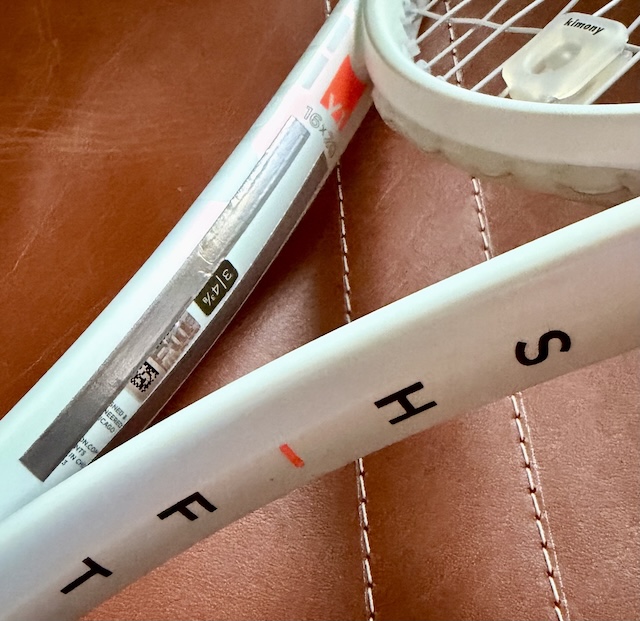
      I think I’ve used most of Kimony’s replacement and overgrips and each has been excellent, at least on par with offerings from much larger companies with more familiar names. But, this is my first experience with their dampener, The Quake Buster (or how I wish I could use the iOS Text Effects to make the letters in Quake explode!). As usual, I was first attracted to the available colors (I chose clear and black). But I had another motive respective to trying the Quake Buster and that was the way it attaches to the racket at the top and sides and the fact that it’s basically square (so as to maximize string contact) and also the fact that the experience of others who wrote about their experience with the Quake Buster state that the dampener is quite soft.

      The words quite soft translate to a thermoplastic that has a fairly low durometer (the lower the durometer the softer and more maleable a material). Harder dampeners (like Head’s)lack significant compliance to dampen much of anything. That said, the design of a dampener like the RTP Shocksorb may have gone too far, with a durometer that’s simply too squishy (and heavy). The question is whether the Kimony Quake Buster gets it just right.

      The Kimony Quake Buster in my Head Instinct MP

      The Kimony packaging has some copy on the back so I had a buddy of mine in Japan translate for me:

      Before impact, the mushroom, which was in a stationary state relative to the Quake Buster main body, moves its head in the direction of the ball due to inertia at the moment of impact.

      After impact, while interfering with vibrations from the strings and other sources, it absorbs (dampens) vibrations in all 360-degree directions.

      In other words, the mushroom works in a truly magical way.

      Come on, a magic mushroom! This is obviously the very best quality ever when it comes to a tennis string dampener. Seriously, I think the Quake Buster is a very well-executed product. The way it attaches to the strings, its shape and perhaps most importantly the durometer of its thermoplastic make it an excellent dampener. The sound isn’t dull but retains a slightly resonant thunk that is quite pleasing.

      Well done, again, Kimony! Tt

    5. The art and science of warming up to serve.

      This has been bothering me for a while. How should a club player warm up to serve? My main problem is this: I tend to hit too fast too early. What’s strange to me is that the speed seems to come automatically. In other words, I am not trying to hit my serves fast or hard. Compare this to my baseball career where I found it very easy to warm up gradually. I enjoyed playing short toss before moving up to long toss before refocusing on pitching at full speed from 60 feet 6 inches. For me, properly warming up to serve would take a little more thought. At first I tried to work it out by myself but I continued to find myself at 75% with two or three serves.

      That can’t be good.

      Lexie, My tennis coach!

      So, I decided to reach out to two trusted experts. Coach Lexie is one of my favorite tennis coaches at Instagram. Every time she says, “I’m Lexie, your tennis coach.” I smile. It’s nice to think that I’m actually Lexie’s student and her posts always make it feel that way. When I asked her about warm up to serve she was generous enough to write this for me.

      “When I warm up the serve, I start by preparing the body and shoulder before hitting balls. I use light dynamic movements like arm circles, shoulder rolls, torso rotations, and wrist prep to open up my range of motion.

      On court, I add shadow swings and light throwing to groove the service motion and rhythm without tension. From there, I move into a progressive serving routine—starting easy to find feel, then gradually adding direction, different targets, and serve types (flat, slice, kick), always focusing on a consistent toss.

      A good serve warm-up is about rhythm and feel first—speed comes last.”

      All of that make sense to me but it’s not easy. I have tried to formalize the process as much as I can. I start by tossing along the fence (another technique Lexie shared on Instagram). My toss tends to creep lower and lower as I hit my serves faster but a fence-high toss allows me body more time to impact the ball with a nice sense of flow.

      Then, I move to the baseline and I toss and catch, another bit of advice from Lexie. This is very helpful because it gives me instant feedback about whether my toss is even in the ballpark. Sometimes it’s not.

      Then, I finally make contact with the ball. My goal for the first ball is to hit the ball as slowly as possible for at least five balls. That’s not easy for me, but I am trying. I promise. In fact, my practice goal is not to exceed 30% when I am hitting serve after serve. Hey, I’m gonna be 65 in April. Sixtyfuckingfive!

      Another Instagram coach who has helped with my warm up is Coach Kirsche. As soon as I started to follow him he came out with a warm up guide for the shoulder. Talk about timing!

      Me? I love this dynamic resistance band stuff but I have to admit that I have a hard time implementing it. Why? Did I mention I was going to be 65 in April? Thing is, every time I’ve tried any resistance band work, even light stuff, I have ended up with a shoulder that’s more sore than it would be after thirty serves. Still, I am going to dedicate myself to doing more of this. I just need to find the sweet spot between overdoing it (my style) and not doing it at all (also my style. You figure that out.

      I’d like to extend my sincere thanks and gratitude to Lexie and Kirsche. Just the feeling of having two great coaches out there who want me to improve makes me want to improve even more.

      Tt

    <style>
    .homeside {padding-top:600px;}
    </style>