Category: Calabasas Pro Tennis Championships

  • Academic tennis: A Tennis thing meditation.

    As those of you who have read Tennis thing know, I owe my tennis to my brother, MIB. He was the one who told me, before even meeting me in person, “Paulie, you would love tennis.” MIB was right, as he so often is. What I doubt, though, was that MIB would have expected how long I would take my twice-a-week lessons with my coach, Caesar Schwarz. It’s been a bit over two years since I started studying tennis with Caesar. I didn’t start out studying the game, I think it became a study gradually, but it is what tennis remains for me.

    What’s the diff, you might be asking? Think back to playing dodge ball when you were a kid. How long was it between your first hearing of the word dodge and the moment when someone was chucking a ball at your head? Most games are learned as they are played. Many people, most people, likely, learn terms by playing it.

    But, I have not. I have learned to play tennis while studying it. I like to watch tennis played whether I am watching a WTA or ATP pro or a little kid with marvelous footwork.

    And, I love to hit the ball.

    What I have not focused on is competition. This is true partly because at my age I am not especially competitive. I’m not even in a competition with myself, to be honest. I want to play tennis correctly out of a motivation to master something at once new and satisfying. That’s an intoxicating combination. But, the question is does the person on the other side of the net count and is anyone keeping score? When Caesar is the guy, he matters. It’s the precision and intentionality of his play that allows me the physical and mental opportunity to learn. He has raised me since I was a 60+ year old tennis newborn and has been instrumental to everything I’ve learned. If any elements of my game are AOK, it’s because of my coach.

    But, and this is something I mused about in Tennis thing, does one need to play tennis, keep score, enter tournaments, seek the humiliation of their opponents to really play tennis?

    There’s this old broad at Calabasas who seems only to hit with whichever pro is available. I have never seen her playing with anyone other than a coach. There’s no serving and each coach tends to hit the ball directly toward the old broad. But, the old broad bashes the ball back with fierce effort and likes to collect winners. And, this brings me to this quote:

    “Some people, they keep on working with a coach, but the coach is just teeing the ball up for them. That’s no way to learn tennis. This is how you learn the game, right here.”

    The previous quote is from Brisbane Stew. He’s a Qantas pilot I met at Pasadena’s Rose Bowl tennis courts. Unlike me, he has scads of tennis experience and is quite fit for 60. Unfortunately, he just told me the Qantas Brizzy to Los Angeles route is now flown using the Boeing 787. Unless Stew changes aircrafts I won’t be seeing him soon. Bummer. Playing with him was always amusing and educational. Back to his quote. He’s not wrong. Playing with him or MIB is not as easy as playing with Caesar but there’s more to it than that.

    I have mentioned before that an example of Caesar‘s particular genius is the ability to hit shots that are consistently challenging for me, but only rarely beyond my capabilities. The other day, I was watching as he served to an elderly, but very fit student. Caesar had to abbreviate no fewer than three elements of his motion, that I could see, in order to hit a serve that was challenging to his student but not overwhelming. Now, can I imagine that I could get better faster if I consistently played with someone like Stew or MIB? I think the answer is undoubtedly, yes, especially if better is defined by advanced competitive ability. However, there’s a significant caveat. And that caveat involves the questions of form and balance. When the ball is coming too fast or bouncing too high or has been hit too wide or too shallow or too deep the kinds of corrections a beginning player like I have to make must ofetn be done in great haste. Not surprisingly, great haste, seldom results in a shot struck with good form or balance. And, there’s the rub, at least for me.

    It’s a great understatement to say that I’ve enjoyed the meditative aspects of tennis. You see, I am on the eve of cutting back on my lessons with Caesar. This change is driven solely by economics. If a small shitpile of cash were to drop onto my head, I would gladly spend it on more frequent and longer lessons with Caesar, but this does not seem likely.

    Early on, I remember Caesar saying that when he and his younger brother, Darius, were taking tennis lessons as kids their family could only afford one lesson each month. Caesar’s dad was a smart guy because he made sure that his sons actually practiced what they were taught during their lessons. That’s my plan and I will be similarly dedicated even though I will still be having four lessons a month. Still, I’m not going to be happy about it.

    When I go to sleep at night I am thinking about my footwork as I move toward a deep, high-bouncing back hand. I’m not thinking about how I can beat someone or keep them from beating me. It will be interesting to see how things differ and stay the same in 2026. Tt

  • Coming soon: My review of the Cancha Racquet Bag Pro

    Because, you know, I’m a pro kind of player.

    Not!

    But I do love my Cancha Original even though it appears to be (sadly) no longer available at the Cancha website.

    I do have to say that a little more room sounds like a good thing to me, especially since I hope to travel quite a bit this year. The Racquet Bag Pro looks like just the ticket when it comes to holding my current favorite rackets, shoes and various tennis and non-tennis gear.

    I’m really looking forward to reviewing it.

    Looks damn stealthy, doesn’t it?
  • The Charles Broom Interview

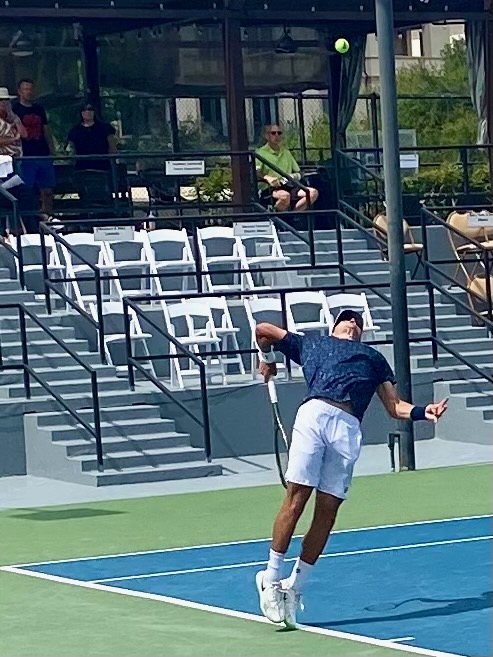
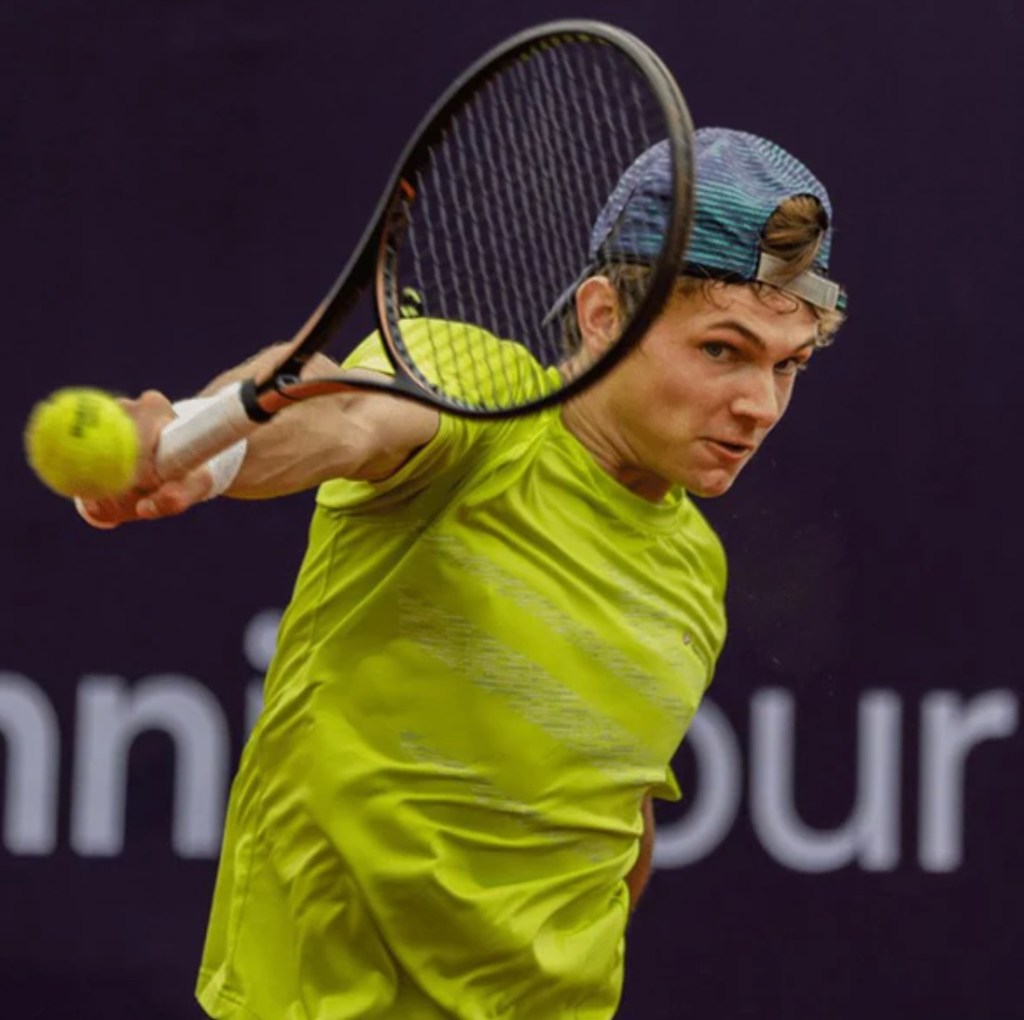
    Charles Broom at the Calabasas Pro Tennis Championships in 2024

    Charles Broom

    Back to the pro event at Calabasas. Whatever drop off there might have been respective to the ability of the players at Indian Wells versus those who played at Calabasas the ease of attending and the ability to get really up close more than made up for it. If it doesn’t quite come across on television rest assured that tennis is a stunningly athletic game. Players reach, sprint, strike, leap all while making the endless series of adjustments that I’ve come to learn are the very essence of tennis. I readily admit to being quick to align myself with one player over another. This happened again and again at Calabasas. A player whines about being impeded by a line judge (he wasn’t) and he becomes public enemy number one as did another player with an unfortunate tendency to slam his racket against the fence when a point didn’t go his way.  I was in luck. UK-based Charles Broom was among the higher ranked players and one of his early matches was scheduled to start mere minutes after my arrival.

    Watching Broom’s superb all-court play I immediately began to wonder about the life of a professional tennis player. I didn’t wonder as much about the life of a teaching tennis professional or a high-level amateur. No, I wondered about the mindset and life of a playing professional. I decided I’d try to interview just such a player for this book.  And, none other than Charles Broom was gracious enough to accept my invitation to answer some questions, so here they are:

    PC: Who got you started in tennis and how old were you when you first picked up a racket?

    Charles Broom: I’m very fortunate in that I live very close to a local tennis club. From as early as 2 years old, I would go over to the club with my mum who would throw me balls to hit. As I got older, I learned to hit against the wall that was there on my own – trying to get the longest rally I could. I then started getting more serious lessons at around 5 years old and played my first tournament at 7. So you could say I started quite early. 

    PC: How long did it take for tennis to evolve from a game you played into the only sport you played?

    Charles Broom: My parents don’t come from a tennis background, but certainly a sporty one. They made a very strong effort for me to try all different types of sport, ranging from swimming to gymnastics. From around 7 to 11 years old my main two sports became tennis and football (soccer), but as I was starting to progress in tennis by having some good results in national under 10 tournaments, it came to the point where I had to choose one over the other. 

    PC: You played your college tennis at Dartmouth and Baylor. What made you choose Dartmouth and how long did it take you to decide that playing as a professional might be in your future?

    Charles Broom: I went to a very academic school in the UK and from 15-18 years old I was only training 8 hours a week to stay on top of my school work. I also wasn’t that highly ranked internationally as a junior, so I wasn’t getting any offers from ‘top 25’ tennis schools. I wanted to go down the academic route, so going to an Ivy league school became my top option. I went on visits to Dartmouth and Harvard, but ultimately decided on Dartmouth based on the quality of the campus, coaches and how well I got on with the team. I loved my time there. As well as making some life long friends, I felt I had made big improvements in my game, so I wanted to try playing some professional tournaments in the summer. I lost in qualifying a few times before finally making it through to my first main draw of a 15k in America. I managed to win in 3 sets and got my first ATP point. I always had the dream to play tennis professionally, but once I got my first ATP point, that cemented the fact I at least wanted to try after college and see how far I could get to. 

    PC: Speaking of your college days, could you have picked a more difficult major than Biological Chemistry? What was it like balancing study with what must have been a very full slate of tennis?

    Charles Broom: I certainly didn’t make life easy for myself. I had studied Biology, Chemistry and Maths in my last year of school in the UK, so I wanted to continue down that route as I felt it was what I was best at. It wasn’t easy to balance tennis and studying. There were lots of labs that often would be 3, 4 or 5 hours sometimes, I’d have to do school work in the hotel lobbies when we played teams away from home, and generally I wouldn’t be getting more than 6 or 7 hours sleep most nights. I don’t regret it though as it taught me valuable lessons in time management, organization, discipline and sacrifice. Not only that, but it’s rare in tennis that you feel your best every single day you go out to play a match. To have played some of my best tennis while being tired or slightly ill gives me confidence as, when I am out on tour, I have a wealth of experience to fall back on in how to deal with those types of situations. 

    PC: Was it a big decision to turn professional or had it always been a part of your plan?

    Charles Broom: It required some discussion with my parents and the coaches I was working with at Baylor for my master’s degree, as I still had to finish some classes once my tennis eligibility had expired. I would say the decision to play professionally had already been made, but the logistics of where I was going to train, who would I have as a coach, how would I support myself financially, these were all very important issues that needed to be ironed out. 

    PC: With your ranking right around 300 in singles, did you have any thoughts when you watched Luca Nardi (then ranked 123) when he defeated Novak Djokovic back in early March?

    Charles Broom: I did watch some of the match, and funnily enough I was at the same tournament as him at the end of 2023 sitting next to each other in the locker room. It’s certainly a surprise when Novak loses to someone lower ranked purely based on how dominant he has been over the last decade. With that being said, the reality of professional tennis is that the level difference between someone 150 and 50 in the world, as an example, is much narrower than some people might think. I’ve now started to play in some higher level Challenger tournaments and played against the likes of David Goffin. At the end of the day, they’re all just tennis players that have to hit the ball back and forth over the net, the same as I do. And on any given day they might be struggling to do that for whatever reason, just as a professional golfer might wake up and something feels a bit different in their golf swing. It’s not to say they are any worse at golf, but you just feel better on some days than others — that’s life. How you deal with that, in my opinion, is what separates someone ranked 150 and 50. 

    PC: As a follow up, what differences do you see when you see players ranked, say, inside the top 25 as opposed to the top 200? I would have to guess the differences look very slight, but what do you see?

    Charles Broom: For sure there are small differences in how hard the top guys hit the ball, or the quality of certain shots, but the more impressive thing is how consistent they are. They all have different game styles, but the vast majority are centered around being disciplined and not making unforced errors. I’ve had the fortune of practicing with Sir Andy Murray a few times. What stands out to me the most is how consistent he is with his ball striking and intensity. It’s not to say he never misses or even that he hits the ball considerably harder than I do, but it just feels relentless from the other side of the net. The other difference is in the mentality of those top players. To be so consistent week to week in their performances is remarkable. 

    PC: The concept of consistency seems simple until I really start to think about it. Club players like to say they want to be more consistent but it always seems like what they really want is just a higher ability level. When it comes to professionals like you and Andy Murray consistency means so much more because of the staggeringly high level of your play. I know this doesn’t read like much of a question but would you like to say a bit about the areas of your own game you wish were more consistent?

    Charles Broom: Certainly the basic principle of being consistent is the same for me, Andy or a club player where you have to get the ball over the net and in between the lines more than your opponent. My goals that are related to consistency are around the quality of shot I hit, whether that be a serve or groundstroke, as I want to put as much pressure on my opponent without risking making an unforced error. I would also say the serve is the most important shot in the game, so having a consistent serve is vital to go to the next level. 

    PC: What is your current setup, including racket brand, model, string, string tension and racket weight, if you know it?

    Charles Broom: I use a Wilson Blade 18×20 racket that I have weighted to 332g and 327g in swing weight. I use Alu Power 1.30mm and Wilson Revolve spin strings which are strung at around 53 lbs. That varies based on the conditions we play in week to week.

    PC: We’re having our conversation during the third week of May in 2024. As the clay season approaches its peak, what are your goals for the rest of the year?

    Charles Broom: My immediate goal is to try and play in Wimbledon this year. I feel I have a strong chance at playing in at least the qualifying event, but it has always been a dream of mine to play in the main draw. My other goal is to be ranked inside the top 235 by the end of the year to give myself a chance at playing in the Australian open qualifying. I believe I am at the level of competing consistently in Challenger and Grand Slam qualifying events, but it certainly won’t be easy to get there.

    PC: Finally, thank you, Charlie, for the thoughtfulness of your responses. I truly appreciate your time and look forward to continuing to follow your career for the remainder of 2024 and beyond.

    Charles Broom: You’re very welcome. Thank you Paul. 

    PC: In closing I want to offer a few more words about Charlie. When I first thought to interview him I only knew him by his name, world ranking and a few visual elements of his game, witnesses first hand. But, after I did a little research I came to see him as an even more complete person and I’m glad that I made that effort. Charlie got his B.S. in Biological Chemistry from Dartmouth. Then, during his final year of college eligibility he completed his Masters in Sports Pedagogy from Baylor University. When I realized all that Charlie had accomplished as a player and as a student, I came to respect him even more. 

    And, he reminded me of a figure from golf. Sorry; I know…again. 

    Here I am thinking of Bobby Jones. I made the connection in the back of my mind before I thought about it formally. Jones got his B.S. in Mechanical Engineering from Georgia Tech in 1922, while playing for the varsity golf team. He then earned an A.B. in English Literature from Harvard College in 1924. Eventually, he became a lawyer after attending Emory University School of Law. During this time, and after, and until his retirement at the age of 28, Jones was the greatest golfer in the world, either amateur or professional. We are not likely to see another player, in any sport, accomplish what Jones accomplished before he reached his 30th year. Let us not forget the fact that Jones was the only sportsmen to ever receive two ticker-tape parades in New York.

    We live in the era of acceleration. Kids want to graduate with a 4.0+ so they can avoid the drudgery of four full years of college. Little do they know that they will be called upon to work for a living once they’re done with that thing they were so hell-bent to shorten. We live in the era when developing athletes compare their ability, at any age, to the exact number of dollars that might be gained from a contract with Nike. And, I see nothing inherently wrong with any of this. Still, at my age and having seen what I have seen in my 60 years on this planet, I have come to respect something different, perhaps, than the average person might. I am thinking here of one the rarest qualities of our contemporary world; that of the renaissance man. 

    I’m not trying to lay heavy expectations on Charlie Broom that are more challenging than anything that’s come before in his quarter of a century of life. I simply respect his degrees and the discipline they required as much as I do his game. Each is impressive to me and I have the very slightest idea of what it took to attain them. I do not need to wish Charlie Broom good luck when it comes to tennis or chemistry. He has done his very best to take ordinary luck out of the equation. And that, I think, will always be his greatest accomplishment.

    Here’s a brief update on Charlie Broom.

    From The Guardian, July 1 2024:

    “Broom lost 6-3, 7-5, 6-4 against Stan Wawrinka, the former world No 3. He had secured a wild card with a fine run of form on the Challenger circuit and started the match as only a marginal underdog with the bookmakers, despite the 153-run gap in the ratings ladder to his Swiss opponent.”

    So, Charles Broom succeeded in one of his stated goals and made it to Wimbledon this year.

    Well done, Charlie!

    Tt