Category: Interview

  • Walter Redondo Interview

    Shortly after I started playing tennis, back in the late summer of 2024, I began to sift through the internet looking for information on players, coaches and the game itself. I wasn’t usually looking for something or someone specific, but I always have a special interest in coaches and the techniques they use to teach. Tennis, it turns out, is not much different from golf. There are a lot of gurus, a lot of experts standing around, ready to tell players how the best players in the world do what they do. After playing for a while, taking lessons twice a week, I began to apply a lot of what I know about golf teachers to what I was learning about tennis coaches. As a group, tennis coaches are far better at what they do than golf teachers. I describe the differences in Tennis thing so give it a read to learn more.

    Walter Redondo

    One of the more interesting coaches I stumbled upon was Robert Lansdorp. He came, seemingly, from nowhere but was an influential coach to Pete Sampras, Lindsay Davenport, Tracy Austin and Maria Sharapova and many others. Lansdorp, born in the Dutch East Indies, came to California in the early 1960s. Little is known about what he did during that first decade but sometime in the 1970s he was introduced to San Diego’s Walter Redondo.

    In an interview given toward the end of his life in 2024, Lansdorp said the most talented player he ever worked with was Walter Redondo. Thinking for moment about the list of other players who Lansdorp coached, they of the 25 grand slam victories, made me want to learn more about Walter Redondo. It turns out Walter Redondo was easy to find at his San Diego art gallery.

    Tennis thing: Walter, I’ve been trying to decide whether we should talk about art first or tennis and I’ve settled on art. What got you interested in art and how old were you?

    Walter Redondo: Art really became interesting for me around the age of six. Before that, I hadn’t paid too much attention to it. One day, I was walking down the hallway of the house we lived at the time and my older brother was in his room and as I was passing by I saw he was doing a drawing so I walked in and looked at what he was doing and got a piece of paper. And, basically, I drew what he drew with the materials he had around him, and as I looked at my drawing, I recognized that mine was very close to what he was doing. I thought to myself, well, if I can do what my older brother does it must mean I can make art.

    Somehow it just registered for me that, OK, I enjoy art! From that point art just started to take shape in everything I was doing. From the time I started first grade my teachers recognized I could draw and I was creative. My teachers and school nurtured my art by having me create their classroom display boards and eventually others at my school started and realizing what I could do. Before I knew it, I was designing and creating works for the stage for performers at my school. So, really, my school nurtured my art early on.

    Tennis thing: Ok, same question about tennis. Who got you into the game and how old were you?

    Walter Redondo: Oh again, I was around probably the same age, about six or seven. My grandmother was the one that actually got us involved in tennis. Because there were so many of us in the family, there were nine of us, and my father being in the Navy and was away a lot, and my grandmother needed to work and so on, but she had found a sport that she loved. She would watch films of Helen Wills Moody and the other great players and figured out what she could do to get us involved in the sport. Because she truly loved tennis, she would bring us to the tennis courts and so it was my grandmother who introduced tennis to us and from that point it just kinda took off.

    Tennis thing: You know Walter, what put you into my mind was an rather offhanded comment by Robert Lansdorp in an interview he gave some years ago. In it, he said you were the most talented player he ever worked with. And I thought to myself, Lansdorp worked with Sampras, Sharapova and Davenport. How many slams among that trio? 25? But, he mentions you, Walter Redondo. But right now I really want to know more about your art and especially your gallery.

    Walter Redondo: You know my art is constantly evolving. Obviously, as we move, just as a tennis player does, we’re trying to sharpen skills and trying to evolve into a stronger voice. When I think about art and tennis there’s such a similarity, but when I think about, you know where I am in my life as as as an artist, and where I’m in my career, figure what was important to me as I had a little bit more control over my art career.

    Part of that was being able to show and grow because often times when you get involved with the gallery, you develop a clientele that you actually start to paint for, to some degree. And so you kind of move in that way, which is a great thing also because it’s developing me as an artist and as a painter. So, I thought to myself, as I’m sitting in my home, that all this art is on the walls, and I think, as I was evolving I started recognizing, as well as the gallery owners were starting to recognize, that I was selling a lot of my work.

    And often times some owners would say that my work kept their gallery open in a given month. Abd, I was so gratified to hear that. It was confirmation that I needed to give my own gallery a shot. I’ve always dreamt of owning my own gallery. That also says a lot about where I am spiritually. I love believing. I love faith. I love entering into something with the understanding that, you know, the work ethic, the whole thing of being able to believe in something that hasn’t yet transpired but will by believing in faith and hard work.

    I like the whole inner person of my being to grow. And I think as a tennis player, or you as a writer, we want to evolve and grow as a person because it’s the person that we basically play with and so our person becomes stronger and more confident in the things we believe. There’s a difference from what I choose to believe and that for me is where I’m with my art. You know understanding that what I’m painting, what I’m receiving from the outside, whether it be someone’s giving me something they look for as far as a commission or whether it be that, you know, I’m picking up things around me in my environment that hopefully will make a difference or change for someone’s perspective our outlook on the way to see life.

    Tennis thing: I’m right with you on all of that and I think whenever you create anything, particularly in visual arts but also perhaps in writing, when you start you often don’t know when you’re gonna finish and sometimes you don’t know if you’re going to finish. For me anyway, as a writer in creative and in business writing, you always finish because it’s the job you have to do, but in creative writing you only finish if you want to and if you need to. You have to have faith.

    Walter Redondo: Personally I think it’s a such a privilege to be able to move in this way. I think this is for everybody really, you know I was literally thinking and taking notes for myself in regards to my approach to art. And, people will ask me how do you start? And, you know, we basically start with nothing but once we start that first stroke or that first line you’re developing, but then there’s kind of a mess. You know as I’m moving along and I’m just scattering paint. I’m moving paint. I really don’t have anything in mind but I’m doing this with a lot of energy. But, what’s beautiful about it is the discovery that while I’m doing this I’m taking notes of little details here and there so that I can resolve all these mistakes, or what one could think are mistakes, but actually be able to use them. I think that’s the beauty of being able to be creative is understanding how a problem gets solved just like we do on the tennis court. I like that the gathering of thoughts in the energies and even the discipline to focus as long as it takes us to get to a certain place, I think that’s a real privilege for all of us, whether it be in business or being creative with art or playing tennis.

    Tennis thing: When you speak about resolving mistakes it reminds me of something one of the tennis coaches where I play said. One day when I was sitting by the courts getting ready to play and he walks by and says, “I’ve just discovered the secret to tennis and I’m gonna share it with you.” I said, “OK, Austin, what’s the secret?” He says, “Adjust. Then, when you’re done adjusting adjust again and just keep on adjusting.”

    Walter Redondo: Isn’t that so true? And another thing I’ve discovered, you know, as I have thought about this and spoken with a number of the students I’ve worked with when we watch the top players: They have come into such a confidence with their own game style we would think that they are not making adjustments to their opponents, but their opponents are making adjustments because of them. And here I’m thinking getting to the point where you are just playing your game and you stick to it, everyone has to adjust to and accommodate what you’re doing. That’s a great place!

    Tennis thing: Now let me take you back to Robert Lansdorp, so we know he was impressed with you as a player but how did you come to work with with him and what was the experience like for you?

    Walter Redondo: I think I was the first player he worked with who became recognized. While we were over at Morley Field Robert had just started teaching and he recognized that our family was not well-to-do so my grandmother who is the one that got me started. We would go around and pick up aluminum cans out of the trash cans. But, it was really out of the kindness of his heart that Robert started working with me. It was really out of God’s grace to have a gentleman of Robert’s ability become part of the process of my life. He taught about discipline and a work ethic. Robert worked me hard but at the same time he recognized how much I loved tennis. In later years, Robert would come down San Diego and I remember him saying, “You know Walter, as a coach you see a lot of players who come to you, but there will only be a very few who have something that’s truly special. It’s not necessarily how they hit the ball but there’s something that’s a little bit different. It could be a work ethic. It could be a longer focus or it could be a kind of hunger. You’re going see a lot of players, but they may not have the substance that it takes to be a great player.”

    Tennis thing: I think tennis more than any other game I can think of brings element of artistic expression and here. I’m thinking about the court as a canvas, the arc of the ball the angles, all those angles! As one who has been a high-level player and a professional artist can you say something about how art relates to tennis and tennis relates to art for you?

    Walter Redondo: Oh yeah, so the beautiful thing about this whole thing is that in tennis and art we strike with we make one quick strike at the very beginning, right? We hit a ball. I put a mark on the canvas same thing at the very end. So, regardless of what happens we’re ending with two strokes in both tennis and art you know? The similarity of the intuitiveness, the whole play on how the focus and the way I may use space on the canvas to lead, or mark, or line to lead the eye because all I’m trying to do is lead the eye to a certain place on the canvas in the same way I would with, maybe, locating a ball in the corner of the court to open the space on the court. So, all I’m doing is taking what I’m doing on the tennis court and applying it to a canvas. So, whether it would be a color that’s a little bit more yellow, just for example, yellow being a very happy color. Orange being very energetic, red passionate, so I’m combining all these colors with lines and space. The beauty of this, I think what I love about is, and being involved with the process I’m sure you totally understand. Often times I’ve shared with individuals that in tennis when I go to sit down between sets, I’m just not drinking water. It’s like me stepping away from the canvas. What I’m doing as I’m looking at the canvas and I’m organizing my mind how I’m gonna resolve this painting, the same way I would in regards to OK this is what’s happening in the last few games. I’ve got my notes now. I’ve got to try to resolve this match and how I approach it is really going to be Important. So, that’s kind of really my whole take; being confident with my strikes on the canvas, letting go and surrendering to the process and believing in the outcome.

    Tennis thing: Walter, I want to thank you for spending this time with me and having this chat about art and the game we love.

    Walter Redondo: I’m honored, Paul. It’s been a lot of fun!

    Tt

  • Impacting Tennis is ready to improve your game.

    Until I began playing tennis in 2023, my sports were baseball and golf. Baseball (and I gather Cricket) may be the two most elementally unchanged ball sports. Sure, we’ve been living in baseball’s live-ball era since the time of Babe Ruth but other than that, little has changed between the baseball and the bat over the last century.

    Golf is totally different story with technical advancements in ball and club (especially driver) construction that has fundamentally changed the game forever if not for better. The impact of multilayer balls and max-COR drivers is inarguable and these improvements have been augmented by the practice of data-based club and shaft fitting. Today, the average recreational players can avail themselves of most of the tech a touring pro can. Of course, the tour pro doesn’t pay.

    I see tennis somewhere between those extremes. Until recently, my favorite racket was a borrowed 2014 Head Prestige Pro. It’s still my favorite racket but my advancing years have suggested that lighter may be better for my game if not my ego. Still, the fact that a twelve year old frame could still be useful to a player at my level gives me great respect for what a great racket Head could build all those years ago and a little less respect for their 2025 offerings which I am sure they describe as far more advanced than my old Prestige.

    What all this means is I can easily imagine a day when a tennis player, pro or amateur, can have their tennis racket (and strings) evaluated by measured data. Golf has already done this and more. Golf tour pros, with their unimaginably consistent swings, can tune their clubs to their ball of choice, chasing their ideal of ball speed, spin and feel. I would be surprised if players on the WTA and ATP can’t do something similar right now. And, if they can, you and I will be able to soon. Whether this will help the game of mere mortals like me is anyone’s guess.

    I am so glad anyone seeking beneficial alteration of their tennis racket can reach out to Miha Flisek of Impacting tennis. Even tbough my skills were still in their infancy when I first started playing tennis I  knew and could feel that details mattered. In fact, everything mattered. The marriage of string, racket velocity, racket weight, weight distribution, racket flex (on multiple axes) and swing shape are a fascinating combination of variables and destined to confuse most players, leading to a great deal of misunderstanding.

    I sought to learn all I could, sometimes surprised by how such complicated issues were spoken of with such a cavalier attitude. I was lucky my early searches pointed me toward Miha and his excellent videos. HIs clarity did a lot to demystify that which could easily be mystifying. I’m grateful Miha was generous enough to contribute his time to answering my questions about him and Impacting Tennis.

    Tennis thing: Tell me a little about your own history playing tennis? How old were you when you started?

    Miha Flisek: I started playing tennis very early, but at the same time I was also into archery and basketball. It wasn’t until an injury took contact sports off the table that I really began focusing on tennis. From the beginning, I was very sensitive to equipment. In archery, even the smallest change can completely alter your shot, and I brought that same mindset into tennis. I was honestly surprised how little attention most tennis players gave to their rackets.

    Later in college, I started combining my background in engineering with my growing understanding of tennis equipment. That’s when things really started to click. I began connecting the dots between player movement, stroke mechanics, and racket behavior. That’s how Impacting Tennis was born, from the idea that tennis gear shouldn’t be treated as an afterthought but as a core part of performance.

    Tennis thing: How long did it take for you to begin customizing your own rackets? What were some of your early modifications?

    Miha Flisek: I started modifying my rackets almost immediately, experimenting with strings, shifting balance points, and later adding lead tape. At the very beginning, I didn’t even have proper materials. I remember finding some old lead pipes and literally hammering them flat to make my own thin strips of lead, that was my first version of lead tape. It was very DIY, but it gave me a hands-on feel for how mass placement affects the racket.

    The real transformation came later when I gained the technical knowledge to calculate what I was doing. Instead of just feeling the difference, I could measure swingweight, balance, MGR/I, twistweight, and understand what each change was actually doing. That’s when customization stopped being trial and error and started becoming engineering and that’s really what laid the groundwork for everything I do now.

    Tennis thing: When players come to you for customization, do they usually have a specific goal in mind, or do they rely on your guidance to help them improve?

    Miha Flisek: Players usually come in with a clear goal in mind, whether it’s more spin, more control, or more stability, and I help them move toward it. But we never start with the racket. First, we look at where the player is in their career, what’s limiting their game, what they’re trying to improve. We take into account their technique, movement patterns, and overall development.

    Only after that do we adapt the equipment. The racket becomes a tool that supports their goals. When you get it right, it’s not just a better racket, it’s a better version of their game.

    Tennis thing: One of the most interesting aspects of tennis for me are the significance of audible cues. The Octo damper is designed to reduce unwanted vibrations while keeping the higher-frequency feedback that’s important for feel, timing, and contact cues. What led you to choose the thermoplastic elastomer PEBA (Polyether block amide) and were there other materials you considered?

    Octo damper

    Miha Flisek: I was already working with PEBA on a different project and found the material really interesting. It was being used in high-performance running shoes for its energy return properties, and it had just started to become available for 3D printing.

    The Octo damper actually came out of working with the material. I realized it had the ideal combination of characteristics, soft enough to reduce unwanted low-frequency vibration, but responsive enough to preserve the high-frequency feedback that’s so important for timing and feel. It wasn’t something I set out to create, it just made perfect sense once I started using the material.

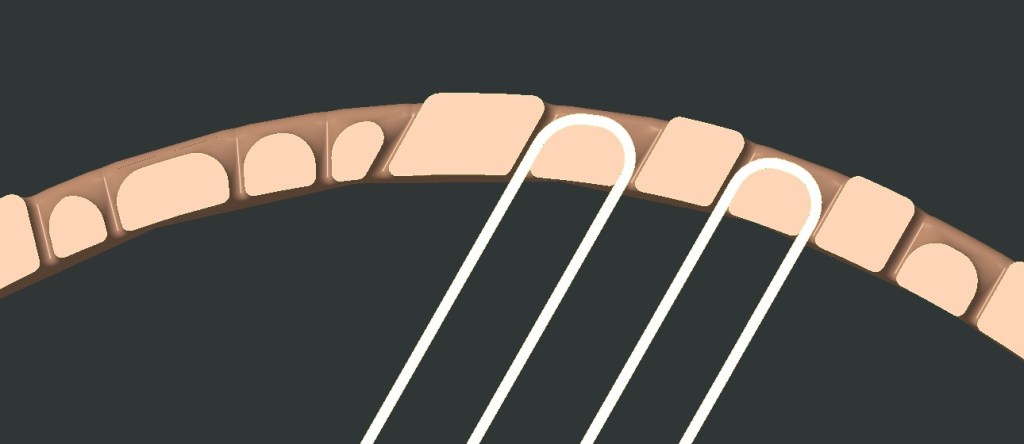
    Tennis thing:  I am really fascinated that you actually 3D printed a tennis racket! Without getting too deep into the technical weeds, how many separate pieces were needed to create TO Stardust and what adhesive did you use? Also, I found your use of rounded string transitions rather than traditional grommets to be exceptionally clever. What was the total print time?

    Miha Flisek:TO Stardust was printed as a single solid frame. No adhesives, no bonding. Just one continuous piece. That required a very large and advanced 3D printer along with specialized materials. The handle pallets and buttcap were added afterward, like with a standard racket.

    The total print time was about 12 hours. One of the standout features is the integrated rounded string holes, which replace traditional grommets. That not only reduces unnecessary components but also gives the stringbed a more consistent response. The project was a way to test what happens when you throw out legacy design assumptions and build a racket from the ground up using modern tools.

    Tennis thing: Many ATP players still use racket designs that are more than a decade old, often under new paint jobs. Do you think racket technology has plateaued or do you see meaningful trends in design or construction that could still benefit players?

    Miha Flisek: I don’t see any real leaps in racket technology happening right now. The core materials, like carbon fiber laminates, have been around for a long time, and most of the available geometries and design concepts have already been explored or exhausted. There’s not much on the horizon in terms of radically different materials that would offer meaningful improvements.

    What we are seeing today, like the shift toward lighter and more powerful rackets, isn’t so much about technological progress as it is about adjusting to external changes, especially the balls. Balls have become lighter and less consistent, which makes it harder to get penetration through the court, so players are shifting toward rackets that help generate more pace and spin.

    TO Stardust on court and ready for play.

    The next real shift in racket design will probably come with the maturation of 3D printing technology, particularly once continuous carbon fiber printing becomes viable. That’s when we’ll finally be able to explore forms, layups, and mass distributions that are simply impossible to achieve with traditional molding techniques.

    Tennis thing : What’s next for Impacting Tennis? What enhancements can we expect to see in TO Stardust v2?

    Miha Flisek:That ties directly into the future of TO Stardust. Right now, with the current 3D printing materials and processes, it’s not quite at the performance level I want, at least not for professional-level play. The design itself showed what’s possible in terms of rethinking racket construction, like grommetless string transitions and integrated frame geometry, but to move to the next stage, we’re waiting for the technology to catch up, especially in terms of continuous fiber reinforcement.

    When I saw TO Stardust’s grommetless construction, I knew Impacting Tennis was serious about innovation.

    In the meantime, my focus is on consulting and helping players unlock performance through better equipment understanding and customization. I’m also exploring string design using a novel material that hasn’t been used in tennis yet. The long-term goal remains the same: use engineering and first principles to push tennis forward, not just follow trends.

    Tennis thing: Thanks for participating, Miha. I will be posting my review of the Octo damper soon. I’ve been evaluating along with a trusted pro at my club. So far, I am really liking it, especially its amazingly light weight. 

  • A Tennis thing chat with tennis professional, Long Dao

    I learned about tennis professional Long Dao while researching an article about the rise and fall of the Pierce College tennis team. I have come to think of community colleges like Pierce as stepping stones for students who lack something they need to go directly to a four-year college or university. Sometimes what’s lacking is financial, other times it’s academic and often it’s a combination of things that bring students to a school like Pierce. As a guy who went from Pierce to UCLA, I’m very grateful the school was there for me in all the ways it was. As I think back on the professors I had both at Pierce and UCLA I am pleased to think that, in many ways, it was the professors at Pierce who had the most consistently positive impact on me.

    I didn’t play intercollegiate sports while I was at Pierce but I knew they had a great tennis team. By the way, I went to Pierce in 1980 so we’re talking about a good long while ago. Finding out Pierce no longer had a tennis team was a real shock to me. You see, a couple years back I took up tennis and this has brought me to consider a lot of tennis playing what-ifs, one being a musing about playing tennis for Pierce back in the 80s.

    But, let me connect my first thoughts about community colleges generally to intercollegiate sports. It is more than a shame that Pierce College does not have a tennis team. To me, it points to an institutional failing that may be centered at the Los Angeles Community College District or it could be a home-grown failing with the administration of Pierce College in Woodland Hills. No matter. It is a very unfortunate example of Pierce College failing its students.

    Even though we’ve just reached the day when colleges are able to directly pay their so-called student athletes it’s important to acknowledge that only the most elite athletes playing for the highest-profile colleges are likely to see much of anything in terms of financial compensation. One can argue this an elevation of student athletes at all schools but I would argue that what it really does is create an even greater separation between elite athletes and the kind of true student-athletes who have always been a part of competitive sports at schools like Pierce, or even Division III athletes. More is the pity.

    I am very grateful that Long Dao, the last coach of Pierce College, has been generous enough to be interviewed by Tennis thing.

    Thank you, Long!

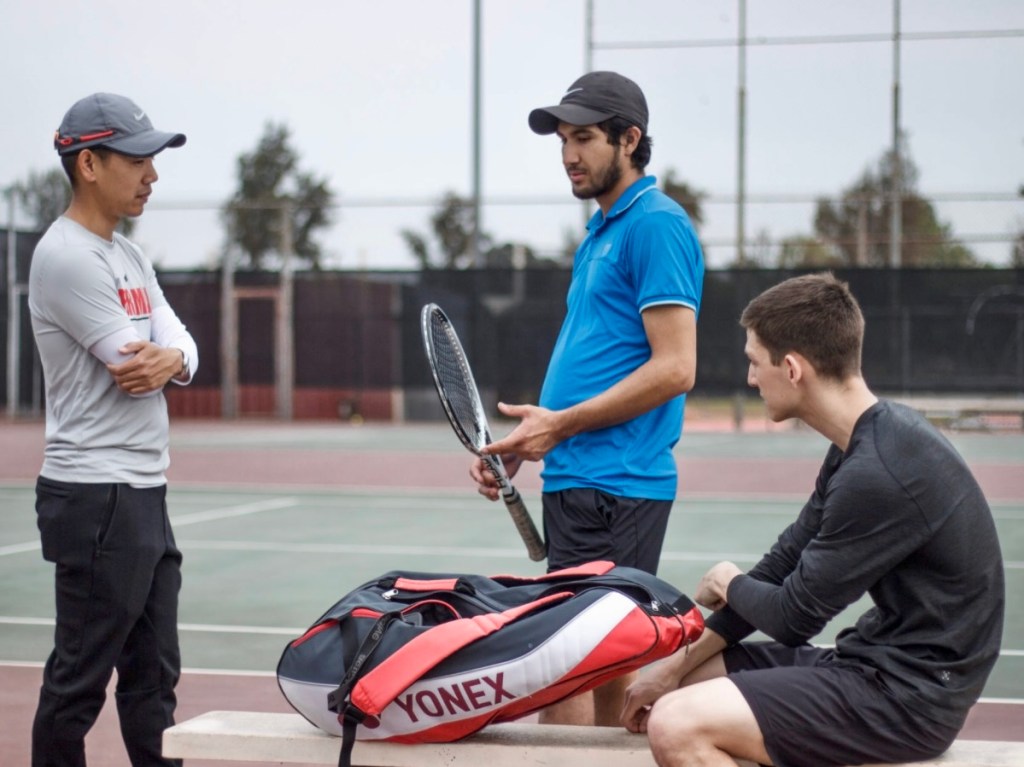
    Coach Long Dao with student athletes at Pierce College, 2019 (Photo by Chris Torres)

    Tennis thing: Tell me a little about how you got started in tennis. Who got you into the game and where did you first play?

    Long Dao: My first exposure to tennis was around when I was five or six years old when my family (aunts, uncles and cousins) would play and I would tag along.  But I never did any serious training  until I got to high school.  Essentially, I did not start my tennis career until I was 14 years old.

    Tennis thing: By the time you became a student at Pierce, had you ever heard of Coach Paul Xanthos?

    Long Dao: I had not heard of Coach Xanthos until the first day of fall practice when I joined the team in 2005.

    Tennis thing: How long did your own playing career extend? Did you continue to play while you finished your education at UNLV and Long Beach?

    Long Dao: Competitive tennis ended for me right around when I transferred to UNLV.  I may have played a few tournaments here or there but training and regular tournaments practically ended around then.

    Tennis thing: I know you were an assistant at Pierce before taking over the team yourself. What were the most important lessons you learned from Coach Xanthos? Also, what did you have to learn for yourself the hard way, from your own coaching experience?

    Long Dao: Simplicity.  Coach Xanthos would always try to simplify the game for us as players.  That is something to this day I try to do for my students.  

    As a player, I was always one to drill and drill, be extremely repetitive in training, till I reached my goals, whether it was to perfect a shot or execute patterns.  I was relentless in how I went about that.  I have come to learn that many students, especially the younger players that I have worked with, learn and process things differently than I do.  So being able to change teaching styles to reach and connect with different players was something that I had to learn over time.  

    Tennis thing: I didn’t know Pierce was forced to abandon their tennis program until earlier this year and I was very disappointed. As I point out in my article, it was hard to believe a school with an enrollment as large as Pierce could not field a team. I know it’s ancient history now but do you think Pierce valued its tennis history enough? Could the school have done more to keep a team under the school’s banner?

    Long Dao: Short answer, no. I have some of the fondest memories there as a player and coach.  I have had the pleasure of meeting wonderful people there from teammates, players and staff members to fellow colleagues and coaches from Pierce and other schools, many of whom I’m friends with to this day.  Some of my favorite coaching memories happened there, taking the team from last in the conference to challenging for the conference team title and winning an individual conference doubles title. 

    But, it was shortly after that accomplishment I learned tennis at Pierce was, sadly, not valued as much as I had hoped.  It simply was another class that was offered and if it does not generate the revenue from enrollment or participation than, like many other classes or offerings at the school, the program will end up getting cut.    

    Tennis thing: I’m sure it’s very different for you, being a tennis professional, rather than coaching a group of college students. Do you miss coaching a team and can you see yourself coaching at the college level down the road?

    Long Dao: There are some aspects of coaching a team that I miss and others I don’t.  Will I ever coach another college team? I honestly don’t know.

    Tt

  • The Charles Broom Interview

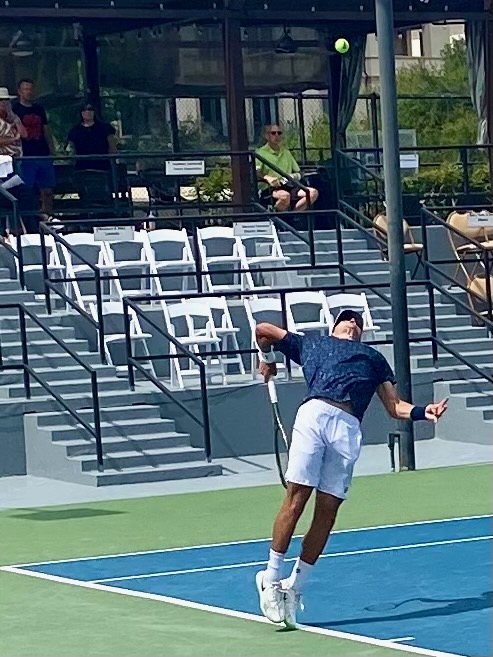
    Charles Broom at the Calabasas Pro Tennis Championships in 2024

    Charles Broom

    Back to the pro event at Calabasas. Whatever drop off there might have been respective to the ability of the players at Indian Wells versus those who played at Calabasas the ease of attending and the ability to get really up close more than made up for it. If it doesn’t quite come across on television rest assured that tennis is a stunningly athletic game. Players reach, sprint, strike, leap all while making the endless series of adjustments that I’ve come to learn are the very essence of tennis. I readily admit to being quick to align myself with one player over another. This happened again and again at Calabasas. A player whines about being impeded by a line judge (he wasn’t) and he becomes public enemy number one as did another player with an unfortunate tendency to slam his racket against the fence when a point didn’t go his way.  I was in luck. UK-based Charles Broom was among the higher ranked players and one of his early matches was scheduled to start mere minutes after my arrival.

    Watching Broom’s superb all-court play I immediately began to wonder about the life of a professional tennis player. I didn’t wonder as much about the life of a teaching tennis professional or a high-level amateur. No, I wondered about the mindset and life of a playing professional. I decided I’d try to interview just such a player for this book.  And, none other than Charles Broom was gracious enough to accept my invitation to answer some questions, so here they are:

    PC: Who got you started in tennis and how old were you when you first picked up a racket?

    Charles Broom: I’m very fortunate in that I live very close to a local tennis club. From as early as 2 years old, I would go over to the club with my mum who would throw me balls to hit. As I got older, I learned to hit against the wall that was there on my own – trying to get the longest rally I could. I then started getting more serious lessons at around 5 years old and played my first tournament at 7. So you could say I started quite early. 

    PC: How long did it take for tennis to evolve from a game you played into the only sport you played?

    Charles Broom: My parents don’t come from a tennis background, but certainly a sporty one. They made a very strong effort for me to try all different types of sport, ranging from swimming to gymnastics. From around 7 to 11 years old my main two sports became tennis and football (soccer), but as I was starting to progress in tennis by having some good results in national under 10 tournaments, it came to the point where I had to choose one over the other. 

    PC: You played your college tennis at Dartmouth and Baylor. What made you choose Dartmouth and how long did it take you to decide that playing as a professional might be in your future?

    Charles Broom: I went to a very academic school in the UK and from 15-18 years old I was only training 8 hours a week to stay on top of my school work. I also wasn’t that highly ranked internationally as a junior, so I wasn’t getting any offers from ‘top 25’ tennis schools. I wanted to go down the academic route, so going to an Ivy league school became my top option. I went on visits to Dartmouth and Harvard, but ultimately decided on Dartmouth based on the quality of the campus, coaches and how well I got on with the team. I loved my time there. As well as making some life long friends, I felt I had made big improvements in my game, so I wanted to try playing some professional tournaments in the summer. I lost in qualifying a few times before finally making it through to my first main draw of a 15k in America. I managed to win in 3 sets and got my first ATP point. I always had the dream to play tennis professionally, but once I got my first ATP point, that cemented the fact I at least wanted to try after college and see how far I could get to. 

    PC: Speaking of your college days, could you have picked a more difficult major than Biological Chemistry? What was it like balancing study with what must have been a very full slate of tennis?

    Charles Broom: I certainly didn’t make life easy for myself. I had studied Biology, Chemistry and Maths in my last year of school in the UK, so I wanted to continue down that route as I felt it was what I was best at. It wasn’t easy to balance tennis and studying. There were lots of labs that often would be 3, 4 or 5 hours sometimes, I’d have to do school work in the hotel lobbies when we played teams away from home, and generally I wouldn’t be getting more than 6 or 7 hours sleep most nights. I don’t regret it though as it taught me valuable lessons in time management, organization, discipline and sacrifice. Not only that, but it’s rare in tennis that you feel your best every single day you go out to play a match. To have played some of my best tennis while being tired or slightly ill gives me confidence as, when I am out on tour, I have a wealth of experience to fall back on in how to deal with those types of situations. 

    PC: Was it a big decision to turn professional or had it always been a part of your plan?

    Charles Broom: It required some discussion with my parents and the coaches I was working with at Baylor for my master’s degree, as I still had to finish some classes once my tennis eligibility had expired. I would say the decision to play professionally had already been made, but the logistics of where I was going to train, who would I have as a coach, how would I support myself financially, these were all very important issues that needed to be ironed out. 

    PC: With your ranking right around 300 in singles, did you have any thoughts when you watched Luca Nardi (then ranked 123) when he defeated Novak Djokovic back in early March?

    Charles Broom: I did watch some of the match, and funnily enough I was at the same tournament as him at the end of 2023 sitting next to each other in the locker room. It’s certainly a surprise when Novak loses to someone lower ranked purely based on how dominant he has been over the last decade. With that being said, the reality of professional tennis is that the level difference between someone 150 and 50 in the world, as an example, is much narrower than some people might think. I’ve now started to play in some higher level Challenger tournaments and played against the likes of David Goffin. At the end of the day, they’re all just tennis players that have to hit the ball back and forth over the net, the same as I do. And on any given day they might be struggling to do that for whatever reason, just as a professional golfer might wake up and something feels a bit different in their golf swing. It’s not to say they are any worse at golf, but you just feel better on some days than others — that’s life. How you deal with that, in my opinion, is what separates someone ranked 150 and 50. 

    PC: As a follow up, what differences do you see when you see players ranked, say, inside the top 25 as opposed to the top 200? I would have to guess the differences look very slight, but what do you see?

    Charles Broom: For sure there are small differences in how hard the top guys hit the ball, or the quality of certain shots, but the more impressive thing is how consistent they are. They all have different game styles, but the vast majority are centered around being disciplined and not making unforced errors. I’ve had the fortune of practicing with Sir Andy Murray a few times. What stands out to me the most is how consistent he is with his ball striking and intensity. It’s not to say he never misses or even that he hits the ball considerably harder than I do, but it just feels relentless from the other side of the net. The other difference is in the mentality of those top players. To be so consistent week to week in their performances is remarkable. 

    PC: The concept of consistency seems simple until I really start to think about it. Club players like to say they want to be more consistent but it always seems like what they really want is just a higher ability level. When it comes to professionals like you and Andy Murray consistency means so much more because of the staggeringly high level of your play. I know this doesn’t read like much of a question but would you like to say a bit about the areas of your own game you wish were more consistent?

    Charles Broom: Certainly the basic principle of being consistent is the same for me, Andy or a club player where you have to get the ball over the net and in between the lines more than your opponent. My goals that are related to consistency are around the quality of shot I hit, whether that be a serve or groundstroke, as I want to put as much pressure on my opponent without risking making an unforced error. I would also say the serve is the most important shot in the game, so having a consistent serve is vital to go to the next level. 

    PC: What is your current setup, including racket brand, model, string, string tension and racket weight, if you know it?

    Charles Broom: I use a Wilson Blade 18×20 racket that I have weighted to 332g and 327g in swing weight. I use Alu Power 1.30mm and Wilson Revolve spin strings which are strung at around 53 lbs. That varies based on the conditions we play in week to week.

    PC: We’re having our conversation during the third week of May in 2024. As the clay season approaches its peak, what are your goals for the rest of the year?

    Charles Broom: My immediate goal is to try and play in Wimbledon this year. I feel I have a strong chance at playing in at least the qualifying event, but it has always been a dream of mine to play in the main draw. My other goal is to be ranked inside the top 235 by the end of the year to give myself a chance at playing in the Australian open qualifying. I believe I am at the level of competing consistently in Challenger and Grand Slam qualifying events, but it certainly won’t be easy to get there.

    PC: Finally, thank you, Charlie, for the thoughtfulness of your responses. I truly appreciate your time and look forward to continuing to follow your career for the remainder of 2024 and beyond.

    Charles Broom: You’re very welcome. Thank you Paul. 

    PC: In closing I want to offer a few more words about Charlie. When I first thought to interview him I only knew him by his name, world ranking and a few visual elements of his game, witnesses first hand. But, after I did a little research I came to see him as an even more complete person and I’m glad that I made that effort. Charlie got his B.S. in Biological Chemistry from Dartmouth. Then, during his final year of college eligibility he completed his Masters in Sports Pedagogy from Baylor University. When I realized all that Charlie had accomplished as a player and as a student, I came to respect him even more. 

    And, he reminded me of a figure from golf. Sorry; I know…again. 

    Here I am thinking of Bobby Jones. I made the connection in the back of my mind before I thought about it formally. Jones got his B.S. in Mechanical Engineering from Georgia Tech in 1922, while playing for the varsity golf team. He then earned an A.B. in English Literature from Harvard College in 1924. Eventually, he became a lawyer after attending Emory University School of Law. During this time, and after, and until his retirement at the age of 28, Jones was the greatest golfer in the world, either amateur or professional. We are not likely to see another player, in any sport, accomplish what Jones accomplished before he reached his 30th year. Let us not forget the fact that Jones was the only sportsmen to ever receive two ticker-tape parades in New York.

    We live in the era of acceleration. Kids want to graduate with a 4.0+ so they can avoid the drudgery of four full years of college. Little do they know that they will be called upon to work for a living once they’re done with that thing they were so hell-bent to shorten. We live in the era when developing athletes compare their ability, at any age, to the exact number of dollars that might be gained from a contract with Nike. And, I see nothing inherently wrong with any of this. Still, at my age and having seen what I have seen in my 60 years on this planet, I have come to respect something different, perhaps, than the average person might. I am thinking here of one the rarest qualities of our contemporary world; that of the renaissance man. 

    I’m not trying to lay heavy expectations on Charlie Broom that are more challenging than anything that’s come before in his quarter of a century of life. I simply respect his degrees and the discipline they required as much as I do his game. Each is impressive to me and I have the very slightest idea of what it took to attain them. I do not need to wish Charlie Broom good luck when it comes to tennis or chemistry. He has done his very best to take ordinary luck out of the equation. And that, I think, will always be his greatest accomplishment.

    Here’s a brief update on Charlie Broom.

    From The Guardian, July 1 2024:

    “Broom lost 6-3, 7-5, 6-4 against Stan Wawrinka, the former world No 3. He had secured a wild card with a fine run of form on the Challenger circuit and started the match as only a marginal underdog with the bookmakers, despite the 153-run gap in the ratings ladder to his Swiss opponent.”

    So, Charles Broom succeeded in one of his stated goals and made it to Wimbledon this year.

    Well done, Charlie!

    Tt