

Tt: When did you start playing tennis and who got you into the game?
Jack Oswald: I started playing tennis when I was about five years old, first in the UK. My dad got me into tennis. He was big into tennis, both watching and he played a little bit as well. All of my family played a little bit of tennis at one point for a little while, but I was the one that really stuck at it.
My parents moved to the US when I was five years old, and I really got into it there. There were so many more courts, so many more players around. The weather was better for tennis, to be honest, and I just really got into it. However, it was around about 10 or 11 years old that I became obsessed with tennis, and I really wanted to make it pro. It became basically my mission in life for the next 15 years, I think.
Tt: I was going to ask you Why Bags but instead I’m going to tell you what I think—pretty much all tennis bags suck, even though I’m sure you already know that. First, most tennis bags are made poorly. When it comes to style it’s whatever makes the logo the biggest wins. It’s one area where golf beats tennis hands down. A golfer can buy a golf bag that’s designed to be carried by the player, carried by a caddie, put on the back of a golf cart or the kind of golf cart you push or pull. I cannot figure out why tennis bags are so bad. Help me out here, Jack!
Jack Oswald: I know, I feel the same way. I saw so much innovation in the bag space in so many different industries, like the outdoors space and golf, which is probably the closest thing to tennis. I believed there could be something better we could be doing here.
Also, as I was traveling as a pro tennis player, I felt firsthand, or came across firsthand, the issues of traveling with tennis rackets from country to country on planes, on trains, buses, from hotel room to hotel room. I wanted something that could be better, really, for myself. It was quite a selfish thing to begin with, and I became more aware as it went along that the industry, the tennis industry specifically, needed some innovation.
I have felt like this for a while with tennis that some of the areas of tennis are quite antiquated, and it’s caught up a little bit, I think, over the last few years. Especially when I was playing seriously, the tennis world was quite antiquated and the way it was set up really needed some innovation.
Tennis bags were something that I had an experience firsthand with, more from the usability side of things, from using bags. I really wanted to first of all make it easy for myself and then for everyone else, honestly, to travel with tennis rackets and to make it easy for people to play tennis on it during their daily routine, on a daily basis, whether that’s from work travel and anything like that.
I also wanted to make things that really were suited to the player and the person in their daily routine and not just, like you said, big logos and bright colors and things that really have no performance or practical impact.
Tt: What did playing professional tennis teach you about what a traveling tennis player needs to have, right at hand?
Jack Oswald: Honestly, it was the constant traveling as a professional tennis player that really taught me a lot about what could be made easier for people when they are traveling for tennis. I mean, I came across it first hand and had a lot of experiences carrying gear around.
The most tiring part of the whole process of being a tennis player was traveling. I really felt, by making it easier for myself, I could eventually make it easier for others. If there were an easier way to travel as a tennis player, I believed that could affect everybody, not just professional players but people who are trying to fit tennis into their daily routine.
My goal was to make a difference there and, in some way, help people be more active and carry their passions with them. Yeah, I think it was the constant going from place to place that really helped me understand how traveling for tennis could be made easier with the right gear.
Tt: How long did Cancha’s prototyping stage last? Did you evaluate all of the photos or did you reach out to other tennis players?
Jack Oswald: Honestly, too long. I started designing the bags in 2018, knowing nothing about soft goods design, product design in general. I really went into the deep end, but we didn’t know much about it. I spent a lot of time traveling to trade shows, speaking to designers, taking samples with me to employment tournament from 2018 until 2020, even 2021. It was a long time, three or four years of design and no sales coming in, which was difficult because I didn’t have much money to play with to do this.
We ended up doing a Kickstarter campaign and raising some money to begin with from friends and family that really helped me to get things off the ground. It was a huge learning experience. I learned so much about product design and the soft goods world, making bags, and also the practicality of traveling with bags and what you actually needed.
I went through many, many prototypes. Many of them broke on me during my travels, which was really frustrating at the time. There’s nothing worse than a bag breaking on you when you’re mid-trip, but it was a really humbling experience. It was a really enlightening experience. I learned a tremendous amount, and I still have all those prototypes saved. They remind me of how far we’ve come.
Tt: What about materials? How many did you have to evaluate before you settled on the final Cancha material?
Jack Oswald: To be honest, materials are an ongoing thing. We’re constantly refining materials. It’s something that never really ends. We have gone through many different versions of the materials we’re using. A bag has over a hundred components, so we’re constantly evaluating and looking at new innovations in the material space. I think there’s a whole lot more we can be doing there as well.
It was really through testing and seeing what was out there and all the different changes that were going on in the space, and seeing what worked for us and retesting it out that helped us arrive at a starting point. From there on, we’re just constantly evolving.
Our bags have new materials all the time. Sometimes people don’t notice them because it’s been a slight improvement that is just a quality of life improvement, and other times it’s a big change that people really notice. I think it makes all the difference. I think that constant drive to improve our products, existing products as well as new products, has helped us a lot over the years.
Tt: I’m lucky enough to have both the Cancha Racket Bag Pro and the Original Cancha Tennis Bag. I love them both but if I could wish for one thing it would be more and bigger zippered pockets. Do you feel my pain or am I crazy?
Jack Oswald: I agree, and feedback is a thing that we take extremely seriously. I’m constantly hearing from people about what they love about the bag, but also what they don’t love about the bag they’re using. One thing is we can’t please everybody, and you have to pick a side on some things and what we feel is best. I agree there’s certainly improvements that can be made, and we’re constantly making those improvements.
We get feedback all the time, like I said, from customers, and we take it seriously. I am constantly working with my team on new improvements, new designs, constantly traveling to visit our manufacturing partners and material suppliers. It’s an ongoing, never-ending process; that’s what’s so great about it.
I think if you look at where we’ve come from there until now, I think there’s been a huge amount of improvement. I appreciate your feedback because that it’s something that we can certainly do better, and I think that’s what this is all about
Tt: Every time I drop by the Cancha website I see another cool product that I need, Need, NEED. If we hit the Fast Forward button forward to 2030 will Cancha still be a tennis brand, a lifestyle brand, or both?
Jack Oswald: That’s interesting. I wouldn’t even necessarily consider ourselves a tennis brand specifically. I think that we have a really cool niche in the tennis space, but people who play racket sports of all kinds buy our bags, and people who don’t as well buy our bags. Everyday carry bags are part of our line-up now, and we’re constantly building out because we want to be part of people’s daily routine, helping them be active in all areas. I think my experience as a tennis player, as a traveling tennis player, has helped us really innovate in that space, but I think there’s a lot more we can do.
I want us to be both. I think we can talk in a very niche way to tennis players and meet their needs, but I think we can also be something for other people as well. I really appreciate what you say about the new products and the innovation. I think that that really means a lot to me because I’m trying my absolute best as a founder of a very young company to come up with things that I really feel proud about.
I don’t go into product categories or even product lines without feeling like I can really make a difference in the space. I have a lot of ideas for things that we can be doing. Sometimes I have more ideas than resources to do them, which is probably a good thing; it keeps me focused. I can’t say exactly where we’ll be, but I think there’s a whole lot of cool stuff in the pipeline that I’m just so excited to share.
Tt: Thank you, Jack, for taking the time and for being a good friend to tennis players everywhere.
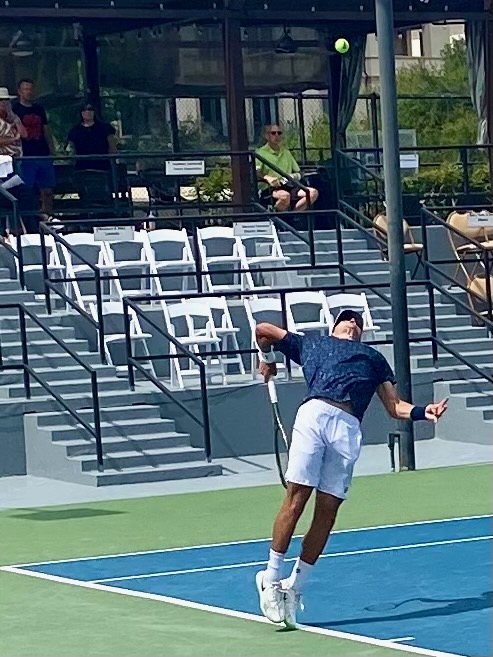
 Tennis thing