I’ve only been playing tennis since late July 2023. But, since then I’ve owned a good number of rackets. Two of them came from the MIB (the 2013 Head Prestige Pro and more recently a Wilson Shift 99). The others I bought used, some on Ebay and a few on Craigslist.
The first variable to be considered was grip size. My first racket was codenamed Battle Axe. It was a Wilson Six One 100 and I really liked it but its grip was 4 1/2 and everyone thought it was just too big. It was, but I enjoyed playing with that racket anyway. I still miss it.
I made the move first to 4 1/4 and later to 4 1/8 to make it easier to use overgrips. Later I drifted back to 4 1/4 by way of a couple Tecnifibres (a TFight 300 and a 305). Overall, the racket that worked best and felt best was my 2018 Head Graphene Touch Prestige Tour. That’s the worst racket name I’ve come across but, all things considered, it’s the racket that has best fit my game and aesthetic.
Then I tried MIB’s Wilson Shift 99 and I was surprised at how easy it was to swing while still feeling solid on impact. At first, I was under the mistaken idea it was a Wilson Shift 99L which weighs 10.1 ounces (286.3G) but once I got it home I realized that when MIB identified it as the lighter one, he meant it was the 10.6 ounce (300.5G) version. Strung, and with my usual Sampras dampener, El Shifto weighs 316G, fully ten grams less than my Head Graphene Touch Prestige Tour. Months earlier, MIB had told me how much difference five grams can matter and here I was finding that eleven grams obviously means even more.
I do enjoy hitting with a heavier racket. It’s not unlike putting with a modern 350G putter as opposed to an 80s Ping putter that typically weighed less that 300G. Mass is your friend when you don’t need much absolute velocity or your don’t need to change directions quickly. I like to think my time playing tennis has made me stronger but I know it hasn’t. When I got started in tennis I was 62 and now I’m 64. I don’t want to deceive myself into thinking I’m defeating the effects of gravity or age.
So, the Wilson Shift has been instructive though I’m not wild about the 16×20 string pattern, plus, its grip is 4 3/8 which is a bit large, even without an overgrip. So, I’ve spent a few days looking for a racket that aligns with the Shift’s basic specs before I found the Head 2022 Instinct MP. It’s very close in terms of weight (the Wilson is a little more head light) and flex though while the Instinct’s head measures 100 sq in as opposed to the Head’s 99 sq in.
Once I get the Instinct, I will have the Head Prestige at 327G and the Head Instinct and the Wilson Shift at right around 315G. I’m pretty sure the 315G rackets will work better for my game. I’m not sure I’ll like them quite as much as the Head Prestige but I still feel a few steps closer to playing with the right racket for me,
The occasion of my family’s 2025 reunion presented an irresistible opportunity. With a little tweaking of flights, rental car and hotel we found ourselves in South Eastern Michigan with the Man in Black himself.
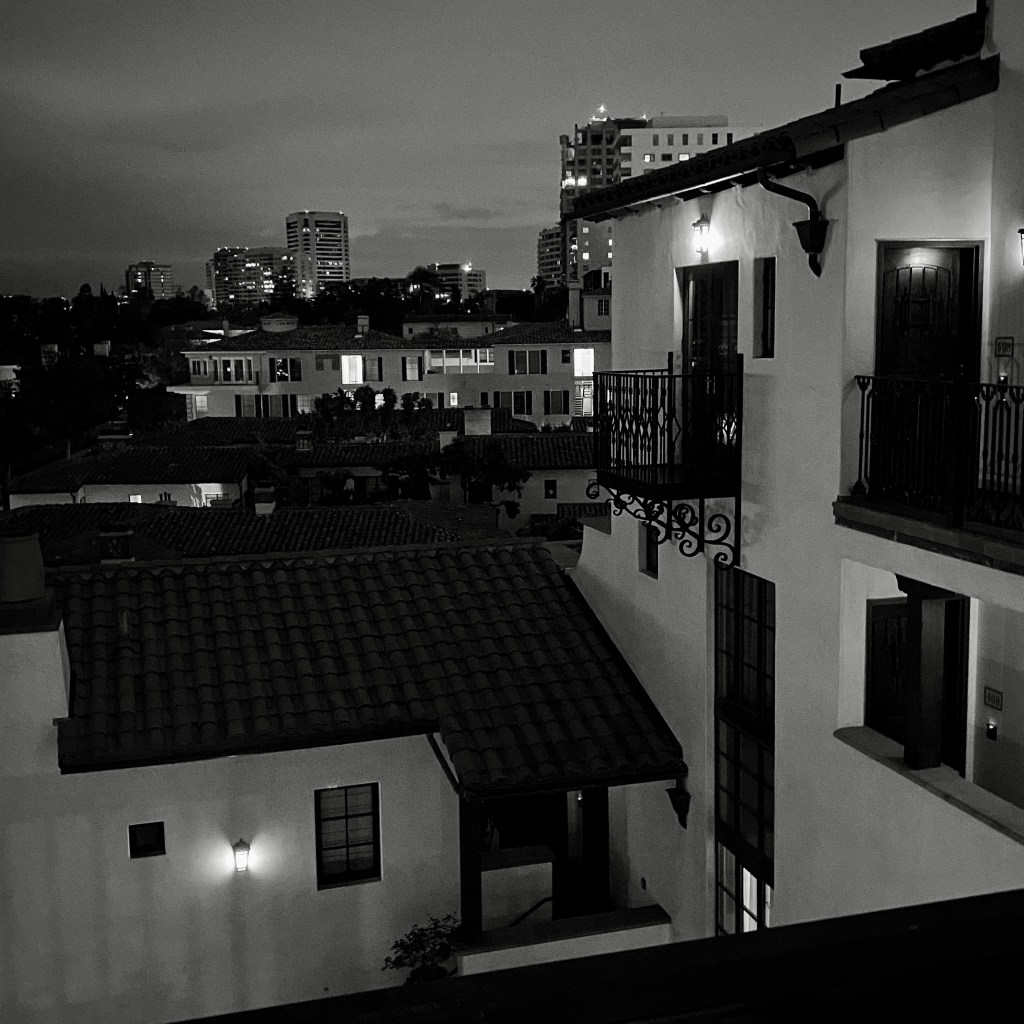
Looking south from the roof top of Plaza La Reina.
The last time the two of us shared a little time we found ourselves on the rooftop of Plaza la Reina in Westwood. The MIB had been generous enough to stay over an extra day so we could play tennis on my birthday. Plus, he got to have breakfast at Henri in Canoga Park, but that is a story for another day.
I think the last time I was in Metro Detroit I was a little kid and my family was on its way to Windsor Ontario and points further east. This time the focus was on MIB’s and his home in Farmington Hills. After we got in town, MIB generously asked if we wanted to go to Ann Arbor.
“Fuck no, brother. This trip is all about spending time with MIB in his native habitat.”
Just when you thought it was safe to step onto a tennis court with a confident stride, you see the MIB looking over the net at you. He’s a great player to warm up with. He likes to start close to the net, refamiliarizing his racket and hands to the variety of shots he likes to play. Then we hit soft volleys back and forth. Then we worked our way back toward the baseline and started to rally. That’s when the MIB Effect starts to take hold. It often seems like his feet don’t interact with the ground with the full force of gravity, he moves with such great ease. His strokes are fine, especially on the angles, but it’s always his footwork that is so fun to watch and listen to. Even the squeek of his Nike Air Zoom Vapor Cage 4 occurs at a higher pitch and amplitude than normal. I especially enjoyed returning serve from MIB (a minor strength of my game). In the end, though, playing with MIB is a reminder of the harsh differential between our games. Still, it was a lot of fun.
I thought about what it was like to play with MIB all the way home to Los Angeles. I knew there was no hope of reducing the differential to zero. Then again, that was never the goal. What I wanted to do was identify as many things as I could to improve in the specific areas that playing with MIB had exposed. So, I did what I always do. I asked my coach, Caesar, he with the unlimited answers to my limitless questions about tennis.
The first thing he said was to focus my attention on the racket of my opponent rather than simply on the ball as it crossed over the net and onto my side of the court. Caesar told me that would help me to identify the kind and the pace of the shot that was likely to be coming my way. That awareness was the first step in preparing for the shot I would need to play very, very soon.
Then he told me of the benefit to moving quickly early and slowing down into the shot. “Bad players are constantly running and stopping. Good players flow to the ball and flow toward their next shot,” he said. Of course, my coach had told me this many times before. But this time it was more urgency and relevant since I’d recently learned I was working too hard creating too little effective movement.
It came as no surprise that three days hanging with the MIB was just not enough. No sooner than we touched down at DTW it felt like we were on our way home. Though time was far too short, I’m glad we made the trip and look forward to sharing a tennis court with MIB again. I will be a little better prepared when that day comes.
A couple weeks back I was lucky enough to catch a couple lessons with Laura Sax at Del Norte in Sacramento. Laura is a super tennis coach. I always try to show up with a specific issue so my lessons with her can exist in kind a parallel universe to what Caesar and I continue to work on.
As we drove from Los Angeles I tried to come up with something. What I finally came up with was my need for more consistency when I’m serving. So, Laura asked to see me hit a few serves.
She said, “Those are kinda Ok. Lotsa pace. Now, show me your second serve.”
I looked down at the court and sighed, “I don’t have one.”
Laura said, “Well, show me what your second serve would look like if you actually had one.”
I sighed again.
Then, I hit something like a flat serve with the pace turned down. It hit the net with authority. Kind of…
Laura said, “Ok, follow me up to the net.”
Over the next few minutes she had me first hit the ball over the net with the edge of the frame while choking up on the racket. That’s not as easy as it sounds, by the way. Then, Laura had me hti the ball over the net with only a downward snap of the wrist. As with an overhead, this was done without the arm or torso bending forward, or following through. A secondary object of the game was to have the ball hit inside the service box, so a distinctly downward strike was in order.
It was kinda fun. I spent much of the rest of the lesson hitting those spikes from the net and out toward the back of the service box on my side of the net. It wasn’t until Laura had me back up to the baseline that I saw the point of the entire exercise. I was hitting a slice!
Who knew?
As the racket snapped, it also rotated left with the ubiquitous pronation that everyone is so excited about. The force of the strike was a combination of the wrist snap multiplied by the racket’s rotational energy. The result, when the ball was struck as the racket was driving forward but still not completely open (read: flat), was a serve with rotation that curved it left (from me) a right handed player.
I’m not very bright so it was not until that very minute that I understood what the totality of the exercise was about. As I said, Laura is a fantastic coach.
On the long drive home I tried to reimagine the movements and, more importantly, the feelings of my two lessons with Laura. I had a fairly decent grasp of what I was trying to achieve but as with all things tennis the goal was fogged by age and lack of significant athletic ability. Still, when I got home I could still feel it although I was triyng to hit the ball too hard (don’t I always?).
Then I remembered something else Laura said. She said that when serving the wrist should be completely at ease and the racket held with the very lightest of grip.
Now, let me tell you why this made sense:I have always, and I mean always, since the time of my first serve, had a difficult time warming up with my serve. I can throw a baseball softly enough that a newborn could catch it with his offhand (Ok, maybe that’s an exageration) but you get the idea. In contrast, I have a very difficult time warming up to serve. My motion, and the overall pace of my early serves are, far too fast and too hard. Who knows why?
But, when I deliberately keep my arm, wrist and elbow relaxed I can hit early serves at Speed 1 and then Speed 3 and so on. It is almost as if I can coordinate the speed better because I am managing the tension (or lack) in my serve (note that I do not write, hitting) arm. Simple, but remember that simple does not always equal easy. Perhaps it never does.
Then, and I hope this doesn’t appear to suplant Laura’s contribution but I stumbled on this video by Patrick Mouratoglou. The looseness or softness is counterintuitive to someone like me who was born to throw a baseball (5.25 ounces at the end of the fingertips) rather than strike a tennis ball (2 ounces, plus or minus) overhead and with an added 27 inches of the racket.
Yes, it’s still (obviously) a striking motion but a very different one.
So, there I am and happy to be there. I have been playing tennis since September of 2023 and I now have a developing the tiny bud of a second serve. Now that wasn’t so hard, now, was it? Tt
I learned about tennis professional Long Dao while researching an article about the rise and fall of the Pierce College tennis team. I have come to think of community colleges like Pierce as stepping stones for students who lack something they need to go directly to a four-year college or university. Sometimes what’s lacking is financial, other times it’s academic and often it’s a combination of things that bring students to a school like Pierce. As a guy who went from Pierce to UCLA, I’m very grateful the school was there for me in all the ways it was. As I think back on the professors I had both at Pierce and UCLA I am pleased to think that, in many ways, it was the professors at Pierce who had the most consistently positive impact on me.
I didn’t play intercollegiate sports while I was at Pierce but I knew they had a great tennis team. By the way, I went to Pierce in 1980 so we’re talking about a good long while ago. Finding out Pierce no longer had a tennis team was a real shock to me. You see, a couple years back I took up tennis and this has brought me to consider a lot of tennis playing what-ifs, one being a musing about playing tennis for Pierce back in the 80s.
But, let me connect my first thoughts about community colleges generally to intercollegiate sports. It is more than a shame that Pierce College does not have a tennis team. To me, it points to an institutional failing that may be centered at the Los Angeles Community College District or it could be a home-grown failing with the administration of Pierce College in Woodland Hills. No matter. It is a very unfortunate example of Pierce College failing its students.
Even though we’ve just reached the day when colleges are able to directly pay their so-called student athletes it’s important to acknowledge that only the most elite athletes playing for the highest-profile colleges are likely to see much of anything in terms of financial compensation. One can argue this an elevation of student athletes at all schools but I would argue that what it really does is create an even greater separation between elite athletes and the kind of true student-athletes who have always been a part of competitive sports at schools like Pierce, or even Division III athletes. More is the pity.
I am very grateful that Long Dao, the last coach of Pierce College, has been generous enough to be interviewed by Tennis thing.
Thank you, Long!
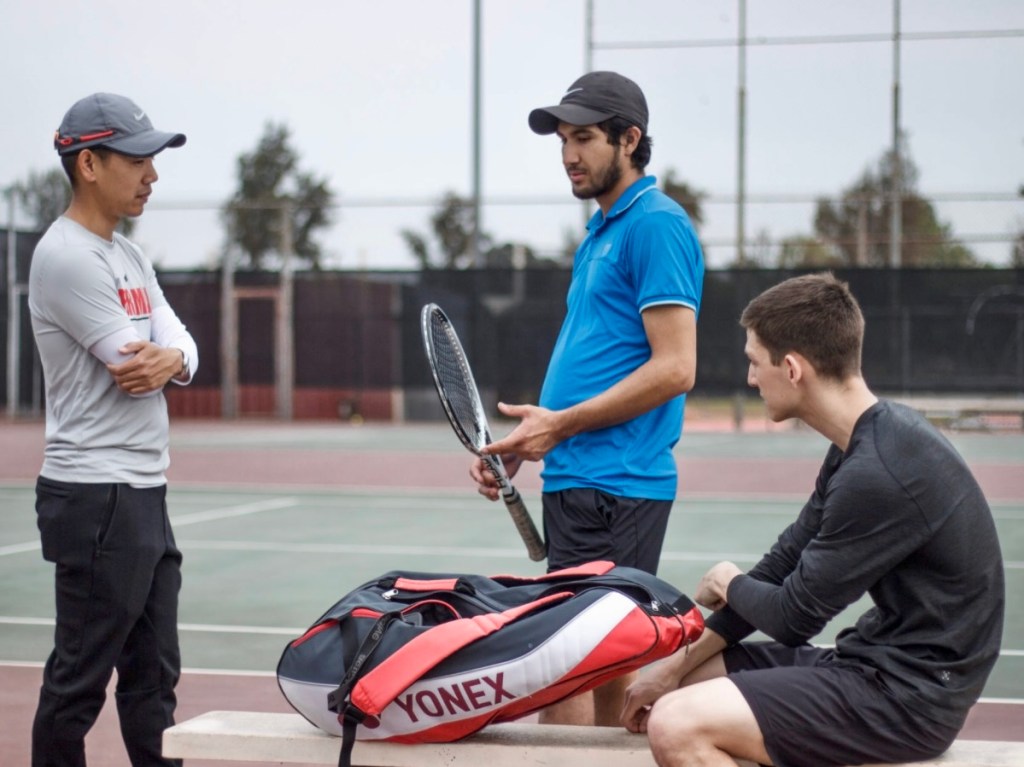
Coach Long Dao with student athletes at Pierce College, 2019 (Photo by Chris Torres)
Tennis thing: Tell me a little about how you got started in tennis. Who got you into the game and where did you first play?
Long Dao: My first exposure to tennis was around when I was five or six years old when my family (aunts, uncles and cousins) would play and I would tag along. But I never did any serious training until I got to high school. Essentially, I did not start my tennis career until I was 14 years old.
Tennis thing: By the time you became a student at Pierce, had you ever heard of Coach Paul Xanthos?
Long Dao: I had not heard of Coach Xanthos until the first day of fall practice when I joined the team in 2005.
Tennis thing: How long did your own playing career extend? Did you continue to play while you finished your education at UNLV and Long Beach?
Long Dao: Competitive tennis ended for me right around when I transferred to UNLV. I may have played a few tournaments here or there but training and regular tournaments practically ended around then.
Tennis thing: I know you were an assistant at Pierce before taking over the team yourself. What were the most important lessons you learned from Coach Xanthos? Also, what did you have to learn for yourself the hard way, from your own coaching experience?
Long Dao: Simplicity. Coach Xanthos would always try to simplify the game for us as players. That is something to this day I try to do for my students.
As a player, I was always one to drill and drill, be extremely repetitive in training, till I reached my goals, whether it was to perfect a shot or execute patterns. I was relentless in how I went about that. I have come to learn that many students, especially the younger players that I have worked with, learn and process things differently than I do. So being able to change teaching styles to reach and connect with different players was something that I had to learn over time.
Tennis thing: I didn’t know Pierce was forced to abandon their tennis program until earlier this year and I was very disappointed. As I point out in my article, it was hard to believe a school with an enrollment as large as Pierce could not field a team. I know it’s ancient history now but do you think Pierce valued its tennis history enough? Could the school have done more to keep a team under the school’s banner?
Long Dao: Short answer, no. I have some of the fondest memories there as a player and coach. I have had the pleasure of meeting wonderful people there from teammates, players and staff members to fellow colleagues and coaches from Pierce and other schools, many of whom I’m friends with to this day. Some of my favorite coaching memories happened there, taking the team from last in the conference to challenging for the conference team title and winning an individual conference doubles title.
But, it was shortly after that accomplishment I learned tennis at Pierce was, sadly, not valued as much as I had hoped. It simply was another class that was offered and if it does not generate the revenue from enrollment or participation than, like many other classes or offerings at the school, the program will end up getting cut.
Tennis thing: I’m sure it’s very different for you, being a tennis professional, rather than coaching a group of college students. Do you miss coaching a team and can you see yourself coaching at the college level down the road?
Long Dao: There are some aspects of coaching a team that I miss and others I don’t. Will I ever coach another college team? I honestly don’t know.
I just bought a LN GoPro Hero 10. It should be here, well, I’m not sure when. The purchase was somewhere between an impulse buy and a planned purchase.
Let’s Go…Pro!
It’s planned from the standpoint that my only current remaining camera is attached to my aged iPhone 11. My Nikon D300 mini-rig is living out its retirement in Michigan and being gently cared for by the MIB. My loyal, if lake-water-challenged, Panasonic Lumix LX3 is vacationing there, too.
So, I’ve been looking for a no-frills, rugged, very compact go-anywhere camera, preferably with a fixed lens. I just don’t seem to take P&S cameras along enough. They always seem a bit flimsy (motorized lens) while the D300 always seemed overly bulky, because it was.
I’ve also been looking for a way to record the horror show I call my tennis serve. Sure, I could bolt my iPhone to the fence but something about that doesn’t appeal to me. It took a while but the idea that a GoPro could address both issues came all at once. From a still-photo perspective, the ability to extract still images from a video at full resolution seemed like a real plus.
Ok, the BBB (Big Black Bag) is not really called the Big Black Bag. Man, you guys are sticklers. It’s called the Racquet Bag Pro and it’s on sale right now. I was excited to get the BBB, sorry, the Racquet Bag Pro to see how much progress Cancha has made since they made my bag, the now-discontinued Original Racquet Bag.
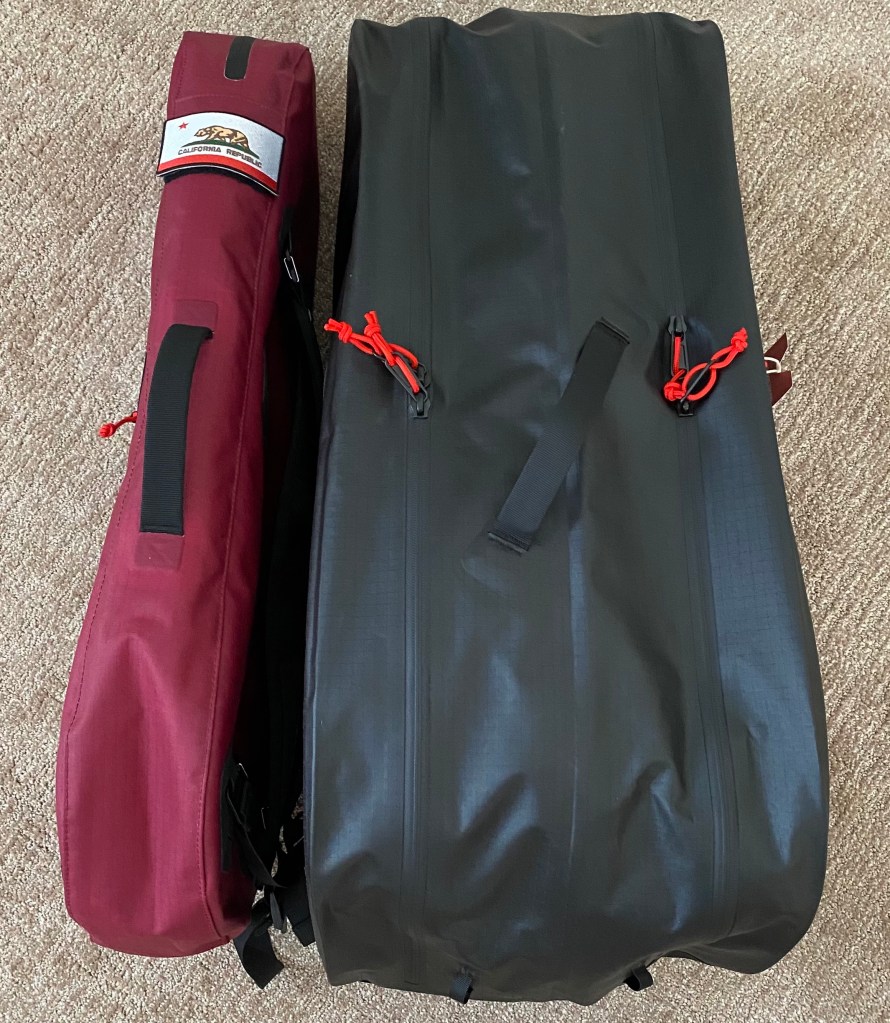
The BBB and my beloved Original Cancha
But, the problem is I am more of a small-bag kind of guy. Think of me as a tennis bag minimalist. Marie Kondo would approve, I’m sure. The good new is the Man in Black is a big-bag kind of guy, so I’ve seen the new Cancha to him. If I know the MIB, and I do, he’ll put the Racquet Bag Pro through its paces and then some.
My own observations about the Racquet Bag Pro are that is a much-refined bag compared to my Original. Material quality seems of the same quality and maybe even a bit more substantial. Everything seems well considered. Note how the horizontal carrying strap is angled. That makes the bag naturally easier to carry and lift without the bag feeling unwieldy. It’s and smart and logical feature. Now ask yourself why more companies don’t think of making their bags like this.
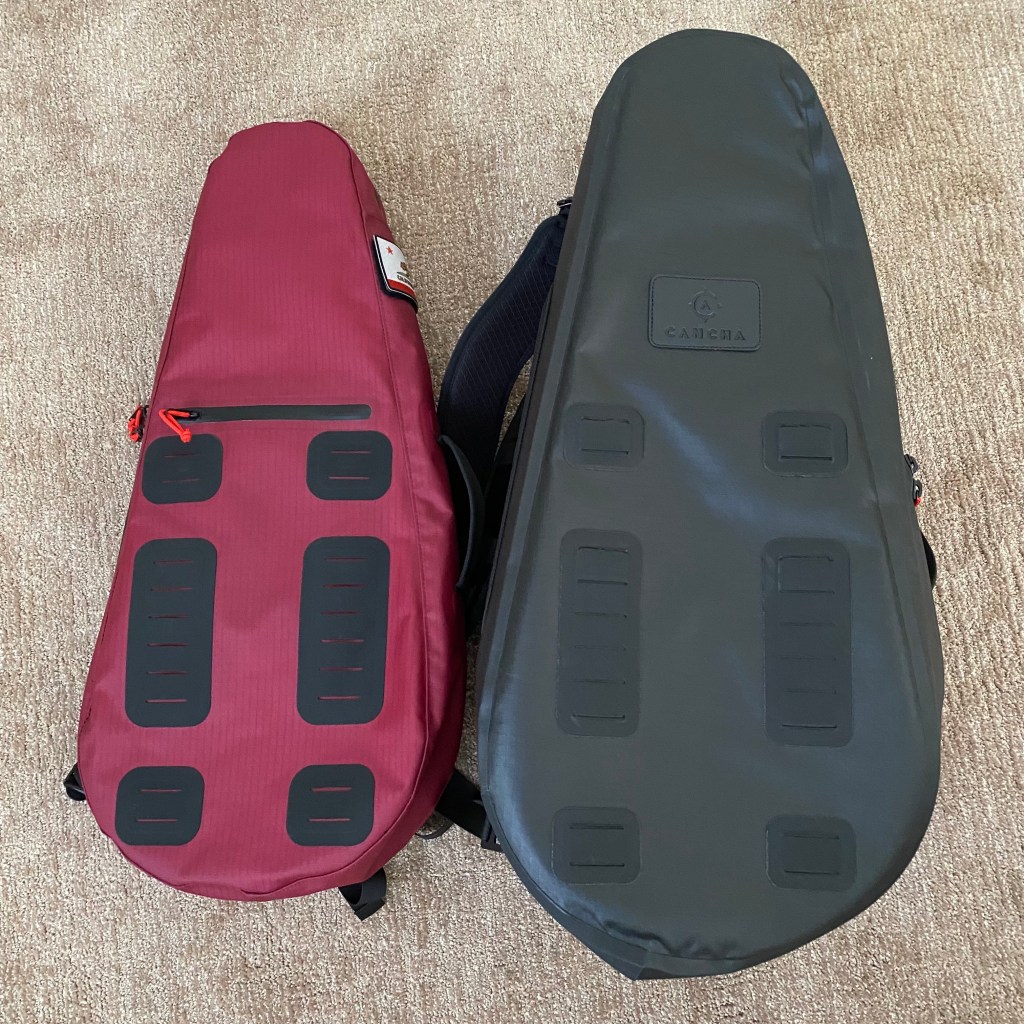
Interesting that even the BBB’s cross-section is larger than the Original’s
I’ve made it a mission of mine to fully utilize the Cancha’s attachment points. The company refers to them as RF Bonded Hypalon Molle Patches for Add-on Accessories.
Uh, yeah. Me? I’ve never used or even heard the term Molle Patch until after I purchased my Original Cancha. So, I started to research them. What I found were a lot of companies using the word Molle to describe a variety of very similar products, respective to their function. I have to admit I hoped Molle would be a more general ecosystem rather than one, primarly, suited to other products from the same company.
In other words, I dig Molle conceptually but have yet to make them quite as useful as I hope to in the future. For a while, I saw my Original Cancha as a do anything-bag if I could utilize its Molle attachment points to add space for shoes and clothes, when needed. At the time, Cancha Wet-Dry Bag was on backorder and I was getting ready to take a trip. I fantasized about modifying a generic shoe bag with Molle but I hit a lot of road blocks. I know. I should just buy the Cancha Wet-Dry bag. But I thought I was so, so clever that I could find an effective work around.
Anyway, I’m excited to get MIB’s take on the BBB and to see his video review. From where I sit, Cancha has another winner here. Will the other bag companies catch up? I’m not sure they’re even trying. Tt
Those of you who’ve read Tennis thing know I started out tennis with a two-handed backhand. My coach Caesar said, “I don’t care what you do after you’ve played for a year but I’d like you to start out hitting your backhand two-handed.”
I was game but I soon found the two-hander less than pleasant. During my third or fourth lesson I asked if I could try to hit my backhands with one hand. Caesar patiently showed me the basics (he plays a one-hander) and I soon found the whole deal more intuitive and less physically challenging. The one-hander also helped to create a more effective shot. What’s not to like?
“You hit a natural slice, mate. And, we’re going to build on it. We’ll add the topspin backhand when the time comes.”
Justine Henin…accept no imitations.
I was all in and began to informally curate a collection of the best one-handers I could find. My favorites, then and now, belong to Gregor Dimitrov, Stan Wawrinka, Roger Federer and the owner of the one-handed backhand of the gods, Justine Henin. If aesthetics matter, and they always do, there’s no comparison between the one and two-hander. As a wise person on the internet once said, “The two-hander has all the elegance of a monkey wrench.”
Then, a couple things happened in a relatively close span of time. I managed to hurt my right wrist somehow. This happened about the same time as I began to learn and practice the topspin one-hander and exactly the same time I was hitting against the wall, a lot. The cherry on the sundae was Stew From Brisbane, my sometimes hitting partner whom I know from Brookside in Pasadena.
To me, Federer’s backhand is second only to Henin’s.
Stew’s 60, three years younger and leaner than me. He’s played for no less than 50 years and is a very solid player. Stew also likes to hit hard pretty much from the jump, which is not my style. He means no harm and I really like him. But, his shots to my backhand, especially the deep and high balls, ate my fledgling one-hander alive in addition to taxing my already-tender wrist.
I did a little soul searching while I had a week off from my lessons with Caesar. By the time we were back at it I had decided to make the big switch to the two-hander.
Before I did I conferred with the MIB himself back in Michigan. “Paulie,” MIB said. “I’ve tried going two-handed at least twice but I always go back.” Various internet gurus cautioned against making the switch especially for players who are older (40+, ha!) and who took up the game later in life.
One guess who that describes…
But, I did it anyway and it’s been fairly brutal. For me, the two-hander is an exceptionally difficult shot. Yes, high balls are somewhat easier but in total it’s a far harder shot from a purely physical standpoint. Sometimes, when I’m tired and the ball’s out wide, I will resort to my one-handed slice. Caesar always catches me and says the same thing. “Hitting your slice is Ok but start two-handed and go one-handed as your stroke begins going forward.”
As if I have time to do all that.
When my baseball career was on life support I made a last ditch effort to teach myself to hit left-handed. It wasn’t a bad idea. A lefty has a little bit of a head start to first and I thought it made me look like the kind of player who would try anything to be more versatile. It changed the way I saw the ball and I found power where I didn’t from the other side of the plate and lacked power where I had it as a right-handed hitter. It was weird, just like the two-handed backhand.
Today is the first time I’ve put the sequence of the change and the factors that informed my switch together in my head. Don’t ask me why it’s taken me so long to see the threads. But, now that I have I think I will stick it out with the two-hander for now. I keep hoping for a breakthrough. Maybe next week or next month. Anything is possible.




 Tennis thing