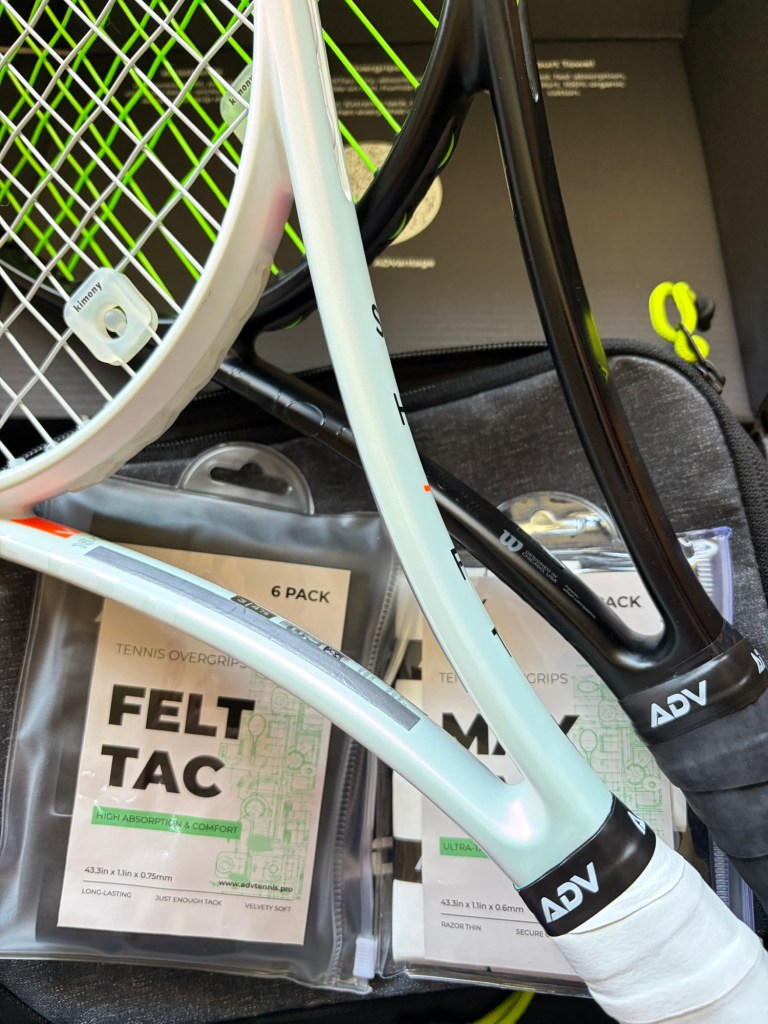
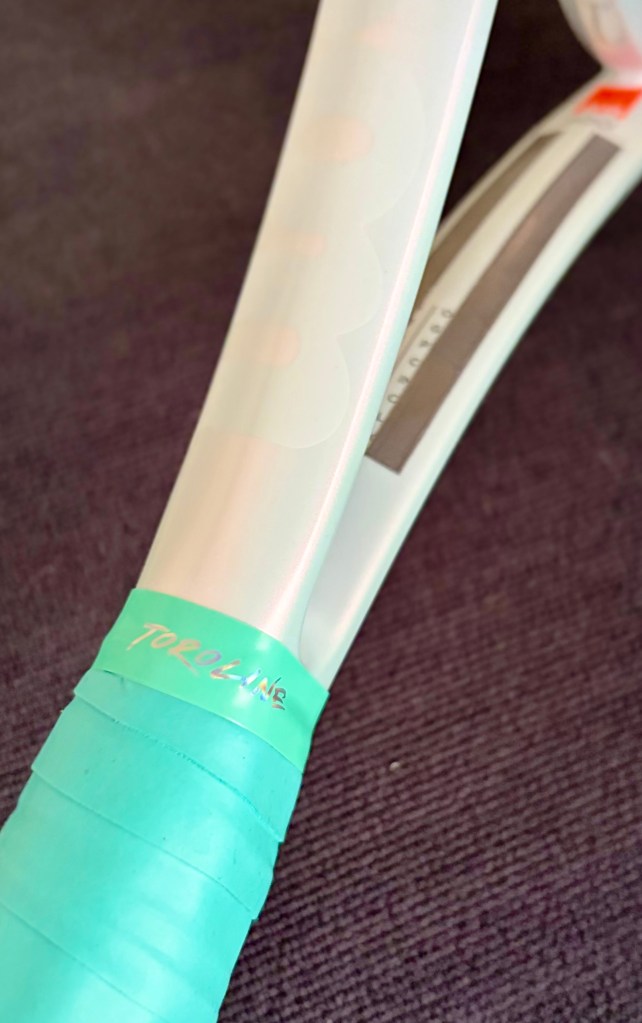
Mint is the tackiest of the three Toroline colors, along with Lavender. Neon Pink is aparently less tacky but it’s Neon Pink, which doesn’t work with any of my rackets or Kimony dampeners. Toroline, being a clever group of folks does things a little different. Their overgrips are tapered on both ends so, in a better world than this, you wouldn’t have to trim the top part before you put on the finishing tape. But, reality intrudes and I ended up having to trim mine anyway.
I prefer two overgrips to any replaacement grip, grip. Toroline does not spec their overgrip’s thickness but I would say it’s on the thin side side two of them render my 4 3/8 grip comfy but firm and the bevels easily felt.
Did I mention this stuff is tacky? Who knows how long it will stay tacky or how durable it is or even, at this point, if it’s too tacky. We will see. Thing is, in golf I was grip obsessed, always trying to find the perfect combination of durometer, compound, texture and tackiness (or smoothness in some cases). I guess it should come as no surprise I’m the same with tennis, always happy to try something new and different. If you’re at all like me give these Torolines a try. Oh, a couple final notes. First, the inner plastic is extremely thin. How thin? I almost accidentally wrapped the grip with it in place. I would love it if someone would come up with a grip that had less plastic. Of course, I am sadly doubtful the grip material itself is exactly Earth Friendly. Tt
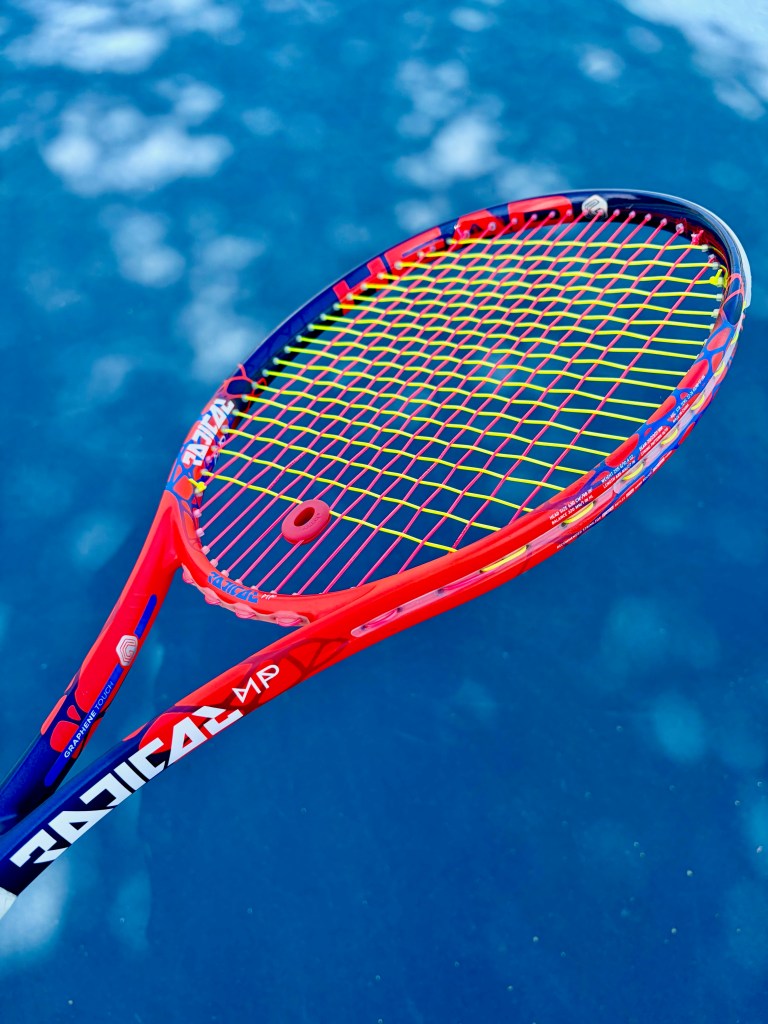
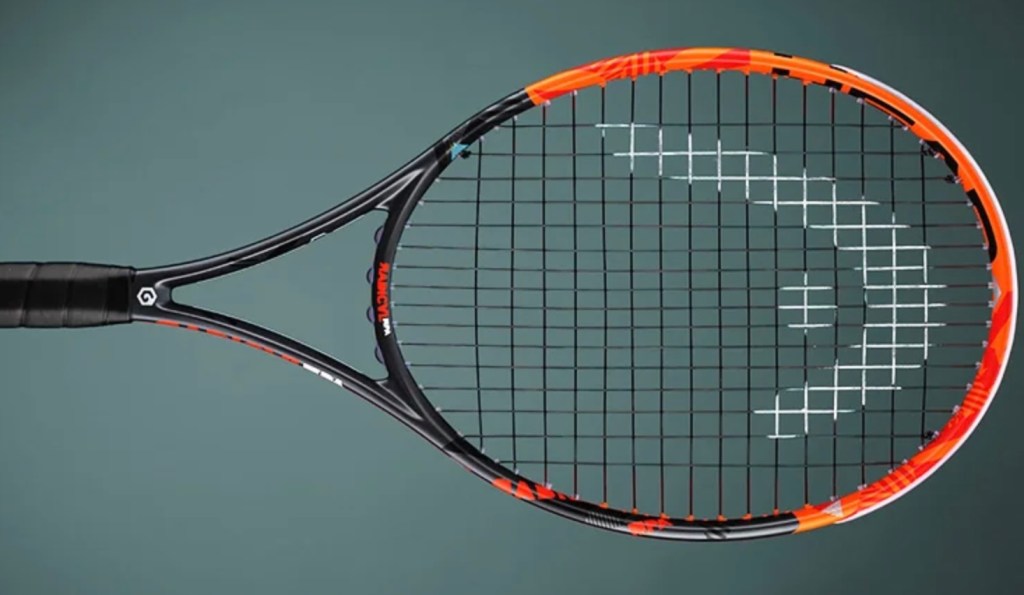
Thing is, I don’t get many warm fuzzys from new rackets. No, for some reason I get the biggest charge out of rackets that are a few years old but still in great shape. That accounts for the appeal of my first (as in first racket purchased by me) racket, a Wilson Six.One 100, codename: Battle Ax in Tennis thing the audiobook. There’s a graphics sweet spot I like and it’s exemplified by my latest purchase, a Head Radical MP Graphene Touch. I snagged it for $50 at the Tennis Warehouse Store in SLO and had it strung today with Toroline K-Pop. Check it out:
I mean, come on, Daddy-O, that thing is damn sexy! The racket itself is in amazing condition considering it’s eight years old. I was a little worried if my stringer, Jason, would say the grommets are done but they’re just dandy. The label on the throat shows a restring date of December 2018, so there’s that. The white Head Hydrosorb grip appears original with the white Head finishing tape applied in a neat & tidy way usually confined to original grips. Initial results are quite positive. If there’s anything worth adding about Toroline K-Pop I will comment in a separate post. Tt
Right around New Years I took a lesson from Chris Phelan, aka, Pro-To-Go in Palm Springs. At one point Chris met me at the net and said, “Look, you hit the ball great. You move Ok. But, you work too hard.”
I admit it. I didn’t get it. In fact, I thought about it a great deal for the rest of our trip and after we got home. Gradually, very gradually, I came to understand. The point Chris was trying to make was, that at my level, what I needed to do is hit the ball deep, with top spin rather than always, or at least usually, putting great value on simply hitting the ball hard.
Today I hit with Old Pete, an off and on student of Caesar.
As we walked onto the court he said. “Listen, I like to hit hard.”
I said, “Rock on, dude. Hit it as hard as you like.”
And, he did.
Chris Phelan in Palm Springs
It took me about five minutes to find myself wondering what, exactly, was the point of relentlessly trying to hit the ball as Old Pete? I still do not have an answer but when I shared my experience with Chris he said: “Sad, but his loss. In the bigger picture, consistency equals a longer tennis life. Since no one enjoys self-destruction, the real fun is in developing a more versatile toolbox—one that includes a soft grip and relaxed wrist to get you out of trouble and make your opponent play one more ball, maybe one more than he’s able to return.”
Sure, I am pointing the finger at Old Pete, and he deserves it. His style of play is neither effective nor enjoyable but if I am being honest, I’ve been guilty of something similar. It says something about me and my development as a tennis player that I didn’t get what Chris Phelan said when he said what he said back in January, in a sincere effort to help me play better tennis for longer.
But now I do, and I’m happy about that and endlessly thankful to Chris Phelan. I can’t wait to get onto the tennis court with him again — maybe this fall. Maybe over the winter, it doesn’t matter.
This time, I’m gonna get what he’s telling me without having to mull it over for a few weeks or a month.
As most of you know, I have only been playing tennis for three years. And, I didn’t start playing tennis until I was 62. I’ll be 65 later this month and I have been through a pretty good number of tennis rackets over that time. Honestly, my early preferences were based on brand and later on color and graphics. If you skip to the end you might conclude they still do.
After a year or so I noticed I liked the look of 98 square inch heads. 98 square inches is a preference that has stood the test of time. Later, I noted a preference for rackets with a strung weight north of 320g that weren’t too stiff. Still later, I started to play more (currently four to five days a week) and in longer sessions with players who hit the ball harder. I remained dedicated to heavier rackets, which I found I swung more smoothly.
I have used rackets with grips sizes ranging from 1/4 to 3/8 and as small as 1/8. When confronted with the ubiquitous and simplistic ring finger measurement tool I measure at 3/8 but my palm is somewhat large for the length of my fingers so 1/4 is closer to ideal. I forgot, the first racket I bought was a Wilson Six.One One Hundred that was 1/2. My coach — taking pity on me for my unwise $35 purchase — expertly peeled off the original leather grip and put on two of his Tecnifibre over grips. He said of the leather grip, “Keep this. It’s in perfect shape.” Ah, the two over grips felt lots better!
I wrote recently about MIB’s Wilson Shift — the one I put on a weight reduction program — and then found I liked. The Shift got me thinking of finding a racket of similar weight and stiffness but with a correct 1/4 grip size, preferably with a 98 square inch head. I found a cache of NOS Head Radical MP from God knows how long ago. Said to have a strung weight of 310g, it was promising and cost less than a $100 bucks delivered. It arrived strung with black Head SynGut. My initial thought was to have it immediately restrung with my second set of Head Lynx Power Soft Proto I picked up from TW for a buck a set. Then I reconsidered and I took the Radical out to hit a few serves. It feels just dandy, pretty much like every racket I’ve tried save an unfortunate few that shall remain nameless.
I confess I may be largely insensitive to racket variations but I still have some favorites, spec wise, and I believe I’ve settled on a workable weight range. I think my ability or lack of same means I can play with a wide variety of rackets and be happy. That said, I enjoy trying different rackets in the same way I enjoy tasting different craft beers rather than continually ordering the same beers from the same breweries. Sometimes a different racket is simply enjoyable to look at. I could say the same about some beers, come to think of it.
My age even more than my basic ability limits my top end in tennis, no matter how much I play or practice or learn about the tactics and strategy of the game. Or, even how much I love and enjoy the game. Still, I think it’s a good thing my rackets have started to measure and play more like each other. Plus, I dig my new Head’s paint job.
I really enjoy taking one-off tennis lessons. I like to see how I will respond and I also like to see how a tennis pro facing the challenge of helping a student they are unlikely ever to see again faces the challenge. This time the fun took place during an unusual heatwave that made it all the way to California’s Central Coast where we have had a four-day getaway planned for months.
The pro was a lefty and even older than me, if you can imagine. I was quite upfront that I was looking for someone to rally with but that instructive comment was always welcome. The rally lasted all but five minutes before the question, “Can you slice your forehand?” I said I could but found the shot less than common. Sure, it’s fun but it’s seldom needed or effective. But, I was game so I hit a few to show the shot was no problem for me
Here’s where things got weird. The coach wanted to talk about the split step. It seems that a lot of his students land flat footed when asked to split step. He then asked if I knew about split step and float? I confessed that I did not. The coach went on to say that split step and float means the player lands on one foot, so as to aid their ability to move in that direction.
No.
That’s what I said, for a couple reasons. First, how is the player supposed to know which direction they need to know at the moment they split step? Second, the idea of hopping off both feet and landing on one seems like an unwise practice.
Sorry.
After the lesson I really felt badly. You see, the coach had hit on two genuinely good points. The first was a more level driving motion on high bouncing one-handed backhands. The second was to use the ball point to rotate the off arm toward the striking arm to aid in spacing. Both of those thoughts worked great.
Yup, I would take another lesson from this guy.
Yes, I think he was dead-wrong about the split step.
Yes, I learned something during the lesson and I enjoyed myself.
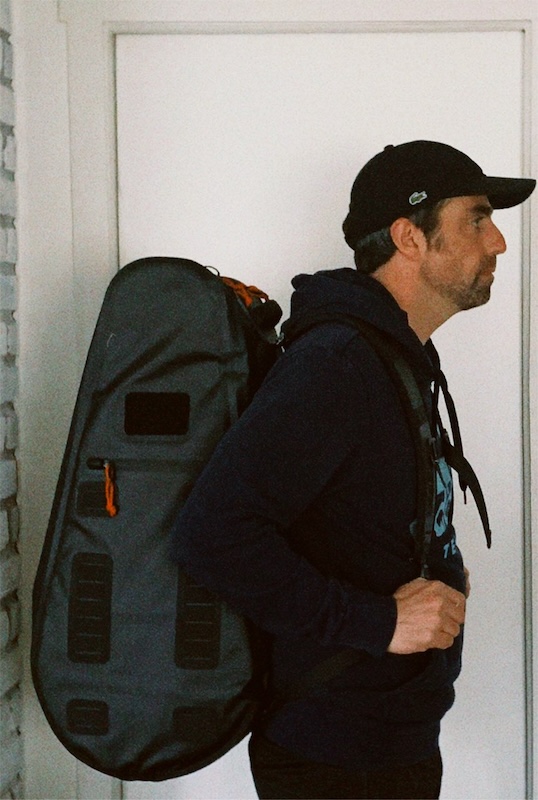
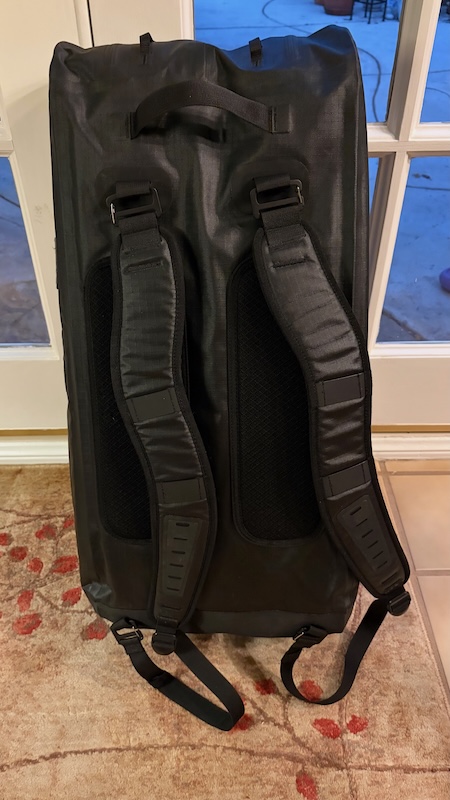
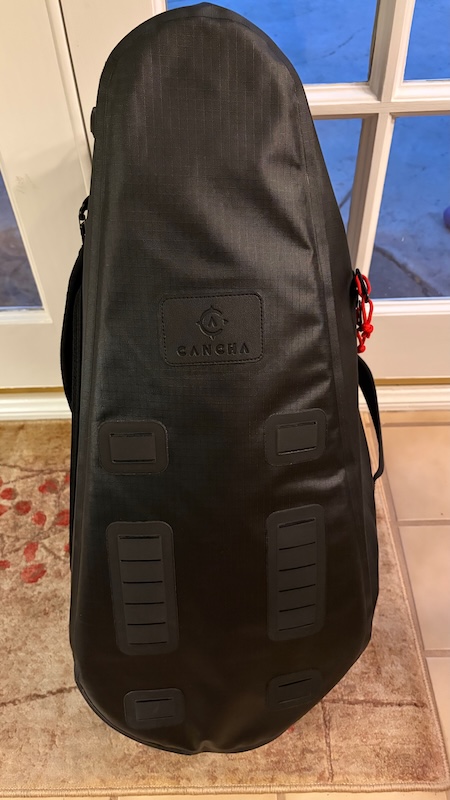
MIB has been using the Cancha Racket Bag Pro for a year. I know because I shipped the bag to him last February. He’s been using it as his one and only bag ever since.
Now, MIB is not your typical recreational player. No, he’s a three to four day a week doubles warrior. He not only admits to being hard on tennis gear, he occasionally celebrates the fact. Tennis racket blood sacrifices into trash cans and the like—you get the idea. When MIB told me he had shipped the back back to me I was expecting the worst. Instead, the Cancha Racket Bag Pro looked new.
Have a look.
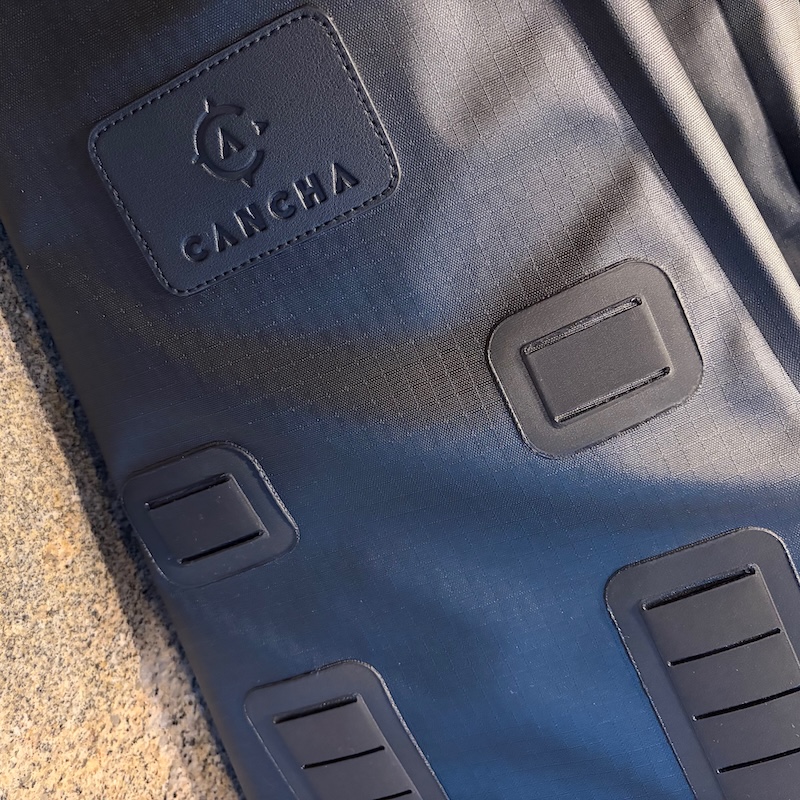
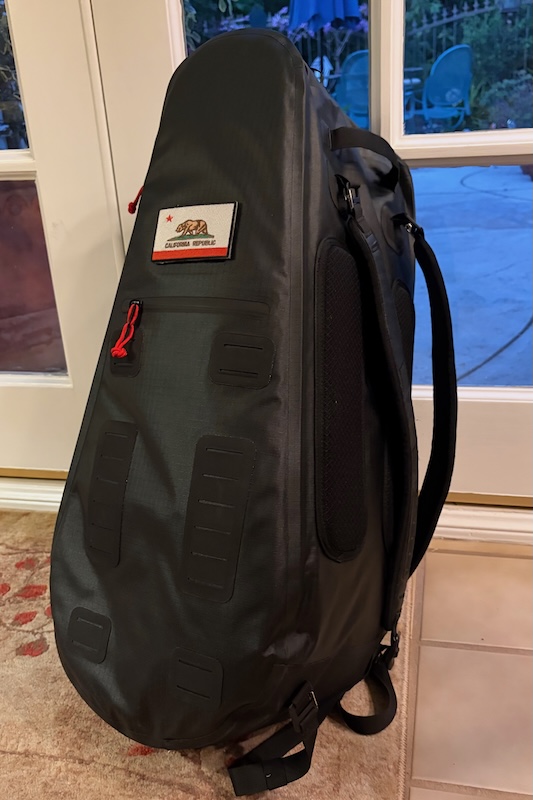
MIB used the hell out of the Cancha Racket Bag Pro but you could not tell by how the bag looks after a full year.
Zippers are perfect.
MOLLE points are perfect.
Fabric is perfect.
Straps and handle the same.
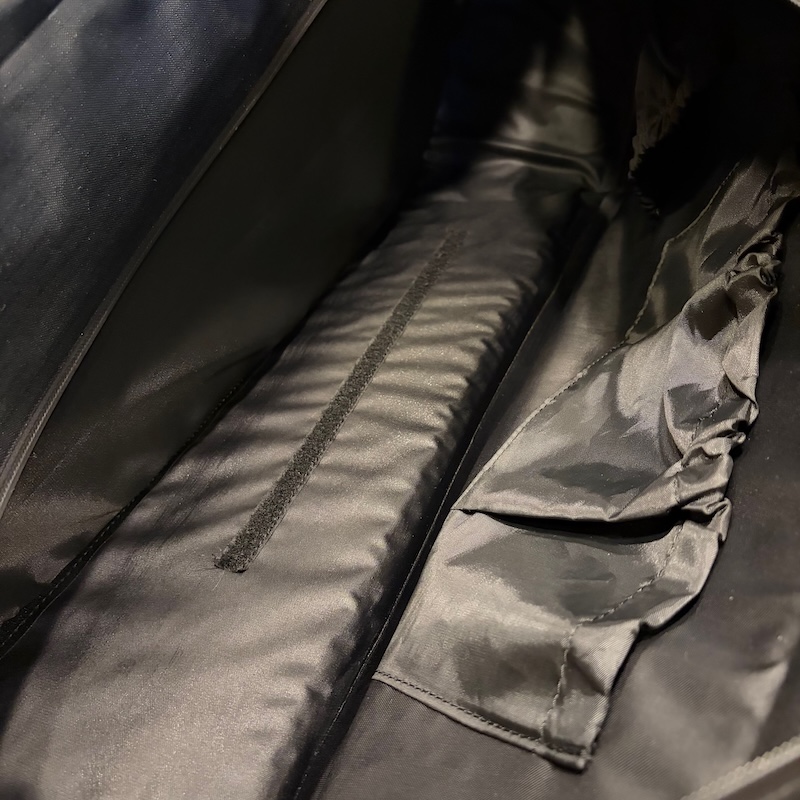
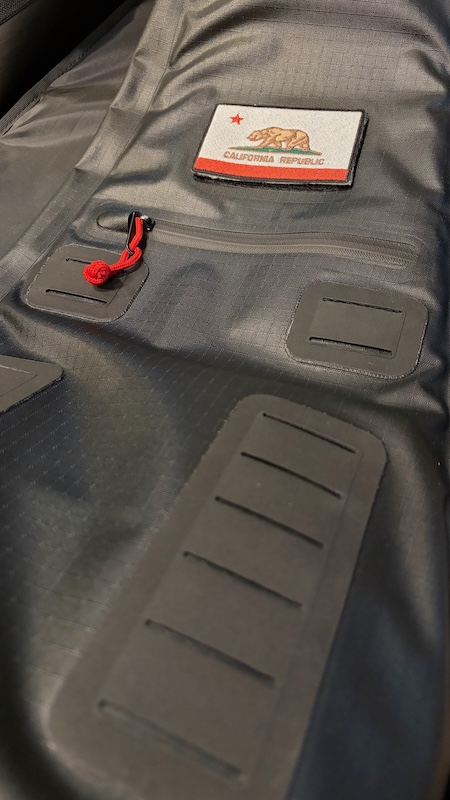
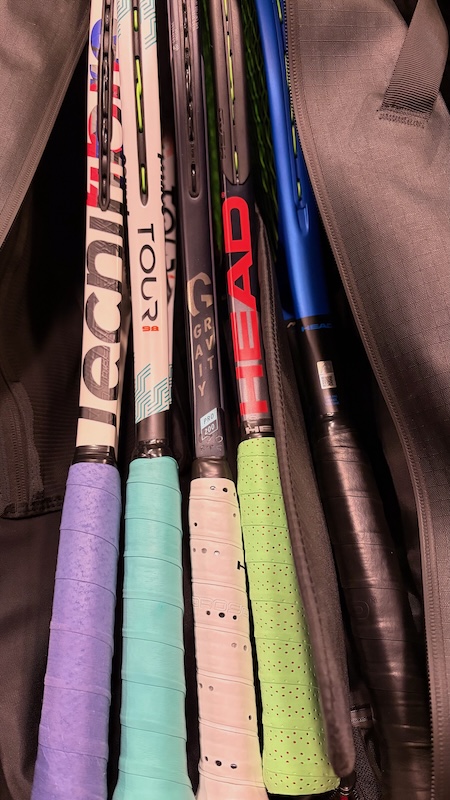
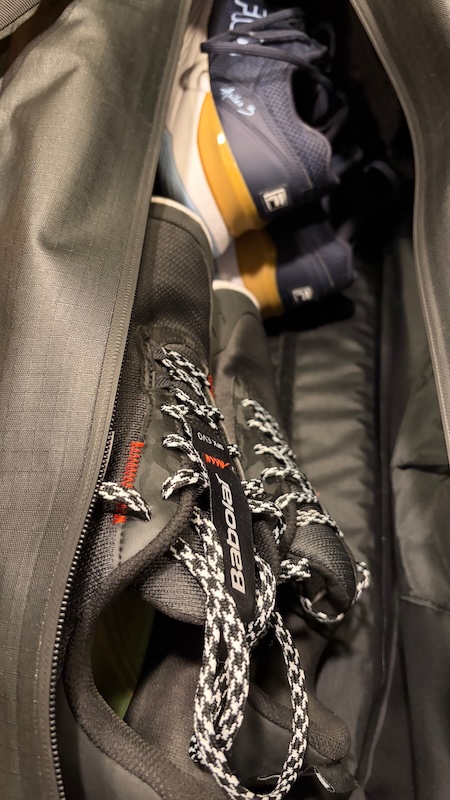
I am quite certain the bag could pass for new. Ok, so my trusty California patch would give it away but otherwise the bag looks like new. So, now it’s my turn with the Cancha Racket Bag Pro. It swallows up my rackets and two pair of shoes and everything else that needs to be inside. I am really looking forward to traveling with the bag on a tennis trip later this month and for my birthday getaway in April. I will report back once I get the Cancha Racket Bag Pro out on court. But if I were you, I would cut to the chase and expect me to be even more impressed with this fantastic bag once I have had the chance to use it myself. Well done, Cancha! Tt
Kimony could be my favorite tennis accessory brand. There’s just something about companies like Kimony with just the right vibe (no pun intended). Plus, tennis accessories like grips, tools and dampeners can be so engaging on a personal level. As someone who has done a lot of business in Japan, both in my previous marketing life in high-end audio and later in golf, I appreciate the ethos of Japanese companies, especially small ones like Kimony.
They know what they’re about.
They know what matters to them and they know how to make it.
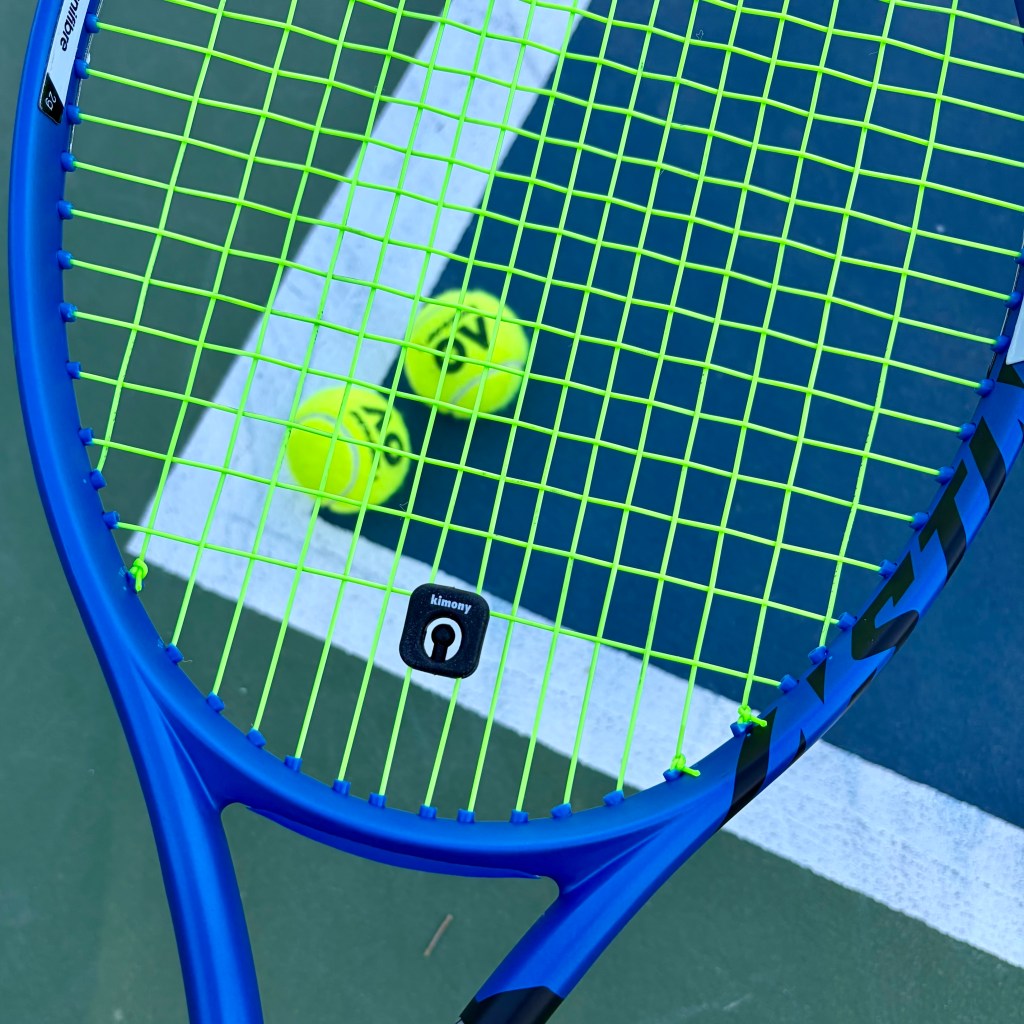
I think I’ve used most of Kimony’s replacement and overgrips and each has been excellent, at least on par with offerings from much larger companies with more familiar names. But, this is my first experience with their dampener, The Quake Buster (or how I wish I could use the iOS Text Effects to make the letters in Quake explode!). As usual, I was first attracted to the available colors (I chose clear and black). But I had another motive respective to trying the Quake Buster and that was the way it attaches to the racket at the top and sides and the fact that it’s basically square (so as to maximize string contact) and also the fact that the experience of others who wrote about their experience with the Quake Buster state that the dampener is quitesoft.
The words quite soft translate to a thermoplastic that has a fairly low durometer (the lower the durometer the softer and more maleable a material). Harder dampeners (like Head’s)lack significant compliance to dampen much of anything. That said, the design of a dampener like the RTP Shocksorb may have gone too far, with a durometer that’s simply too squishy (and heavy). The question is whether the Kimony Quake Buster gets it just right.
The Kimony Quake Buster in my Head Instinct MP
The Kimony packaging has some copy on the back so I had a buddy of mine in Japan translate for me:
Beforeimpact, the mushroom, which was in a stationary state relative to the Quake Buster main body, moves its head in the direction of the ball due to inertia at the moment of impact.
After impact, while interfering with vibrations from the strings and other sources, it absorbs (dampens) vibrations in all 360-degree directions.
In other words, the mushroom works in a truly magical way.
Come on, a magic mushroom! This is obviously the very best quality ever when it comes to a tennis string dampener. Seriously, I think the Quake Buster is a very well-executed product. The way it attaches to the strings, its shape and perhaps most importantly the durometer of its thermoplastic make it an excellent dampener. The sound isn’t dull but retains a slightly resonant thunk that is quite pleasing.
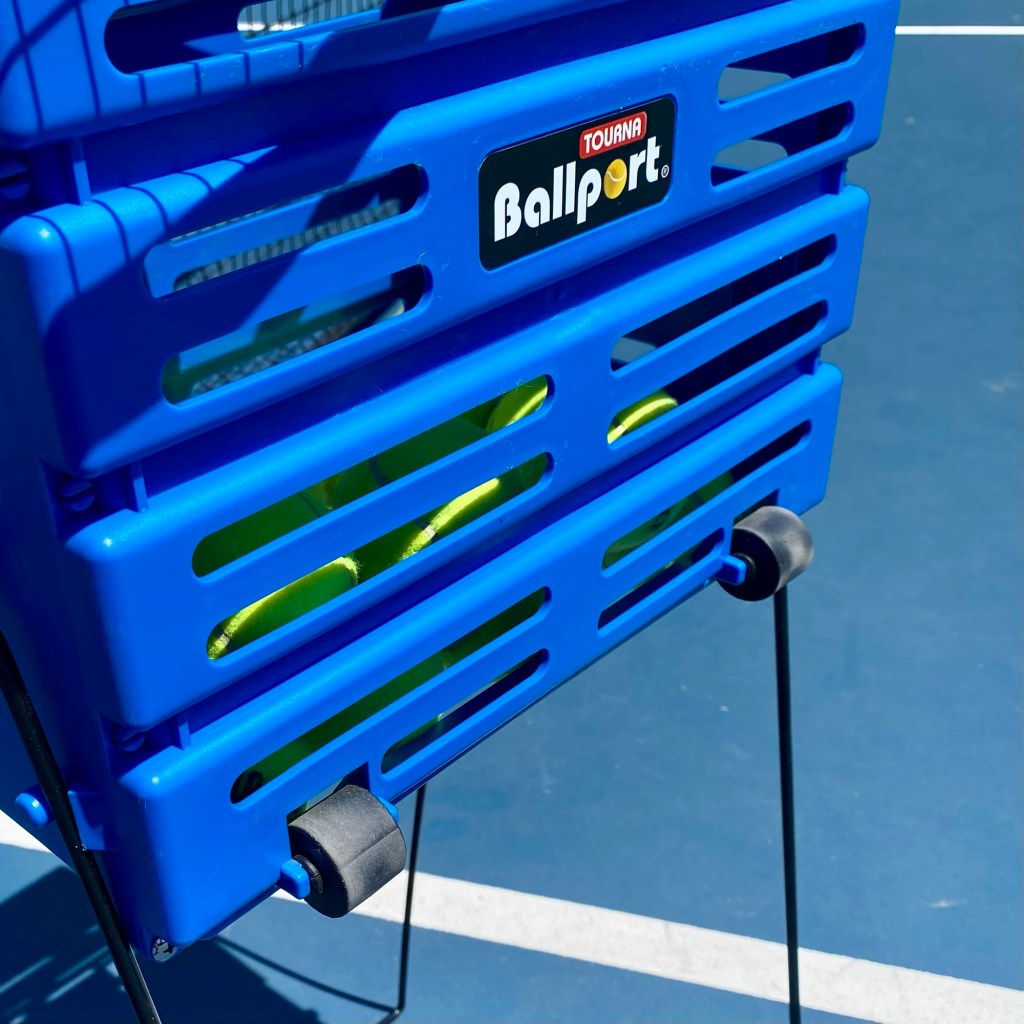
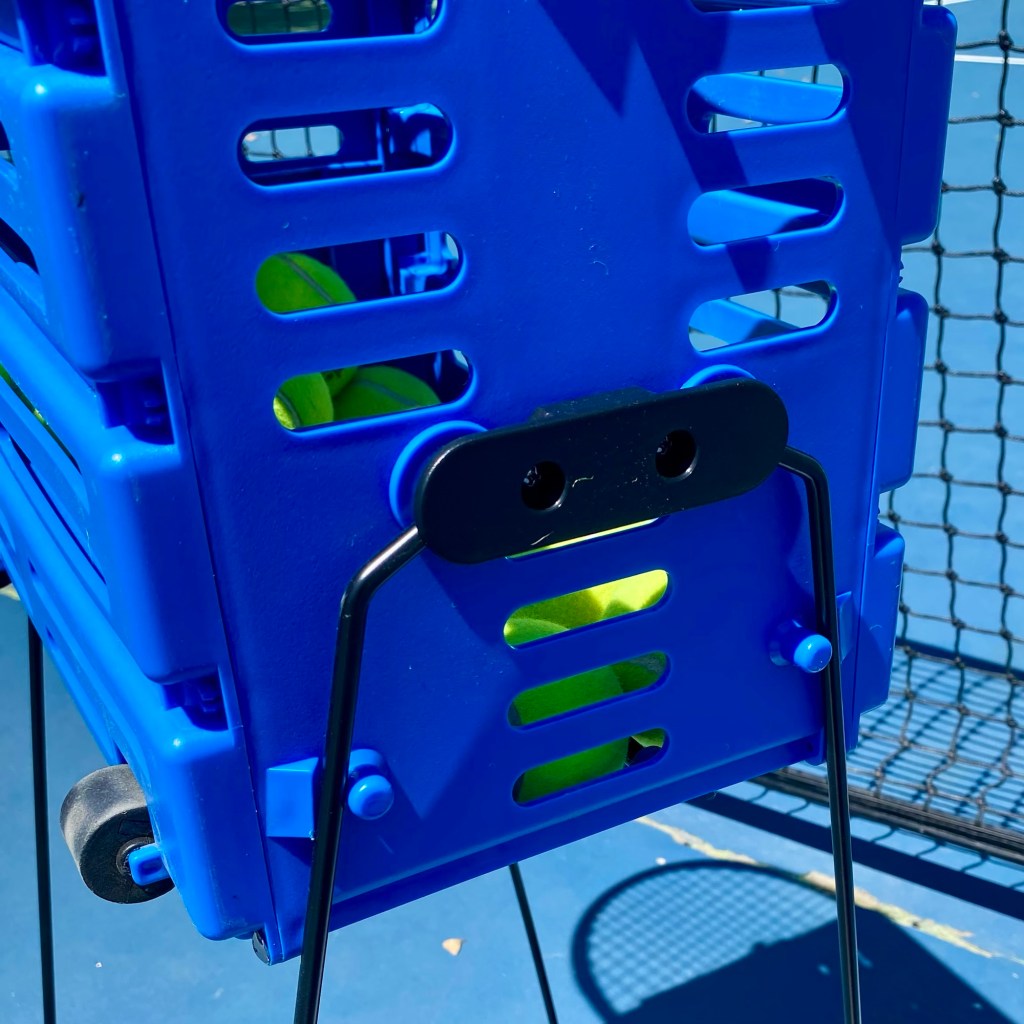
I dig the Tourna Ballport Deluxe. It’s light, holds plenty of balls (I will leave its exact capacity for my esteemed colleagues at YouTube) and has wheels. In fact, Deluxe means wheels, funky two-piece wheels to be precise. Check ‘em out:
See the little slit in the wheel? Yeah, that should work!
I cannot imagine making this hopper more efficiently than they have, when you consider that it’s nearly free. That said, the screws that hold it together grip only to plastic. Even the legs rely on plastic to lock open and closed.
Have a look:
Yeah, man; those legs are locked, that’s for sure!
It’s super light duty and made with cheapness firmly in front of mind, but it works as intended.
I love that phrase and it applies perfectly here. Oh wait. I do have one more niggling complaint. Every time I take the Ballport Deluxe out of the trunk one or more balls have gone rogue and made a break for it!
There goes another one! Grab it!
Two-piece wheels, all-plastic construction and escape-prone balls notwithstanding, I just loves my Ballport Deluxe.
It took a while before I decided I wanted to wear sunglasses when I played tennis. On one hand it’s not like i”m out there forever but my eyes aren’t getting any younger either. Light weight is good, as is visual coverage. I was interested in getting a bit more contrast while still maintaining decently accurate rendering of color.
Nike Trainer: Let down by odd fit and flimsy build.
These has the blue reflective lenses and were fine optically. But, the Nike’s were let down by their exceptionally flimsy construction and the fact that they rode so high on my nose they created a coverage problem under the lenses. In decades of sunglass use I have never had that issue before.
Well done for a little cash. Good work, Tifosi!
I’ve had pretty good luck with Tifosi. They make a lot of different sunglasses at significantly different price points. The Tifosi Optics Centus are one of their less expensive designs but have been impressive to me so far. The Centus are actually a gram lighter than the Nikes but somehow feel sigificantly more durable than the swoosh shades. I’ve never had a pair of sunglasses with brown lenses unless you count the brown-lensed Vuarnet’s I borrowed from my roommate at UCLA from time to time. The Centus’ brown worked great with the yellow of the ball and the blue of the court to keep everything as visible as possible. They fit much better than the Nikes and left no odd coverage gap in any direction. The only commnt on fit I’d like to make is that the centus could be better suited to medium to wide faces rather than narrow to medium. With their design and light weight they have no tendency to shift or slide around during play. Well done for a little cash. Good work, Tifosi! Tt
Until I began playing tennis in 2023, my sports were baseball and golf. Baseball (and I gather Cricket) may be the two most elementally unchanged ball sports. Sure, we’ve been living in baseball’s live-ball era since the time of Babe Ruth but other than that, little has changed between the baseball and the bat over the last century.
Golf is totally different story with technical advancements in ball and club (especially driver) construction that has fundamentally changed the game forever if not for better. The impact of multilayer balls and max-COR drivers is inarguable and these improvements have been augmented by the practice of data-based club and shaft fitting. Today, the average recreational players can avail themselves of most of the tech a touring pro can. Of course, the tour pro doesn’t pay.
I see tennis somewhere between those extremes. Until recently, my favorite racket was a borrowed 2014 Head Prestige Pro. It’s still my favorite racket but my advancing years have suggested that lighter may be better for my game if not my ego. Still, the fact that a twelve year old frame could still be useful to a player at my level gives me great respect for what a great racket Head could build all those years ago and a little less respect for their 2025 offerings which I am sure they describe as far more advanced than my old Prestige.
What all this means is I can easily imagine a day when a tennis player, pro or amateur, can have their tennis racket (and strings) evaluated by measured data. Golf has already done this and more. Golf tour pros, with their unimaginably consistent swings, can tune their clubs to their ball of choice, chasing their ideal of ball speed, spin and feel. I would be surprised if players on the WTA and ATP can’t do something similar right now. And, if they can, you and I will be able to soon. Whether this will help the game of mere mortals like me is anyone’s guess.
I am so glad anyone seeking beneficial alteration of their tennis racket can reach out to Miha Flisek of Impacting tennis. Even tbough my skills were still in their infancy when I first started playing tennis I knew and could feel that details mattered. In fact, everything mattered. The marriage of string, racket velocity, racket weight, weight distribution, racket flex (on multiple axes) and swing shape are a fascinating combination of variables and destined to confuse most players, leading to a great deal of misunderstanding.
I sought to learn all I could, sometimes surprised by how such complicated issues were spoken of with such a cavalier attitude. I was lucky my early searches pointed me toward Miha and his excellent videos. HIs clarity did a lot to demystify that which could easily be mystifying. I’m grateful Miha was generous enough to contribute his time to answering my questions about him and Impacting Tennis.
Tennis thing: Tell me a little about your own history playing tennis? How old were you when you started?
Miha Flisek: I started playing tennis very early, but at the same time I was also into archery and basketball. It wasn’t until an injury took contact sports off the table that I really began focusing on tennis. From the beginning, I was very sensitive to equipment. In archery, even the smallest change can completely alter your shot, and I brought that same mindset into tennis. I was honestly surprised how little attention most tennis players gave to their rackets.
Later in college, I started combining my background in engineering with my growing understanding of tennis equipment. That’s when things really started to click. I began connecting the dots between player movement, stroke mechanics, and racket behavior. That’s how Impacting Tennis was born, from the idea that tennis gear shouldn’t be treated as an afterthought but as a core part of performance.
Tennis thing: How long did it take for you to begin customizing your own rackets? What were some of your early modifications?
Miha Flisek: I started modifying my rackets almost immediately, experimenting with strings, shifting balance points, and later adding lead tape. At the very beginning, I didn’t even have proper materials. I remember finding some old lead pipes and literally hammering them flat to make my own thin strips of lead, that was my first version of lead tape. It was very DIY, but it gave me a hands-on feel for how mass placement affects the racket.
The real transformation came later when I gained the technical knowledge to calculate what I was doing. Instead of just feeling the difference, I could measure swingweight, balance, MGR/I, twistweight, and understand what each change was actually doing. That’s when customization stopped being trial and error and started becoming engineering and that’s really what laid the groundwork for everything I do now.
Tennis thing: When players come to you for customization, do they usually have a specific goal in mind, or do they rely on your guidance to help them improve?
Miha Flisek: Players usually come in with a clear goal in mind, whether it’s more spin, more control, or more stability, and I help them move toward it. But we never start with the racket. First, we look at where the player is in their career, what’s limiting their game, what they’re trying to improve. We take into account their technique, movement patterns, and overall development.
Only after that do we adapt the equipment. The racket becomes a tool that supports their goals. When you get it right, it’s not just a better racket, it’s a better version of their game.
Tennis thing: One of the most interesting aspects of tennis for me are the significance of audible cues. The Octo damper is designed to reduce unwanted vibrations while keeping the higher-frequency feedback that’s important for feel, timing, and contact cues. What led you to choose the thermoplastic elastomer PEBA (Polyether block amide) and were there other materials you considered?
Octo damper
Miha Flisek: I was already working with PEBA on a different project and found the material really interesting. It was being used in high-performance running shoes for its energy return properties, and it had just started to become available for 3D printing.
The Octo damper actually came out of working with the material. I realized it had the ideal combination of characteristics, soft enough to reduce unwanted low-frequency vibration, but responsive enough to preserve the high-frequency feedback that’s so important for timing and feel. It wasn’t something I set out to create, it just made perfect sense once I started using the material.
Tennis thing: I am really fascinated that you actually 3D printed a tennis racket! Without getting too deep into the technical weeds, how many separate pieces were needed to create TO Stardust and what adhesive did you use? Also, I found your use of rounded string transitions rather than traditional grommets to be exceptionally clever. What was the total print time?
Miha Flisek:TO Stardust was printed as a single solid frame. No adhesives, no bonding. Just one continuous piece. That required a very large and advanced 3D printer along with specialized materials. The handle pallets and buttcap were added afterward, like with a standard racket.
The total print time was about 12 hours. One of the standout features is the integrated rounded string holes, which replace traditional grommets. That not only reduces unnecessary components but also gives the stringbed a more consistent response. The project was a way to test what happens when you throw out legacy design assumptions and build a racket from the ground up using modern tools.
Tennis thing: Many ATP players still use racket designs that are more than a decade old, often under new paint jobs. Do you think racket technology has plateaued or do you see meaningful trends in design or construction that could still benefit players?
Miha Flisek: I don’t see any real leaps in racket technology happening right now. The core materials, like carbon fiber laminates, have been around for a long time, and most of the available geometries and design concepts have already been explored or exhausted. There’s not much on the horizon in terms of radically different materials that would offer meaningful improvements.
What we are seeing today, like the shift toward lighter and more powerful rackets, isn’t so much about technological progress as it is about adjusting to external changes, especially the balls. Balls have become lighter and less consistent, which makes it harder to get penetration through the court, so players are shifting toward rackets that help generate more pace and spin.
TO Stardust on court and ready for play.
The next real shift in racket design will probably come with the maturation of 3D printing technology, particularly once continuous carbon fiber printing becomes viable. That’s when we’ll finally be able to explore forms, layups, and mass distributions that are simply impossible to achieve with traditional molding techniques.
Tennis thing : What’s next for Impacting Tennis? What enhancements can we expect to see in TO Stardust v2?
Miha Flisek:That ties directly into the future of TO Stardust. Right now, with the current 3D printing materials and processes, it’s not quite at the performance level I want, at least not for professional-level play. The design itself showed what’s possible in terms of rethinking racket construction, like grommetless string transitions and integrated frame geometry, but to move to the next stage, we’re waiting for the technology to catch up, especially in terms of continuous fiber reinforcement.
When I saw TO Stardust’s grommetless construction, I knew Impacting Tennis was serious about innovation.
In the meantime, my focus is on consulting and helping players unlock performance through better equipment understanding and customization. I’m also exploring string design using a novel material that hasn’t been used in tennis yet. The long-term goal remains the same: use engineering and first principles to push tennis forward, not just follow trends.
Tennis thing: Thanks for participating, Miha. I will be posting my review of the Octo damper soon. I’ve been evaluating along with a trusted pro at my club. So far, I am really liking it, especially its amazingly light weight.