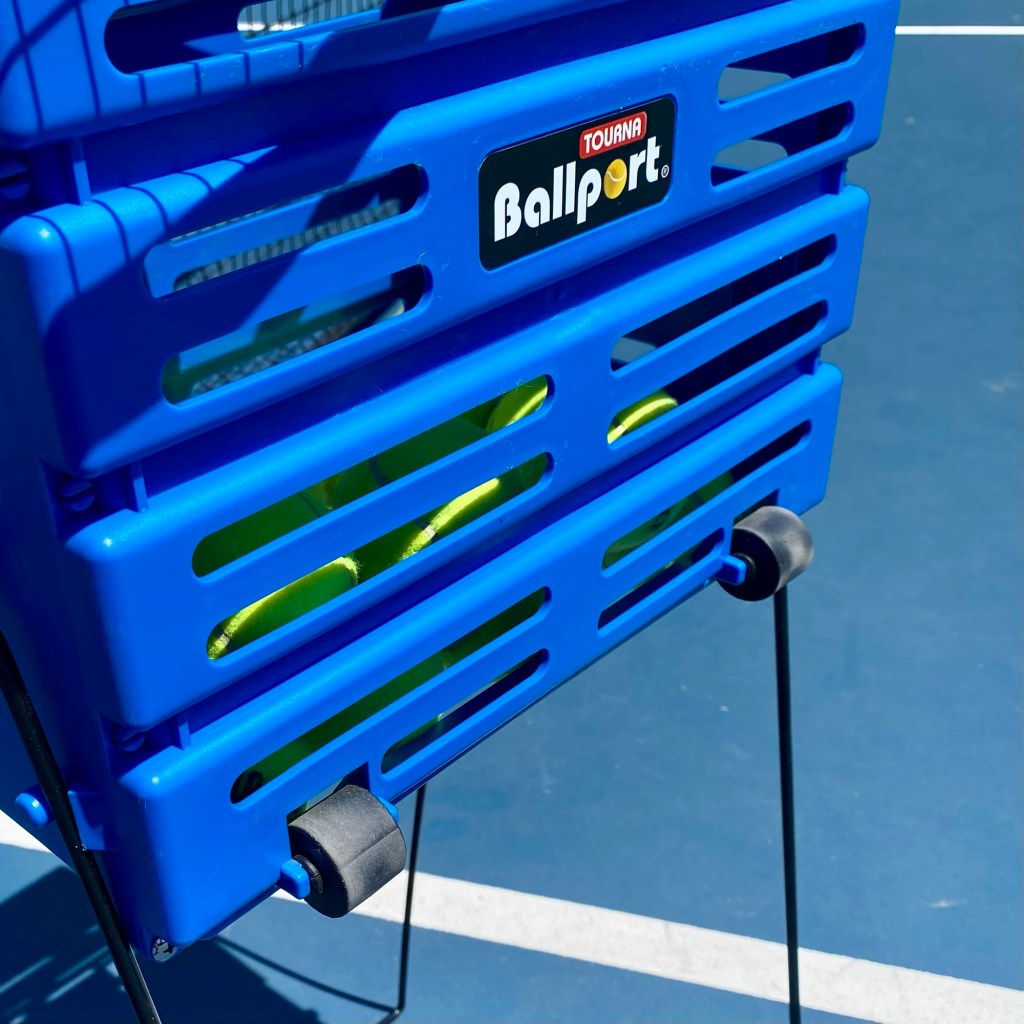
I dig the Tourna Ballport Deluxe. It’s light, holds plenty of balls (I will leave its exact capacity for my esteemed colleagues at YouTube) and has wheels. In fact, Deluxe means wheels, funky two-piece wheels to be precise. Check ‘em out:
See the little slit in the wheel? Yeah, that should work!
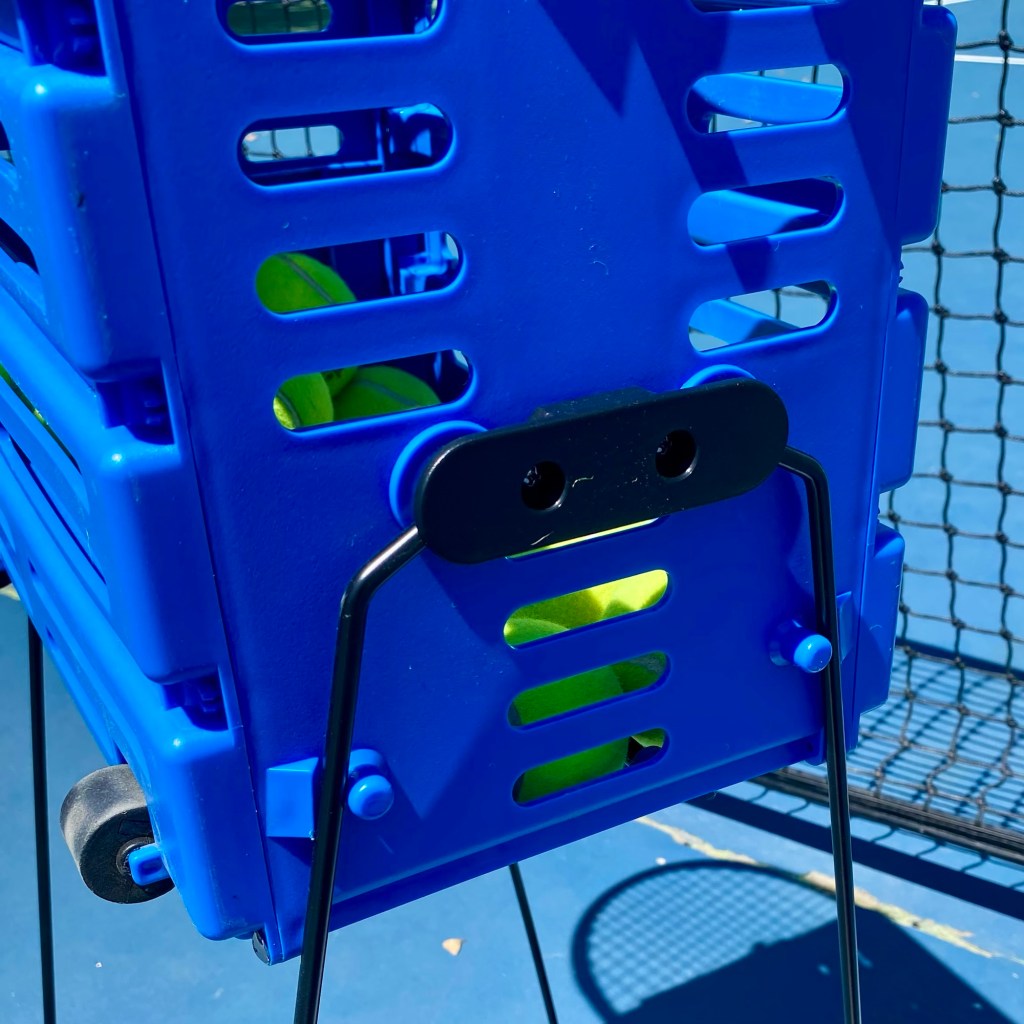
I cannot imagine making this hopper more efficiently than they have, when you consider that it’s nearly free. That said, the screws that hold it together grip only to plastic. Even the legs rely on plastic to lock open and closed.
Have a look:
Yeah, man; those legs are locked, that’s for sure!
It’s super light duty and made with cheapness firmly in front of mind, but it works as intended.
I love that phrase and it applies perfectly here. Oh wait. I do have one more niggling complaint. Every time I take the Ballport Deluxe out of the trunk one or more balls have gone rogue and made a break for it!
There goes another one! Grab it!
Two-piece wheels, all-plastic construction and escape-prone balls notwithstanding, I just loves my Ballport Deluxe.
It took a while before I decided I wanted to wear sunglasses when I played tennis. On one hand it’s not like i”m out there forever but my eyes aren’t getting any younger either. Light weight is good, as is visual coverage. I was interested in getting a bit more contrast while still maintaining decently accurate rendering of color.
Nike Trainer: Let down by odd fit and flimsy build.
These has the blue reflective lenses and were fine optically. But, the Nike’s were let down by their exceptionally flimsy construction and the fact that they rode so high on my nose they created a coverage problem under the lenses. In decades of sunglass use I have never had that issue before.
Well done for a little cash. Good work, Tifosi!
I’ve had pretty good luck with Tifosi. They make a lot of different sunglasses at significantly different price points. The Tifosi Optics Centus are one of their less expensive designs but have been impressive to me so far. The Centus are actually a gram lighter than the Nikes but somehow feel sigificantly more durable than the swoosh shades. I’ve never had a pair of sunglasses with brown lenses unless you count the brown-lensed Vuarnet’s I borrowed from my roommate at UCLA from time to time. The Centus’ brown worked great with the yellow of the ball and the blue of the court to keep everything as visible as possible. They fit much better than the Nikes and left no odd coverage gap in any direction. The only commnt on fit I’d like to make is that the centus could be better suited to medium to wide faces rather than narrow to medium. With their design and light weight they have no tendency to shift or slide around during play. Well done for a little cash. Good work, Tifosi! Tt
Until I began playing tennis in 2023, my sports were baseball and golf. Baseball (and I gather Cricket) may be the two most elementally unchanged ball sports. Sure, we’ve been living in baseball’s live-ball era since the time of Babe Ruth but other than that, little has changed between the baseball and the bat over the last century.
Golf is totally different story with technical advancements in ball and club (especially driver) construction that has fundamentally changed the game forever if not for better. The impact of multilayer balls and max-COR drivers is inarguable and these improvements have been augmented by the practice of data-based club and shaft fitting. Today, the average recreational players can avail themselves of most of the tech a touring pro can. Of course, the tour pro doesn’t pay.
I see tennis somewhere between those extremes. Until recently, my favorite racket was a borrowed 2014 Head Prestige Pro. It’s still my favorite racket but my advancing years have suggested that lighter may be better for my game if not my ego. Still, the fact that a twelve year old frame could still be useful to a player at my level gives me great respect for what a great racket Head could build all those years ago and a little less respect for their 2025 offerings which I am sure they describe as far more advanced than my old Prestige.
What all this means is I can easily imagine a day when a tennis player, pro or amateur, can have their tennis racket (and strings) evaluated by measured data. Golf has already done this and more. Golf tour pros, with their unimaginably consistent swings, can tune their clubs to their ball of choice, chasing their ideal of ball speed, spin and feel. I would be surprised if players on the WTA and ATP can’t do something similar right now. And, if they can, you and I will be able to soon. Whether this will help the game of mere mortals like me is anyone’s guess.
I am so glad anyone seeking beneficial alteration of their tennis racket can reach out to Miha Flisek of Impacting tennis. Even tbough my skills were still in their infancy when I first started playing tennis I knew and could feel that details mattered. In fact, everything mattered. The marriage of string, racket velocity, racket weight, weight distribution, racket flex (on multiple axes) and swing shape are a fascinating combination of variables and destined to confuse most players, leading to a great deal of misunderstanding.
I sought to learn all I could, sometimes surprised by how such complicated issues were spoken of with such a cavalier attitude. I was lucky my early searches pointed me toward Miha and his excellent videos. HIs clarity did a lot to demystify that which could easily be mystifying. I’m grateful Miha was generous enough to contribute his time to answering my questions about him and Impacting Tennis.
Tennis thing: Tell me a little about your own history playing tennis? How old were you when you started?
Miha Flisek: I started playing tennis very early, but at the same time I was also into archery and basketball. It wasn’t until an injury took contact sports off the table that I really began focusing on tennis. From the beginning, I was very sensitive to equipment. In archery, even the smallest change can completely alter your shot, and I brought that same mindset into tennis. I was honestly surprised how little attention most tennis players gave to their rackets.
Later in college, I started combining my background in engineering with my growing understanding of tennis equipment. That’s when things really started to click. I began connecting the dots between player movement, stroke mechanics, and racket behavior. That’s how Impacting Tennis was born, from the idea that tennis gear shouldn’t be treated as an afterthought but as a core part of performance.
Tennis thing: How long did it take for you to begin customizing your own rackets? What were some of your early modifications?
Miha Flisek: I started modifying my rackets almost immediately, experimenting with strings, shifting balance points, and later adding lead tape. At the very beginning, I didn’t even have proper materials. I remember finding some old lead pipes and literally hammering them flat to make my own thin strips of lead, that was my first version of lead tape. It was very DIY, but it gave me a hands-on feel for how mass placement affects the racket.
The real transformation came later when I gained the technical knowledge to calculate what I was doing. Instead of just feeling the difference, I could measure swingweight, balance, MGR/I, twistweight, and understand what each change was actually doing. That’s when customization stopped being trial and error and started becoming engineering and that’s really what laid the groundwork for everything I do now.
Tennis thing: When players come to you for customization, do they usually have a specific goal in mind, or do they rely on your guidance to help them improve?
Miha Flisek: Players usually come in with a clear goal in mind, whether it’s more spin, more control, or more stability, and I help them move toward it. But we never start with the racket. First, we look at where the player is in their career, what’s limiting their game, what they’re trying to improve. We take into account their technique, movement patterns, and overall development.
Only after that do we adapt the equipment. The racket becomes a tool that supports their goals. When you get it right, it’s not just a better racket, it’s a better version of their game.
Tennis thing: One of the most interesting aspects of tennis for me are the significance of audible cues. The Octo damper is designed to reduce unwanted vibrations while keeping the higher-frequency feedback that’s important for feel, timing, and contact cues. What led you to choose the thermoplastic elastomer PEBA (Polyether block amide) and were there other materials you considered?
Octo damper
Miha Flisek: I was already working with PEBA on a different project and found the material really interesting. It was being used in high-performance running shoes for its energy return properties, and it had just started to become available for 3D printing.
The Octo damper actually came out of working with the material. I realized it had the ideal combination of characteristics, soft enough to reduce unwanted low-frequency vibration, but responsive enough to preserve the high-frequency feedback that’s so important for timing and feel. It wasn’t something I set out to create, it just made perfect sense once I started using the material.
Tennis thing: I am really fascinated that you actually 3D printed a tennis racket! Without getting too deep into the technical weeds, how many separate pieces were needed to create TO Stardust and what adhesive did you use? Also, I found your use of rounded string transitions rather than traditional grommets to be exceptionally clever. What was the total print time?
Miha Flisek:TO Stardust was printed as a single solid frame. No adhesives, no bonding. Just one continuous piece. That required a very large and advanced 3D printer along with specialized materials. The handle pallets and buttcap were added afterward, like with a standard racket.
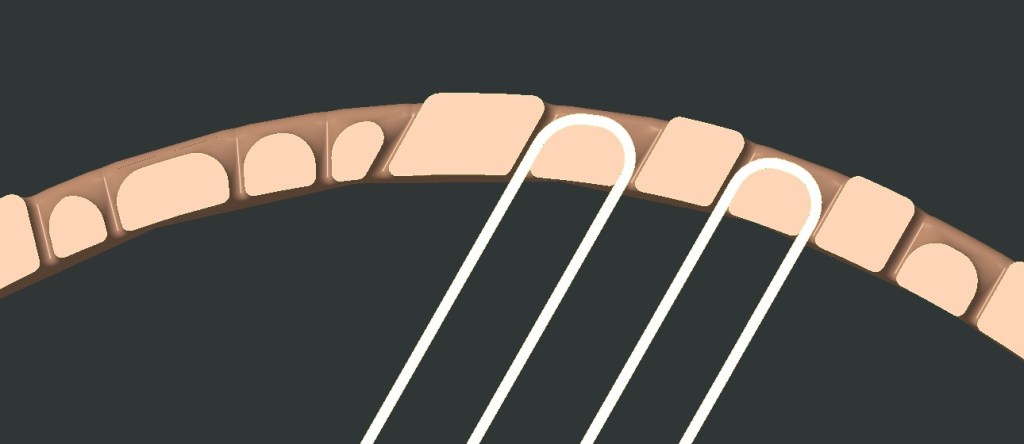
The total print time was about 12 hours. One of the standout features is the integrated rounded string holes, which replace traditional grommets. That not only reduces unnecessary components but also gives the stringbed a more consistent response. The project was a way to test what happens when you throw out legacy design assumptions and build a racket from the ground up using modern tools.
Tennis thing: Many ATP players still use racket designs that are more than a decade old, often under new paint jobs. Do you think racket technology has plateaued or do you see meaningful trends in design or construction that could still benefit players?
Miha Flisek: I don’t see any real leaps in racket technology happening right now. The core materials, like carbon fiber laminates, have been around for a long time, and most of the available geometries and design concepts have already been explored or exhausted. There’s not much on the horizon in terms of radically different materials that would offer meaningful improvements.
What we are seeing today, like the shift toward lighter and more powerful rackets, isn’t so much about technological progress as it is about adjusting to external changes, especially the balls. Balls have become lighter and less consistent, which makes it harder to get penetration through the court, so players are shifting toward rackets that help generate more pace and spin.
TO Stardust on court and ready for play.
The next real shift in racket design will probably come with the maturation of 3D printing technology, particularly once continuous carbon fiber printing becomes viable. That’s when we’ll finally be able to explore forms, layups, and mass distributions that are simply impossible to achieve with traditional molding techniques.
Tennis thing : What’s next for Impacting Tennis? What enhancements can we expect to see in TO Stardust v2?
Miha Flisek:That ties directly into the future of TO Stardust. Right now, with the current 3D printing materials and processes, it’s not quite at the performance level I want, at least not for professional-level play. The design itself showed what’s possible in terms of rethinking racket construction, like grommetless string transitions and integrated frame geometry, but to move to the next stage, we’re waiting for the technology to catch up, especially in terms of continuous fiber reinforcement.
When I saw TO Stardust’s grommetless construction, I knew Impacting Tennis was serious about innovation.
In the meantime, my focus is on consulting and helping players unlock performance through better equipment understanding and customization. I’m also exploring string design using a novel material that hasn’t been used in tennis yet. The long-term goal remains the same: use engineering and first principles to push tennis forward, not just follow trends.
Tennis thing: Thanks for participating, Miha. I will be posting my review of the Octo damper soon. I’ve been evaluating along with a trusted pro at my club. So far, I am really liking it, especially its amazingly light weight.
Yesterday, over a nice, crisp wheat ale (Rasenmäher-Bier [lawnmower beer]) at Enegren, I was waxing lyrical about how much my tennis game would improve if I was able to play with the MIB just once a week.
My ale-sipping companion wondered if my coach, Caesar, wasn’t able to fill that roll. His question revealed the difference between playing for the sheer joy of trying to hang in there, rather like riding a bucking bronco, as opposed to the steady, incremental block-on -block approach of a tennis coach intending to help a player build a complete game.
Outwardly, the best evidence of the kind of play that characterizes a lesson is preparation (anticipating and flowing toward the incoming ball) and executing the proper kind of stroke. It is simple, but simple is often not easy especially in tennis.
Playing with MIB stresses my game to its limits and beyond, but is also just plain fun. A great deal can be learned just by watching him move around the court anticipating and revealing entertaining angles to create.
Caesar would approve of the exercise but I think he’d want to both debrief and decontaminate afterward. I think I will always have the tendency to overhit in tennis, something I never did playing baseball and rarely did on the golf course. I can hear Caesar now, telling me to do all of the same things he has for the last two years. I will sometimes stop just to say that I hear him and that I appreciate what he’s saying and that I am trying my best to put his advice into effective action.
But, the tennis racket and tennis ball contact is simply too enjoyable not to occasionally crank up to 11. Catch that ball in the middle of the racket especially when accompanied by some well-timed movement into the shot and you have an experience that’s hard for me to resist, though I usually do.
Reading Anthony Verghese TheTennis Partner will always stand as a reminder of how rare the best tennis partners will always be. Enjoy it when you find yours.
I’ve only been playing tennis since late July 2023. But, since then I’ve owned a good number of rackets. Two of them came from the MIB (the 2013 Head Prestige Pro and more recently a Wilson Shift 99). The others I bought used, some on Ebay and a few on Craigslist.
The first variable to be considered was grip size. My first racket was codenamed Battle Axe. It was a Wilson Six One 100 and I really liked it but its grip was 4 1/2 and everyone thought it was just too big. It was, but I enjoyed playing with that racket anyway. I still miss it.
I made the move first to 4 1/4 and later to 4 1/8 to make it easier to use overgrips. Later I drifted back to 4 1/4 by way of a couple Tecnifibres (a TFight 300 and a 305). Overall, the racket that worked best and felt best was my 2018 Head Graphene Touch Prestige Tour. That’s the worst racket name I’ve come across but, all things considered, it’s the racket that has best fit my game and aesthetic.
Then I tried MIB’s Wilson Shift 99 and I was surprised at how easy it was to swing while still feeling solid on impact. At first, I was under the mistaken idea it was a Wilson Shift 99L which weighs 10.1 ounces (286.3G) but once I got it home I realized that when MIB identified it as the lighter one, he meant it was the 10.6 ounce (300.5G) version. Strung, and with my usual Sampras dampener, El Shifto weighs 316G, fully ten grams less than my Head Graphene Touch Prestige Tour. Months earlier, MIB had told me how much difference five grams can matter and here I was finding that eleven grams obviously means even more.
I do enjoy hitting with a heavier racket. It’s not unlike putting with a modern 350G putter as opposed to an 80s Ping putter that typically weighed less that 300G. Mass is your friend when you don’t need much absolute velocity or your don’t need to change directions quickly. I like to think my time playing tennis has made me stronger but I know it hasn’t. When I got started in tennis I was 62 and now I’m 64. I don’t want to deceive myself into thinking I’m defeating the effects of gravity or age.
So, the Wilson Shift has been instructive though I’m not wild about the 16×20 string pattern, plus, its grip is 4 3/8 which is a bit large, even without an overgrip. So, I’ve spent a few days looking for a racket that aligns with the Shift’s basic specs before I found the Head 2022 Instinct MP. It’s very close in terms of weight (the Wilson is a little more head light) and flex though while the Instinct’s head measures 100 sq in as opposed to the Head’s 99 sq in.
Once I get the Instinct, I will have the Head Prestige at 327G and the Head Instinct and the Wilson Shift at right around 315G. I’m pretty sure the 315G rackets will work better for my game. I’m not sure I’ll like them quite as much as the Head Prestige but I still feel a few steps closer to playing with the right racket for me,
The occasion of my family’s 2025 reunion presented an irresistible opportunity. With a little tweaking of flights, rental car and hotel we found ourselves in South Eastern Michigan with the Man in Black himself.
Looking south from the roof top of Plaza La Reina.
The last time the two of us shared a little time we found ourselves on the rooftop of Plaza la Reina in Westwood. The MIB had been generous enough to stay over an extra day so we could play tennis on my birthday. Plus, he got to have breakfast at Henri in Canoga Park, but that is a story for another day.
I think the last time I was in Metro Detroit I was a little kid and my family was on its way to Windsor Ontario and points further east. This time the focus was on MIB’s and his home in Farmington Hills. After we got in town, MIB generously asked if we wanted to go to Ann Arbor.
“Fuck no, brother. This trip is all about spending time with MIB in his native habitat.”
Just when you thought it was safe to step onto a tennis court with a confident stride, you see the MIB looking over the net at you. He’s a great player to warm up with. He likes to start close to the net, refamiliarizing his racket and hands to the variety of shots he likes to play. Then we hit soft volleys back and forth. Then we worked our way back toward the baseline and started to rally. That’s when the MIB Effect starts to take hold. It often seems like his feet don’t interact with the ground with the full force of gravity, he moves with such great ease. His strokes are fine, especially on the angles, but it’s always his footwork that is so fun to watch and listen to. Even the squeek of his Nike Air Zoom Vapor Cage 4 occurs at a higher pitch and amplitude than normal. I especially enjoyed returning serve from MIB (a minor strength of my game). In the end, though, playing with MIB is a reminder of the harsh differential between our games. Still, it was a lot of fun.
I thought about what it was like to play with MIB all the way home to Los Angeles. I knew there was no hope of reducing the differential to zero. Then again, that was never the goal. What I wanted to do was identify as many things as I could to improve in the specific areas that playing with MIB had exposed. So, I did what I always do. I asked my coach, Caesar, he with the unlimited answers to my limitless questions about tennis.
The first thing he said was to focus my attention on the racket of my opponent rather than simply on the ball as it crossed over the net and onto my side of the court. Caesar told me that would help me to identify the kind and the pace of the shot that was likely to be coming my way. That awareness was the first step in preparing for the shot I would need to play very, very soon.
Then he told me of the benefit to moving quickly early and slowing down into the shot. “Bad players are constantly running and stopping. Good players flow to the ball and flow toward their next shot,” he said. Of course, my coach had told me this many times before. But this time it was more urgency and relevant since I’d recently learned I was working too hard creating too little effective movement.
It came as no surprise that three days hanging with the MIB was just not enough. No sooner than we touched down at DTW it felt like we were on our way home. Though time was far too short, I’m glad we made the trip and look forward to sharing a tennis court with MIB again. I will be a little better prepared when that day comes.
I bought this booksolely to take advantage of free shipping at Tennis Warehouse. Remember readers, you have to spend money to save money. The book is superb, though perhaps mostly of interest to people like me who are intrigued by the technology, or what’s represented as technology, in tennis. I’ve spent my first year and a half in tennis trying different rackets and strings (not to mention grips and overgrips). At no time have I gotten the sense a given racket made or kept me from being a better player.
I have developed preferences that remain fairly consistent. The first is for a racket with a head size of 98 square inches. The second is for polys that are not strung too tight, always less than 50 pounds. Finally, I trend away from rackets designed to aid in power because, for all of my faults and weaknesses in tennis, I do not suffer from a lack of power.
Back to Cross & Lindsey’s book. Check out this quote:
TENSION AND PLAYER PERCEPTIVENESS Virtually every player assumes that he can tell the difference between different tensions. Some claim to be able to identify a difference of a pound or two. Tests have been performed that bring that claim into question. In a test of 41 advanced recreational players, only 11 (27 percent) could determine a difference of 11 pounds or less. In fact, 15 (37 percent) couldn’t correctly identify the difference even when the tension between two racquets varied by 22 pounds. A small number were able to discern a two-pound difference, however. Players were not allowed to touch the strings or vibrate them to guess tension, and each racquet had a vibration dampener to take away auditory cues.
Using earplugs to further dampen auditory cues lowered the success rates even more. Players were only allowed four hits with each racquet, so the only data the player was interpreting was feel, not an accumulated history of location of ball placement that could be used to deduce string tension. Some players said that they noticed a difference, but then incorrectly chose which racquet had a higher tension.
Auditory cues are huge but they’re not often a subject of conversation with most players so quick and confident to identify what they feel about string tension. I recall a similar test relating to golf. Many players reported that they prefered the feel of putters made from this material or that. But, when they wore earplugs they couldn’t differentiate even the most dissimilar materials or even construction techniques.
For me the question is this: Thinking of the average player is it beneficial to believe in the benefit of this string over that string, this tension over that or this racket over another? To jump ahead, I think using the correct racket (correct as regards weight, head size, stiffness) is very important for new, especially young, players. What I’m asking concerns average adult players. My experience leads me to conclude that it can be entertaining but is largely a waste of time for recreational players to believe that the right (or wrong) racket or string will relevantly affect their games.
With that said, identifying preferences is fine but I contend that mine have little affect on my game, and that’s Ok. I still like what I like. As they saying goes, you can either use the racket you like or the racket someone else likes. Just make sure to keep your focus on your game and not your strings and racket. By the way, I’m not done writing about this book. It’s much too interesting so stay tuned. Tt
A couple weeks back I was lucky enough to catch a couple lessons with Laura Sax at Del Norte in Sacramento. Laura is a super tennis coach. I always try to show up with a specific issue so my lessons with her can exist in kind a parallel universe to what Caesar and I continue to work on.
As we drove from Los Angeles I tried to come up with something. What I finally came up with was my need for more consistency when I’m serving. So, Laura asked to see me hit a few serves.
She said, “Those are kinda Ok. Lotsa pace. Now, show me your second serve.”
I looked down at the court and sighed, “I don’t have one.”
Laura said, “Well, show me what your second serve would look like if you actually had one.”
I sighed again.
Then, I hit something like a flat serve with the pace turned down. It hit the net with authority. Kind of…
Laura said, “Ok, follow me up to the net.”
Over the next few minutes she had me first hit the ball over the net with the edge of the frame while choking up on the racket. That’s not as easy as it sounds, by the way. Then, Laura had me hti the ball over the net with only a downward snap of the wrist. As with an overhead, this was done without the arm or torso bending forward, or following through. A secondary object of the game was to have the ball hit inside the service box, so a distinctly downward strike was in order.
It was kinda fun. I spent much of the rest of the lesson hitting those spikes from the net and out toward the back of the service box on my side of the net. It wasn’t until Laura had me back up to the baseline that I saw the point of the entire exercise. I was hitting a slice!
Who knew?
As the racket snapped, it also rotated left with the ubiquitous pronation that everyone is so excited about. The force of the strike was a combination of the wrist snap multiplied by the racket’s rotational energy. The result, when the ball was struck as the racket was driving forward but still not completely open (read: flat), was a serve with rotation that curved it left (from me) a right handed player.
I’m not very bright so it was not until that very minute that I understood what the totality of the exercise was about. As I said, Laura is a fantastic coach.
On the long drive home I tried to reimagine the movements and, more importantly, the feelings of my two lessons with Laura. I had a fairly decent grasp of what I was trying to achieve but as with all things tennis the goal was fogged by age and lack of significant athletic ability. Still, when I got home I could still feel it although I was triyng to hit the ball too hard (don’t I always?).
Then I remembered something else Laura said. She said that when serving the wrist should be completely at ease and the racket held with the very lightest of grip.
Now, let me tell you why this made sense:I have always, and I mean always, since the time of my first serve, had a difficult time warming up with my serve. I can throw a baseball softly enough that a newborn could catch it with his offhand (Ok, maybe that’s an exageration) but you get the idea. In contrast, I have a very difficult time warming up to serve. My motion, and the overall pace of my early serves are, far too fast and too hard. Who knows why?
But, when I deliberately keep my arm, wrist and elbow relaxed I can hit early serves at Speed 1 and then Speed 3 and so on. It is almost as if I can coordinate the speed better because I am managing the tension (or lack) in my serve (note that I do not write, hitting) arm. Simple, but remember that simple does not always equal easy. Perhaps it never does.
Then, and I hope this doesn’t appear to suplant Laura’s contribution but I stumbled on this video by Patrick Mouratoglou. The looseness or softness is counterintuitive to someone like me who was born to throw a baseball (5.25 ounces at the end of the fingertips) rather than strike a tennis ball (2 ounces, plus or minus) overhead and with an added 27 inches of the racket.
Yes, it’s still (obviously) a striking motion but a very different one.
So, there I am and happy to be there. I have been playing tennis since September of 2023 and I now have a developing the tiny bud of a second serve. Now that wasn’t so hard, now, was it? Tt
I learned about tennis professional Long Dao while researching an article about the rise and fall of the Pierce College tennis team. I have come to think of community colleges like Pierce as stepping stones for students who lack something they need to go directly to a four-year college or university. Sometimes what’s lacking is financial, other times it’s academic and often it’s a combination of things that bring students to a school like Pierce. As a guy who went from Pierce to UCLA, I’m very grateful the school was there for me in all the ways it was. As I think back on the professors I had both at Pierce and UCLA I am pleased to think that, in many ways, it was the professors at Pierce who had the most consistently positive impact on me.
I didn’t play intercollegiate sports while I was at Pierce but I knew they had a great tennis team. By the way, I went to Pierce in 1980 so we’re talking about a good long while ago. Finding out Pierce no longer had a tennis team was a real shock to me. You see, a couple years back I took up tennis and this has brought me to consider a lot of tennis playing what-ifs, one being a musing about playing tennis for Pierce back in the 80s.
But, let me connect my first thoughts about community colleges generally to intercollegiate sports. It is more than a shame that Pierce College does not have a tennis team. To me, it points to an institutional failing that may be centered at the Los Angeles Community College District or it could be a home-grown failing with the administration of Pierce College in Woodland Hills. No matter. It is a very unfortunate example of Pierce College failing its students.
Even though we’ve just reached the day when colleges are able to directly pay their so-called student athletes it’s important to acknowledge that only the most elite athletes playing for the highest-profile colleges are likely to see much of anything in terms of financial compensation. One can argue this an elevation of student athletes at all schools but I would argue that what it really does is create an even greater separation between elite athletes and the kind of true student-athletes who have always been a part of competitive sports at schools like Pierce, or even Division III athletes. More is the pity.
I am very grateful that Long Dao, the last coach of Pierce College, has been generous enough to be interviewed by Tennis thing.
Thank you, Long!
Coach Long Dao with student athletes at Pierce College, 2019 (Photo by Chris Torres)
Tennis thing: Tell me a little about how you got started in tennis. Who got you into the game and where did you first play?
Long Dao: My first exposure to tennis was around when I was five or six years old when my family (aunts, uncles and cousins) would play and I would tag along. But I never did any serious training until I got to high school. Essentially, I did not start my tennis career until I was 14 years old.
Tennis thing: By the time you became a student at Pierce, had you ever heard of Coach Paul Xanthos?
Long Dao: I had not heard of Coach Xanthos until the first day of fall practice when I joined the team in 2005.
Tennis thing: How long did your own playing career extend? Did you continue to play while you finished your education at UNLV and Long Beach?
Long Dao: Competitive tennis ended for me right around when I transferred to UNLV. I may have played a few tournaments here or there but training and regular tournaments practically ended around then.
Tennis thing: I know you were an assistant at Pierce before taking over the team yourself. What were the most important lessons you learned from Coach Xanthos? Also, what did you have to learn for yourself the hard way, from your own coaching experience?
Long Dao: Simplicity. Coach Xanthos would always try to simplify the game for us as players. That is something to this day I try to do for my students.
As a player, I was always one to drill and drill, be extremely repetitive in training, till I reached my goals, whether it was to perfect a shot or execute patterns. I was relentless in how I went about that. I have come to learn that many students, especially the younger players that I have worked with, learn and process things differently than I do. So being able to change teaching styles to reach and connect with different players was something that I had to learn over time.
Tennis thing: I didn’t know Pierce was forced to abandon their tennis program until earlier this year and I was very disappointed. As I point out in my article, it was hard to believe a school with an enrollment as large as Pierce could not field a team. I know it’s ancient history now but do you think Pierce valued its tennis history enough? Could the school have done more to keep a team under the school’s banner?
Long Dao: Short answer, no. I have some of the fondest memories there as a player and coach. I have had the pleasure of meeting wonderful people there from teammates, players and staff members to fellow colleagues and coaches from Pierce and other schools, many of whom I’m friends with to this day. Some of my favorite coaching memories happened there, taking the team from last in the conference to challenging for the conference team title and winning an individual conference doubles title.
But, it was shortly after that accomplishment I learned tennis at Pierce was, sadly, not valued as much as I had hoped. It simply was another class that was offered and if it does not generate the revenue from enrollment or participation than, like many other classes or offerings at the school, the program will end up getting cut.
Tennis thing: I’m sure it’s very different for you, being a tennis professional, rather than coaching a group of college students. Do you miss coaching a team and can you see yourself coaching at the college level down the road?
Long Dao: There are some aspects of coaching a team that I miss and others I don’t. Will I ever coach another college team? I honestly don’t know.
A couple days ago, I stood at the net with my new Monday hitting partner, George. I was helping him with his ball striking. No, not his tennis ball striking but his golf ball striking. My instruction is not what’s interesting about the story. George was talking about playing a local course, the Moorpark Country Club. I winced, knowing what I did about his game. I tried, subtly, without saying he wasn’t nearly good enough to play that course, to convey that golf should be played only on courses that a player can handle.
“Tennis is different,” I said. “Look at this court. It’s the same size a every tennis court you can name. Even Pope Leo XIV’s court is the same size as every other tennis court though we cannot be sure of the dimensions of Pope Julius III’s court (1550-1555) since it no longer exists.”
Even though the popularity of tennis, at least in the United States, rises and falls, tennis courts are everywhere. Nearby Pierce College in Woodland Hills has nine tennis courts for its 20,000 students. What it doesn’t have is a tennis team.
Pierce’s Tex Smith, 1962. Photograph by George Birch.
Founded in 1947 at the Clarence W. Pierce School of Agriculture, Pierce has been home to some great tennis teams and tennis players. Its first team hit the scene in 1961 and by the late 1970s Pierce was a local tennis powerhouse. Coached first by Nick Buzolich, a 6′ 7″ alumnus of Pepperdine, himself a fine tennis and basketball player. Buzolich lost in the quarter-finals of the U.S. Clay Court Championships to Pancho Segura. Early players for Buzolich included Steve King and Tex Smith, both valley boys.
Starting in 1965, Paul Xanthos took over the Pierce team for the next 30-plus years. By 1995 the team had amassed a record of 550-94. I attended Pierce from before the time I graduated from high school in 1979 until I transferred to UCLA in 1981. I can remember seeing the name Xanthos on virtually everything on campus that had anything to do with tennis. He was a walking institution and has been recognized by both the USPTA and the Intercollegiate Tennis Association.
By 2005, the Pierce team was led by a former student of Xanthos, Long Dao. A year later, Xanthos died in Hidden Hills. From then until 2020, Dao caoched the team. As late as 2018, the program had success in sending players to the The Ojai Tennis Tournament with the entire roster nearly advancing to the competition. Darvel Lossangoye went the farthest in the singles competition reaching the Round of 16. The 2018 Pierce team finished the season 7-4.
Days before the team’s February 2020 opener, Interim Athletic Director Susan Armenta made the decision to pull the plug. “Looking at the previous seasons, when it came to the facilities and participation, it made the most sense to drop the program and not pursue another season using some of the resources that we have,” Armenta said. The previous season, Pierce tennis was disqualified heading into every match because of their player shortage. The era of Pierce tennis that spanned from 1961 until 2020 had come to an end.
As a Division III school, Caltech does not offer athletic scholarships. But, with a total undergraduate enrollment of right around 1,000 the school is able to field a men’s (and women’s) tennis team. I know, I’ve seen them play and there are some excellent players on Caltech team of eight. As I noted above, Pierce College has something around twenty times the number of students as Caltech, but no tennis team.
Despite these facts, the then-Dean of Athletics Genice Sarcedo-Magruder said one of the reasons the program was dropped is because of the low enrollment. “The athletic programs are also classes,” Sarcedo-Magruder said. “If there are less than 15 students they tend to get cut, so that is part of the challenge. Our facility is not that good so when you bring in players and they see the courts, they would get discouraged.”
That last sentence is what really motivated me to research and write this. When we think of Pierce we are thinking of eighteen to twenty year olds who lack either the academic preparedness or money to attend a four-year college or university. To believe that population would show up at Pierce, see its nine courts and then move on strains credulity. For reference, Division I UCLA has three tennis courts at its much-vaunted Los Angeles Tennis Center.
Obviously, the issue is not that simple. But, I fear the essence of the problem is far deeper. Pierce College doesn’t need elite athletes. It needs true student athletes. I’m disappointed in the school’s inability to generate enthusiasm for a once-great program that made its mark decades ago. Is it too much to ask for the administration to do all it can to show how those past successes can lead the school to a future that includes tennis? Tt








 Tennis thing