I really enjoy taking one-off tennis lessons. I like to see how I will respond and I also like to see how a tennis pro facing the challenge of helping a student they are unlikely ever to see again faces the challenge. This time the fun took place during an unusual heatwave that made it all the way to California’s Central Coast where we have had a four-day getaway planned for months.
The pro was a lefty and even older than me, if you can imagine. I was quite upfront that I was looking for someone to rally with but that instructive comment was always welcome. The rally lasted all but five minutes before the question, “Can you slice your forehand?” I said I could but found the shot less than common. Sure, it’s fun but it’s seldom needed or effective. But, I was game so I hit a few to show the shot was no problem for me
Here’s where things got weird. The coach wanted to talk about the split step. It seems that a lot of his students land flat footed when asked to split step. He then asked if I knew about split step and float? I confessed that I did not. The coach went on to say that split step and float means the player lands on one foot, so as to aid their ability to move in that direction.
No.
That’s what I said, for a couple reasons. First, how is the player supposed to know which direction they need to know at the moment they split step? Second, the idea of hopping off both feet and landing on one seems like an unwise practice.
Sorry.
After the lesson I really felt badly. You see, the coach had hit on two genuinely good points. The first was a more level driving motion on high bouncing one-handed backhands. The second was to use the ball point to rotate the off arm toward the striking arm to aid in spacing. Both of those thoughts worked great.
Yup, I would take another lesson from this guy.
Yes, I think he was dead-wrong about the split step.
Yes, I learned something during the lesson and I enjoyed myself.
About a month ago, I was playing with Pasadena Steve when he lobbed me—successfully, as it turned out. I say as it turned out because I got to the ball in plenty of time. The problem was that I was still going back, well beyond the baseline, waiting for the ball’s first bounce to finally be in the zone for an overhead. It was the first time we’d ever played on this court and there was a lot going on. The adjacent court was full of kids taking a group lesson. A couple parents were using our court’s bench to watch their kid.
Worse, as I moved back for the ball I had the sense I was getting close to the fence. I was, but I wasn’t so close that my next step would have me crashing into it. At the moment I was slowing down and raising my racket above my head, I lost my footing.
It was a classic case of tanglefoot.
I knew I was going down, but there was little I could do about it other than try to roll into my right side as gently as possible. I hit with the right front of my right knee, then the outer part of my right knee and then my right hip before settling onto my back to appraise the damage. My hip hurt and my knee started to sting. Then I realized I was bleeding from another abrasion on my right elbow. But, overall I felt Ok, so I got back on my feet. By then I could hear Pasadena Steve—three years older than me—calling out to see if I was Ok.
In the moment, I considered asking him if I looked like a big fucking baby. Instead, I picked up the ball and fed him a forehand.
“Right back on the horse,” Steve called.
Yup.
Steve’s a nice guy. He’d just finished reading my first novel and had pages marked with Post-its so he could remember his questions. As I drove him home, I felt just a little shocky, like I had just been in a fender bender.
My elbow was still bleeding but Pasadena Steve went on asking questions:
Now, was Ally based on a little girl you knew?
Me: “Yeah, she was based on a kid my ex-wife taught, second grade, as I recall. Her name was Daisy and she had terrible asthma yet her idiot parents both smoked at home in their tiny two-bedroom apartment.“
And what about the name, Gerry Garcia?
Me: “I wanted a name that was a little odd, Gerry with a G, and Garcia, vaguely Spanish sounding yet the guy’s a pale-skinned redhead. So, nothing really fits Gerry Garcia, not even his name.”
Steve’s what I call a kindly and gentle reader. Even though he reads a great deal (he’s in three book clubs) he’s not jaded. He’s still ready to enjoy a new book on its own terms.
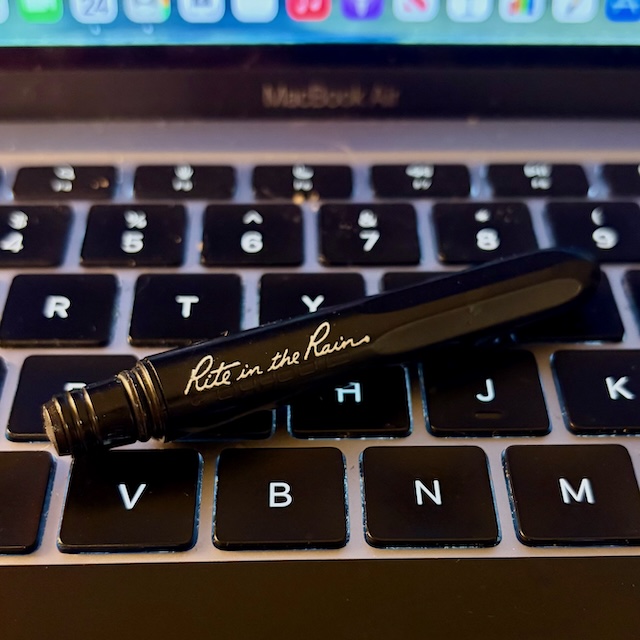
When I pulled up in front of his condo, Steve asked me to sign both copies of the books I’d given him. I pulled out my trusty N°BK92 All-weather pocket pen and composed inscriptions while my elbow oozed blood. I’m really sorry I didn’t manage to sign my name in blood. As I drove toward home, I was especially thankful we would be in time for the end of happy hour at our beloved T. Boyle. In my book, a tumble on a hard court earns a bourbon. And if one is good, two are better.
I was very grateful I hadn’t hurt myself. I couldn’t remember the last time I fell on something as hard and unforgiving as a tennis court. Decades, for sure. As much as I don’t want to do it again, I was impressed that I’d gotten away with it even once. The abrasions are pretty much healed now. I still have a bit of tenderness in my right hip. The strangest part is the stubborn pain in my right side. At first I thought my right elbow had been driven into my ribs but the pain wasn’t exactly in my ribs. It’s still hard to sleep on my right side. No matter where it was, I was very happy I didn’t have to sneeze a single time over the next couple weeks. It would have hurt.
Which brings me back to gratitude. And to the fundamental constant in tennis: uncertainty. Lord willing, as my father would say, I will be 65 in a couple months. As much as I hope to avoid another unplanned trip to the court’s surface, I am undeterred. Tennis and I are good. We’re both worth it, come what may. Tt
Kimony could be my favorite tennis accessory brand. There’s just something about companies like Kimony with just the right vibe (no pun intended). Plus, tennis accessories like grips, tools and dampeners can be so engaging on a personal level. As someone who has done a lot of business in Japan, both in my previous marketing life in high-end audio and later in golf, I appreciate the ethos of Japanese companies, especially small ones like Kimony.
They know what they’re about.
They know what matters to them and they know how to make it.
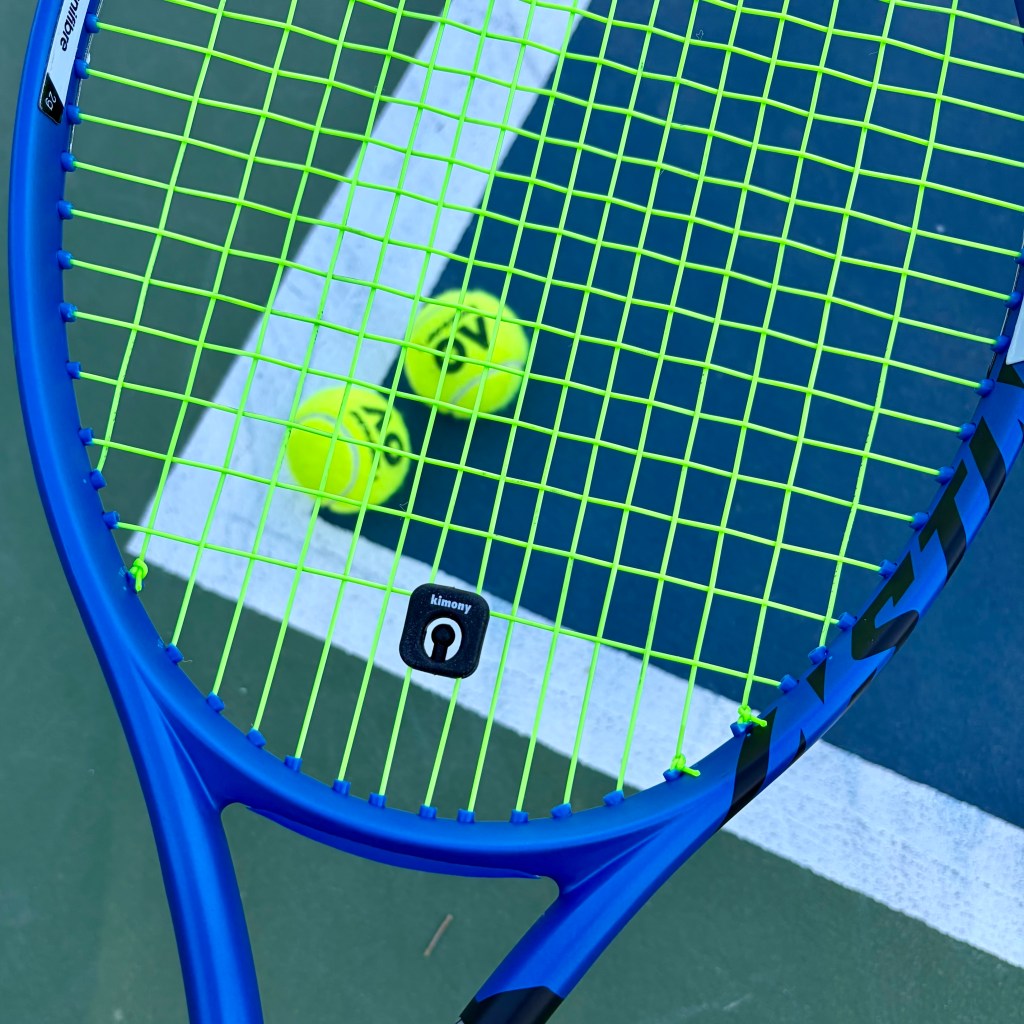
I think I’ve used most of Kimony’s replacement and overgrips and each has been excellent, at least on par with offerings from much larger companies with more familiar names. But, this is my first experience with their dampener, The Quake Buster (or how I wish I could use the iOS Text Effects to make the letters in Quake explode!). As usual, I was first attracted to the available colors (I chose clear and black). But I had another motive respective to trying the Quake Buster and that was the way it attaches to the racket at the top and sides and the fact that it’s basically square (so as to maximize string contact) and also the fact that the experience of others who wrote about their experience with the Quake Buster state that the dampener is quitesoft.
The words quite soft translate to a thermoplastic that has a fairly low durometer (the lower the durometer the softer and more maleable a material). Harder dampeners (like Head’s)lack significant compliance to dampen much of anything. That said, the design of a dampener like the RTP Shocksorb may have gone too far, with a durometer that’s simply too squishy (and heavy). The question is whether the Kimony Quake Buster gets it just right.
The Kimony Quake Buster in my Head Instinct MP
The Kimony packaging has some copy on the back so I had a buddy of mine in Japan translate for me:
Beforeimpact, the mushroom, which was in a stationary state relative to the Quake Buster main body, moves its head in the direction of the ball due to inertia at the moment of impact.
After impact, while interfering with vibrations from the strings and other sources, it absorbs (dampens) vibrations in all 360-degree directions.
In other words, the mushroom works in a truly magical way.
Come on, a magic mushroom! This is obviously the very best quality ever when it comes to a tennis string dampener. Seriously, I think the Quake Buster is a very well-executed product. The way it attaches to the strings, its shape and perhaps most importantly the durometer of its thermoplastic make it an excellent dampener. The sound isn’t dull but retains a slightly resonant thunk that is quite pleasing.
Yeah, I know. Stew looks a little intense here. But stay with me while I fill in the blanks. A year or so ago I was hitting serves at The Rose Bowl Tennis courts right here in Pasadena. Suddenly I hear a voice over the ANC of my Apple AirPod Pro.
“Hey mate, you wanna have a little hit?”
Now remember I was beginner at the time (I still am, when you get right down to it). That was the first time anyone had ever asked to hit with me. Truth be told, I didn’t want to. Of course, I said, “You Bet!” In my ears rang the words of the MIB. “Paulie, you’re going to have to put yourself out there to meet people to play tennis with!”
First time and last time, hitting balls with Stew was an adventure. He hit the ball great and moved lots better than me being a couple years younger and much fitter. But, there weren’t untold miles between us and I never felt like Stew was bored by hitting with me, at least that’s how I want to remember it. After our hit, I asked Stew what his deal was and he told me he flew the Qantas route from Brisbane to LAX. That put him in Pasadena from time to time, usually for three or four days.
So, every now and then I’d get a text or email from Stew and we’d meet up at the Rose Bowl and give the ball the old what for, or what Stew called, the full treatment. We rallied a lot and played some. I was overjoyed to have held my first serve but over time Stew would grind me into dust. But, the grinding process was fun and educational. Stew plays a lot of doubles so whenever the opportunity arose, he’d come in. After this happened a few times I noticed he was waiting to play a forehand volley at a sharp angle. Once I grasped this pattern I tried to make sure never to give him a shot he could hit with his forehand when he was approaching the net. So was born my earliest awareness of tennis tactics en situ.
We had some good chats. I liked to ask him about where he lived and how he came to be a pilot. He told me about his club and how he liked to work on his diesel Jeep. Stew was like me. For us, it was never too hot or windy or cold to play. When it was time for me to go, Stew would scan the courts looking for someone else to hit with. Looking back, I wish I had freed up more time to play when Stew was in town. I was especially sorry to have missed Stew when he wandered his way to the San Marino Tennis Club looking for a hit. The guy was ready to hit anywhere and with anyone.
The end came, as it always does. A few weeks ago I reached out to Stew, asking when he’d be in Pasadena. He sent a message that said his route had changed planes to the Boeing 787 and absent a very unlikely development, he wouldn’t be flying the Brisbane to LAX route anytime soon. Sigh.
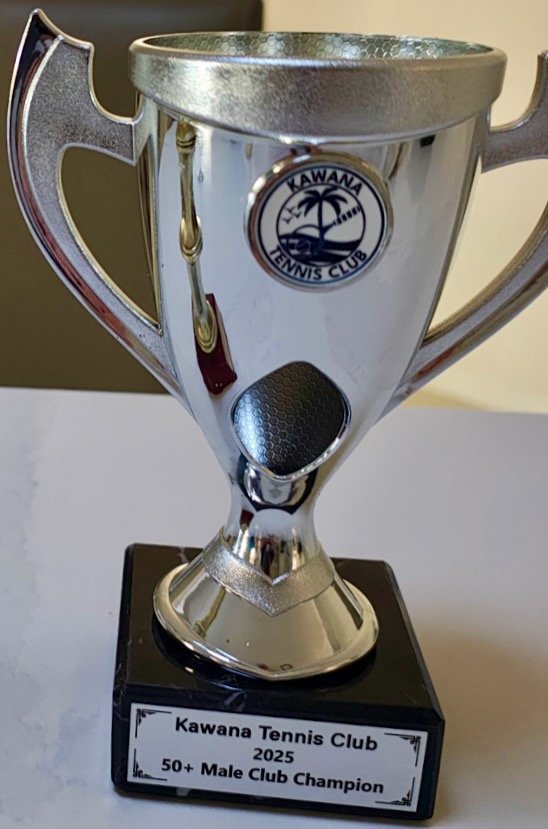
Then, a few days ago, I got this photo from Stew. He had won his club’s, The Kawana Tennis Club, Over-50 Men’s Singles Championship (I told you he was good!). Of course, I’m happy for Stew and he told me he was chuffed. Still, I miss Stew and miss playing with him (in that order). I don’t know how it could happen but I hope our paths cross again. Stew’s a great guy to play tennis with and he taught me a lot without even trying.
As those of you who have read Tennis thing know, I owe my tennis to my brother, MIB. He was the one who told me, before even meeting me in person, “Paulie, you would love tennis.” MIB was right, as he so often is. What I doubt, though, was that MIB would have expected how long I would take my twice-a-week lessons with my coach, Caesar Schwarz. It’s been a bit over two years since I started studying tennis with Caesar. I didn’t start out studying the game, I think it became a study gradually, but it is what tennis remains for me.
What’s the diff, you might be asking? Think back to playing dodge ball when you were a kid. How long was it between your first hearing of the word dodge and the moment when someone was chucking a ball at your head? Most games are learned as they are played. Many people, most people, likely, learn terms by playing it.
But, I have not. I have learned to play tennis while studying it. I like to watch tennis played whether I am watching a WTA or ATP pro or a little kid with marvelous footwork.
And, I love to hit the ball.
What I have not focused on is competition. This is true partly because at my age I am not especially competitive. I’m not even in a competition with myself, to be honest. I want to play tennis correctly out of a motivation to master something at once new and satisfying. That’s an intoxicating combination. But, the question is does the person on the other side of the net count and is anyone keeping score? When Caesar is the guy, he matters. It’s the precision and intentionality of his play that allows me the physical and mental opportunity to learn. He has raised me since I was a 60+ year old tennis newborn and has been instrumental to everything I’ve learned. If any elements of my game are AOK, it’s because of my coach.
But, and this is something I mused about in Tennis thing, does one need to play tennis, keep score, enter tournaments, seek the humiliation of their opponents to really play tennis?
There’s this old broad at Calabasas who seems only to hit with whichever pro is available. I have never seen her playing with anyone other than a coach. There’s no serving and each coach tends to hit the ball directly toward the old broad. But, the old broad bashes the ball back with fierce effort and likes to collect winners. And, this brings me to this quote:
“Some people, they keep on working with a coach, but the coach is just teeing the ball up for them. That’s no way to learn tennis. This is how you learn the game, right here.”
The previous quote is from Brisbane Stew. He’s a Qantas pilot I met at Pasadena’s Rose Bowl tennis courts. Unlike me, he has scads of tennis experience and is quite fit for 60. Unfortunately, he just told me the Qantas Brizzy to Los Angeles route is now flown using the Boeing 787. Unless Stew changes aircrafts I won’t be seeing him soon. Bummer. Playing with him was always amusing and educational. Back to his quote. He’s not wrong. Playing with him or MIB is not as easy as playing with Caesar but there’s more to it than that.
I have mentioned before that an example of Caesar‘s particular genius is the ability to hit shots that are consistently challenging for me, but only rarely beyond my capabilities. The other day, I was watching as he served to an elderly, but very fit student. Caesar had to abbreviate no fewer than three elements of his motion, that I could see, in order to hit a serve that was challenging to his student but not overwhelming. Now, can I imagine that I could get better faster if I consistently played with someone like Stew or MIB? I think the answer is undoubtedly, yes, especially if better is defined by advanced competitive ability. However, there’s a significant caveat. And that caveat involves the questions of form and balance. When the ball is coming too fast or bouncing too high or has been hit too wide or too shallow or too deep the kinds of corrections a beginning player like I have to make must ofetn be done in great haste. Not surprisingly, great haste, seldom results in a shot struck with good form or balance. And, there’s the rub, at least for me.
It’s a great understatement to say that I’ve enjoyed the meditative aspects of tennis. You see, I am on the eve of cutting back on my lessons with Caesar. This change is driven solely by economics. If a small shitpile of cash were to drop onto my head, I would gladly spend it on more frequent and longer lessons with Caesar, but this does not seem likely.
Early on, I remember Caesar saying that when he and his younger brother, Darius, were taking tennis lessons as kids their family could only afford one lesson each month. Caesar’s dad was a smart guy because he made sure that his sons actually practiced what they were taught during their lessons. That’s my plan and I will be similarly dedicated even though I will still be having four lessons a month. Still, I’m not going to be happy about it.
When I go to sleep at night I am thinking about my footwork as I move toward a deep, high-bouncing back hand. I’m not thinking about how I can beat someone or keep them from beating me. It will be interesting to see how things differ and stay the same in 2026. Tt
I’ve only been playing tennis since late July 2023. But, since then I’ve owned a good number of rackets. Two of them came from the MIB (the 2013 Head Prestige Pro and more recently a Wilson Shift 99). The others I bought used, some on Ebay and a few on Craigslist.
The first variable to be considered was grip size. My first racket was codenamed Battle Axe. It was a Wilson Six One 100 and I really liked it but its grip was 4 1/2 and everyone thought it was just too big. It was, but I enjoyed playing with that racket anyway. I still miss it.
I made the move first to 4 1/4 and later to 4 1/8 to make it easier to use overgrips. Later I drifted back to 4 1/4 by way of a couple Tecnifibres (a TFight 300 and a 305). Overall, the racket that worked best and felt best was my 2018 Head Graphene Touch Prestige Tour. That’s the worst racket name I’ve come across but, all things considered, it’s the racket that has best fit my game and aesthetic.
Then I tried MIB’s Wilson Shift 99 and I was surprised at how easy it was to swing while still feeling solid on impact. At first, I was under the mistaken idea it was a Wilson Shift 99L which weighs 10.1 ounces (286.3G) but once I got it home I realized that when MIB identified it as the lighter one, he meant it was the 10.6 ounce (300.5G) version. Strung, and with my usual Sampras dampener, El Shifto weighs 316G, fully ten grams less than my Head Graphene Touch Prestige Tour. Months earlier, MIB had told me how much difference five grams can matter and here I was finding that eleven grams obviously means even more.
I do enjoy hitting with a heavier racket. It’s not unlike putting with a modern 350G putter as opposed to an 80s Ping putter that typically weighed less that 300G. Mass is your friend when you don’t need much absolute velocity or your don’t need to change directions quickly. I like to think my time playing tennis has made me stronger but I know it hasn’t. When I got started in tennis I was 62 and now I’m 64. I don’t want to deceive myself into thinking I’m defeating the effects of gravity or age.
So, the Wilson Shift has been instructive though I’m not wild about the 16×20 string pattern, plus, its grip is 4 3/8 which is a bit large, even without an overgrip. So, I’ve spent a few days looking for a racket that aligns with the Shift’s basic specs before I found the Head 2022 Instinct MP. It’s very close in terms of weight (the Wilson is a little more head light) and flex though while the Instinct’s head measures 100 sq in as opposed to the Head’s 99 sq in.
Once I get the Instinct, I will have the Head Prestige at 327G and the Head Instinct and the Wilson Shift at right around 315G. I’m pretty sure the 315G rackets will work better for my game. I’m not sure I’ll like them quite as much as the Head Prestige but I still feel a few steps closer to playing with the right racket for me,
The occasion of my family’s 2025 reunion presented an irresistible opportunity. With a little tweaking of flights, rental car and hotel we found ourselves in South Eastern Michigan with the Man in Black himself.
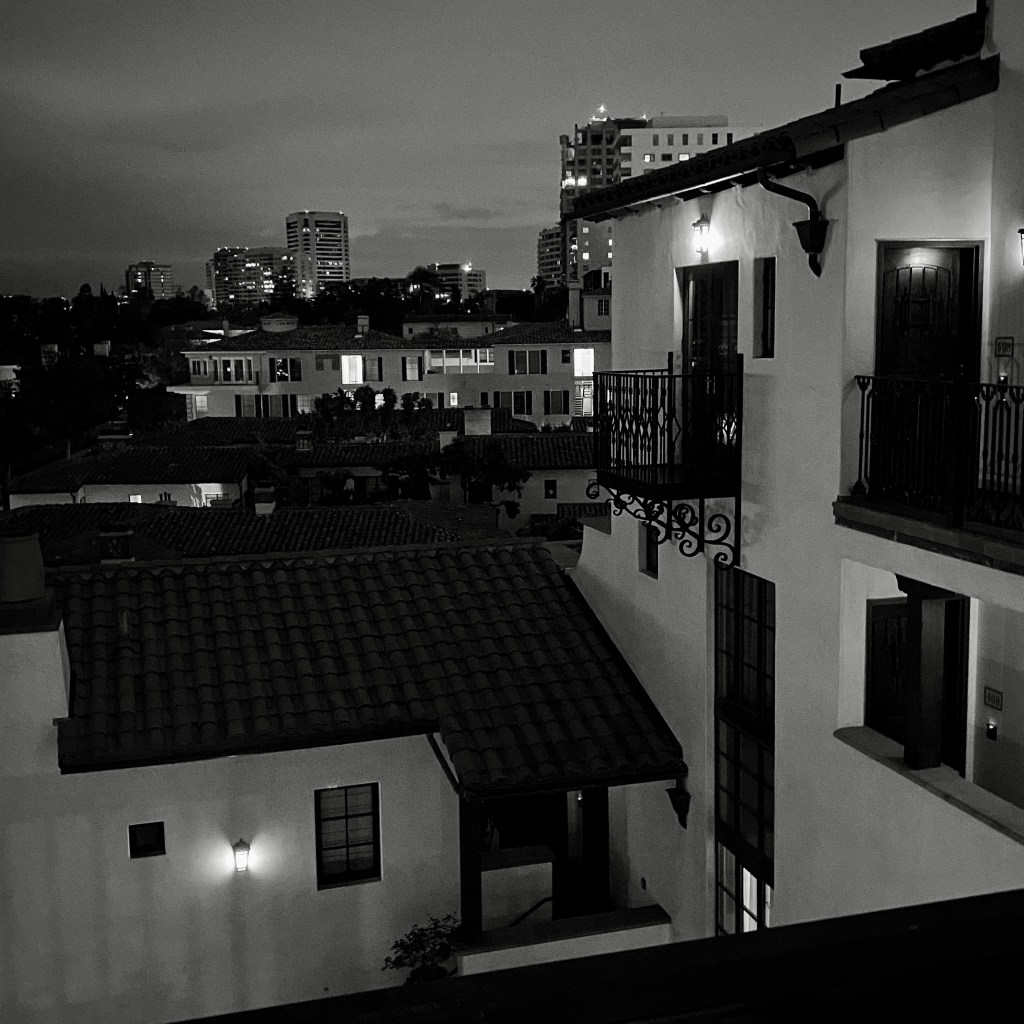
Looking south from the roof top of Plaza La Reina.
The last time the two of us shared a little time we found ourselves on the rooftop of Plaza la Reina in Westwood. The MIB had been generous enough to stay over an extra day so we could play tennis on my birthday. Plus, he got to have breakfast at Henri in Canoga Park, but that is a story for another day.
I think the last time I was in Metro Detroit I was a little kid and my family was on its way to Windsor Ontario and points further east. This time the focus was on MIB’s and his home in Farmington Hills. After we got in town, MIB generously asked if we wanted to go to Ann Arbor.
“Fuck no, brother. This trip is all about spending time with MIB in his native habitat.”
Just when you thought it was safe to step onto a tennis court with a confident stride, you see the MIB looking over the net at you. He’s a great player to warm up with. He likes to start close to the net, refamiliarizing his racket and hands to the variety of shots he likes to play. Then we hit soft volleys back and forth. Then we worked our way back toward the baseline and started to rally. That’s when the MIB Effect starts to take hold. It often seems like his feet don’t interact with the ground with the full force of gravity, he moves with such great ease. His strokes are fine, especially on the angles, but it’s always his footwork that is so fun to watch and listen to. Even the squeek of his Nike Air Zoom Vapor Cage 4 occurs at a higher pitch and amplitude than normal. I especially enjoyed returning serve from MIB (a minor strength of my game). In the end, though, playing with MIB is a reminder of the harsh differential between our games. Still, it was a lot of fun.
I thought about what it was like to play with MIB all the way home to Los Angeles. I knew there was no hope of reducing the differential to zero. Then again, that was never the goal. What I wanted to do was identify as many things as I could to improve in the specific areas that playing with MIB had exposed. So, I did what I always do. I asked my coach, Caesar, he with the unlimited answers to my limitless questions about tennis.
The first thing he said was to focus my attention on the racket of my opponent rather than simply on the ball as it crossed over the net and onto my side of the court. Caesar told me that would help me to identify the kind and the pace of the shot that was likely to be coming my way. That awareness was the first step in preparing for the shot I would need to play very, very soon.
Then he told me of the benefit to moving quickly early and slowing down into the shot. “Bad players are constantly running and stopping. Good players flow to the ball and flow toward their next shot,” he said. Of course, my coach had told me this many times before. But this time it was more urgency and relevant since I’d recently learned I was working too hard creating too little effective movement.
It came as no surprise that three days hanging with the MIB was just not enough. No sooner than we touched down at DTW it felt like we were on our way home. Though time was far too short, I’m glad we made the trip and look forward to sharing a tennis court with MIB again. I will be a little better prepared when that day comes.
A couple weeks back I was lucky enough to catch a couple lessons with Laura Sax at Del Norte in Sacramento. Laura is a super tennis coach. I always try to show up with a specific issue so my lessons with her can exist in kind a parallel universe to what Caesar and I continue to work on.
As we drove from Los Angeles I tried to come up with something. What I finally came up with was my need for more consistency when I’m serving. So, Laura asked to see me hit a few serves.
She said, “Those are kinda Ok. Lotsa pace. Now, show me your second serve.”
I looked down at the court and sighed, “I don’t have one.”
Laura said, “Well, show me what your second serve would look like if you actually had one.”
I sighed again.
Then, I hit something like a flat serve with the pace turned down. It hit the net with authority. Kind of…
Laura said, “Ok, follow me up to the net.”
Over the next few minutes she had me first hit the ball over the net with the edge of the frame while choking up on the racket. That’s not as easy as it sounds, by the way. Then, Laura had me hti the ball over the net with only a downward snap of the wrist. As with an overhead, this was done without the arm or torso bending forward, or following through. A secondary object of the game was to have the ball hit inside the service box, so a distinctly downward strike was in order.
It was kinda fun. I spent much of the rest of the lesson hitting those spikes from the net and out toward the back of the service box on my side of the net. It wasn’t until Laura had me back up to the baseline that I saw the point of the entire exercise. I was hitting a slice!
Who knew?
As the racket snapped, it also rotated left with the ubiquitous pronation that everyone is so excited about. The force of the strike was a combination of the wrist snap multiplied by the racket’s rotational energy. The result, when the ball was struck as the racket was driving forward but still not completely open (read: flat), was a serve with rotation that curved it left (from me) a right handed player.
I’m not very bright so it was not until that very minute that I understood what the totality of the exercise was about. As I said, Laura is a fantastic coach.
On the long drive home I tried to reimagine the movements and, more importantly, the feelings of my two lessons with Laura. I had a fairly decent grasp of what I was trying to achieve but as with all things tennis the goal was fogged by age and lack of significant athletic ability. Still, when I got home I could still feel it although I was triyng to hit the ball too hard (don’t I always?).
Then I remembered something else Laura said. She said that when serving the wrist should be completely at ease and the racket held with the very lightest of grip.
Now, let me tell you why this made sense:I have always, and I mean always, since the time of my first serve, had a difficult time warming up with my serve. I can throw a baseball softly enough that a newborn could catch it with his offhand (Ok, maybe that’s an exageration) but you get the idea. In contrast, I have a very difficult time warming up to serve. My motion, and the overall pace of my early serves are, far too fast and too hard. Who knows why?
But, when I deliberately keep my arm, wrist and elbow relaxed I can hit early serves at Speed 1 and then Speed 3 and so on. It is almost as if I can coordinate the speed better because I am managing the tension (or lack) in my serve (note that I do not write, hitting) arm. Simple, but remember that simple does not always equal easy. Perhaps it never does.
Then, and I hope this doesn’t appear to suplant Laura’s contribution but I stumbled on this video by Patrick Mouratoglou. The looseness or softness is counterintuitive to someone like me who was born to throw a baseball (5.25 ounces at the end of the fingertips) rather than strike a tennis ball (2 ounces, plus or minus) overhead and with an added 27 inches of the racket.
Yes, it’s still (obviously) a striking motion but a very different one.
So, there I am and happy to be there. I have been playing tennis since September of 2023 and I now have a developing the tiny bud of a second serve. Now that wasn’t so hard, now, was it? Tt
I learned about tennis professional Long Dao while researching an article about the rise and fall of the Pierce College tennis team. I have come to think of community colleges like Pierce as stepping stones for students who lack something they need to go directly to a four-year college or university. Sometimes what’s lacking is financial, other times it’s academic and often it’s a combination of things that bring students to a school like Pierce. As a guy who went from Pierce to UCLA, I’m very grateful the school was there for me in all the ways it was. As I think back on the professors I had both at Pierce and UCLA I am pleased to think that, in many ways, it was the professors at Pierce who had the most consistently positive impact on me.
I didn’t play intercollegiate sports while I was at Pierce but I knew they had a great tennis team. By the way, I went to Pierce in 1980 so we’re talking about a good long while ago. Finding out Pierce no longer had a tennis team was a real shock to me. You see, a couple years back I took up tennis and this has brought me to consider a lot of tennis playing what-ifs, one being a musing about playing tennis for Pierce back in the 80s.
But, let me connect my first thoughts about community colleges generally to intercollegiate sports. It is more than a shame that Pierce College does not have a tennis team. To me, it points to an institutional failing that may be centered at the Los Angeles Community College District or it could be a home-grown failing with the administration of Pierce College in Woodland Hills. No matter. It is a very unfortunate example of Pierce College failing its students.
Even though we’ve just reached the day when colleges are able to directly pay their so-called student athletes it’s important to acknowledge that only the most elite athletes playing for the highest-profile colleges are likely to see much of anything in terms of financial compensation. One can argue this an elevation of student athletes at all schools but I would argue that what it really does is create an even greater separation between elite athletes and the kind of true student-athletes who have always been a part of competitive sports at schools like Pierce, or even Division III athletes. More is the pity.
I am very grateful that Long Dao, the last coach of Pierce College, has been generous enough to be interviewed by Tennis thing.
Thank you, Long!
Coach Long Dao with student athletes at Pierce College, 2019 (Photo by Chris Torres)
Tennis thing: Tell me a little about how you got started in tennis. Who got you into the game and where did you first play?
Long Dao: My first exposure to tennis was around when I was five or six years old when my family (aunts, uncles and cousins) would play and I would tag along. But I never did any serious training until I got to high school. Essentially, I did not start my tennis career until I was 14 years old.
Tennis thing: By the time you became a student at Pierce, had you ever heard of Coach Paul Xanthos?
Long Dao: I had not heard of Coach Xanthos until the first day of fall practice when I joined the team in 2005.
Tennis thing: How long did your own playing career extend? Did you continue to play while you finished your education at UNLV and Long Beach?
Long Dao: Competitive tennis ended for me right around when I transferred to UNLV. I may have played a few tournaments here or there but training and regular tournaments practically ended around then.
Tennis thing: I know you were an assistant at Pierce before taking over the team yourself. What were the most important lessons you learned from Coach Xanthos? Also, what did you have to learn for yourself the hard way, from your own coaching experience?
Long Dao: Simplicity. Coach Xanthos would always try to simplify the game for us as players. That is something to this day I try to do for my students.
As a player, I was always one to drill and drill, be extremely repetitive in training, till I reached my goals, whether it was to perfect a shot or execute patterns. I was relentless in how I went about that. I have come to learn that many students, especially the younger players that I have worked with, learn and process things differently than I do. So being able to change teaching styles to reach and connect with different players was something that I had to learn over time.
Tennis thing: I didn’t know Pierce was forced to abandon their tennis program until earlier this year and I was very disappointed. As I point out in my article, it was hard to believe a school with an enrollment as large as Pierce could not field a team. I know it’s ancient history now but do you think Pierce valued its tennis history enough? Could the school have done more to keep a team under the school’s banner?
Long Dao: Short answer, no. I have some of the fondest memories there as a player and coach. I have had the pleasure of meeting wonderful people there from teammates, players and staff members to fellow colleagues and coaches from Pierce and other schools, many of whom I’m friends with to this day. Some of my favorite coaching memories happened there, taking the team from last in the conference to challenging for the conference team title and winning an individual conference doubles title.
But, it was shortly after that accomplishment I learned tennis at Pierce was, sadly, not valued as much as I had hoped. It simply was another class that was offered and if it does not generate the revenue from enrollment or participation than, like many other classes or offerings at the school, the program will end up getting cut.
Tennis thing: I’m sure it’s very different for you, being a tennis professional, rather than coaching a group of college students. Do you miss coaching a team and can you see yourself coaching at the college level down the road?
Long Dao: There are some aspects of coaching a team that I miss and others I don’t. Will I ever coach another college team? I honestly don’t know.
I just bought a LN GoPro Hero 10. It should be here, well, I’m not sure when. The purchase was somewhere between an impulse buy and a planned purchase.
Let’s Go…Pro!
It’s planned from the standpoint that my only current remaining camera is attached to my aged iPhone 11. My Nikon D300 mini-rig is living out its retirement in Michigan and being gently cared for by the MIB. My loyal, if lake-water-challenged, Panasonic Lumix LX3 is vacationing there, too.
So, I’ve been looking for a no-frills, rugged, very compact go-anywhere camera, preferably with a fixed lens. I just don’t seem to take P&S cameras along enough. They always seem a bit flimsy (motorized lens) while the D300 always seemed overly bulky, because it was.
I’ve also been looking for a way to record the horror show I call my tennis serve. Sure, I could bolt my iPhone to the fence but something about that doesn’t appeal to me. It took a while but the idea that a GoPro could address both issues came all at once. From a still-photo perspective, the ability to extract still images from a video at full resolution seemed like a real plus.



 Tennis thing