
I learned about tennis professional Long Dao while researching an article about the rise and fall of the Pierce College tennis team. I have come to think of community colleges like Pierce as stepping stones for students who lack something they need to go directly to a four-year college or university. Sometimes what’s lacking is financial, other times it’s academic and often it’s a combination of things that bring students to a school like Pierce. As a guy who went from Pierce to UCLA, I’m very grateful the school was there for me in all the ways it was. As I think back on the professors I had both at Pierce and UCLA I am pleased to think that, in many ways, it was the professors at Pierce who had the most consistently positive impact on me.
I didn’t play intercollegiate sports while I was at Pierce but I knew they had a great tennis team. By the way, I went to Pierce in 1980 so we’re talking about a good long while ago. Finding out Pierce no longer had a tennis team was a real shock to me. You see, a couple years back I took up tennis and this has brought me to consider a lot of tennis playing what-ifs, one being a musing about playing tennis for Pierce back in the 80s.
But, let me connect my first thoughts about community colleges generally to intercollegiate sports. It is more than a shame that Pierce College does not have a tennis team. To me, it points to an institutional failing that may be centered at the Los Angeles Community College District or it could be a home-grown failing with the administration of Pierce College in Woodland Hills. No matter. It is a very unfortunate example of Pierce College failing its students.
Even though we’ve just reached the day when colleges are able to directly pay their so-called student athletes it’s important to acknowledge that only the most elite athletes playing for the highest-profile colleges are likely to see much of anything in terms of financial compensation. One can argue this an elevation of student athletes at all schools but I would argue that what it really does is create an even greater separation between elite athletes and the kind of true student-athletes who have always been a part of competitive sports at schools like Pierce, or even Division III athletes. More is the pity.
I am very grateful that Long Dao, the last coach of Pierce College, has been generous enough to be interviewed by Tennis thing.
Thank you, Long!
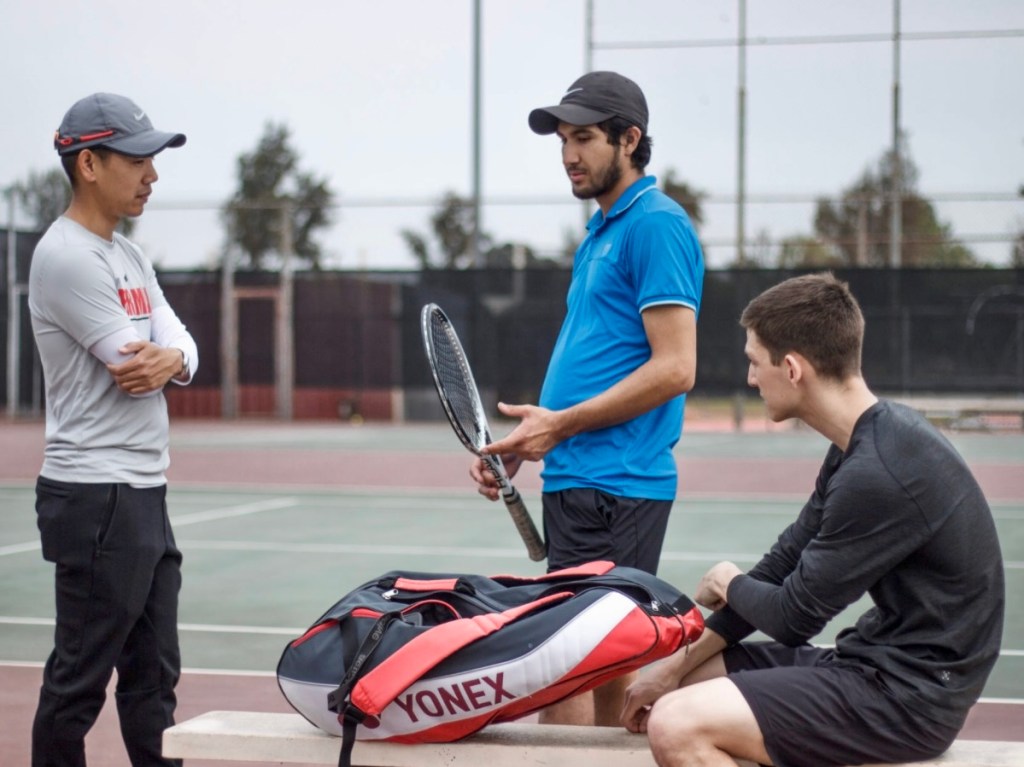
Tennis thing: Tell me a little about how you got started in tennis. Who got you into the game and where did you first play?
Long Dao: My first exposure to tennis was around when I was five or six years old when my family (aunts, uncles and cousins) would play and I would tag along. But I never did any serious training until I got to high school. Essentially, I did not start my tennis career until I was 14 years old.
Tennis thing: By the time you became a student at Pierce, had you ever heard of Coach Paul Xanthos?
Long Dao: I had not heard of Coach Xanthos until the first day of fall practice when I joined the team in 2005.
Tennis thing: How long did your own playing career extend? Did you continue to play while you finished your education at UNLV and Long Beach?
Long Dao: Competitive tennis ended for me right around when I transferred to UNLV. I may have played a few tournaments here or there but training and regular tournaments practically ended around then.
Tennis thing: I know you were an assistant at Pierce before taking over the team yourself. What were the most important lessons you learned from Coach Xanthos? Also, what did you have to learn for yourself the hard way, from your own coaching experience?
Long Dao: Simplicity. Coach Xanthos would always try to simplify the game for us as players. That is something to this day I try to do for my students.
As a player, I was always one to drill and drill, be extremely repetitive in training, till I reached my goals, whether it was to perfect a shot or execute patterns. I was relentless in how I went about that. I have come to learn that many students, especially the younger players that I have worked with, learn and process things differently than I do. So being able to change teaching styles to reach and connect with different players was something that I had to learn over time.
Tennis thing: I didn’t know Pierce was forced to abandon their tennis program until earlier this year and I was very disappointed. As I point out in my article, it was hard to believe a school with an enrollment as large as Pierce could not field a team. I know it’s ancient history now but do you think Pierce valued its tennis history enough? Could the school have done more to keep a team under the school’s banner?
Long Dao: Short answer, no. I have some of the fondest memories there as a player and coach. I have had the pleasure of meeting wonderful people there from teammates, players and staff members to fellow colleagues and coaches from Pierce and other schools, many of whom I’m friends with to this day. Some of my favorite coaching memories happened there, taking the team from last in the conference to challenging for the conference team title and winning an individual conference doubles title.
But, it was shortly after that accomplishment I learned tennis at Pierce was, sadly, not valued as much as I had hoped. It simply was another class that was offered and if it does not generate the revenue from enrollment or participation than, like many other classes or offerings at the school, the program will end up getting cut.
Tennis thing: I’m sure it’s very different for you, being a tennis professional, rather than coaching a group of college students. Do you miss coaching a team and can you see yourself coaching at the college level down the road?
Long Dao: There are some aspects of coaching a team that I miss and others I don’t. Will I ever coach another college team? I honestly don’t know.
Tt

 Tennis thing