Tag: Tennis books

  • Old Pete likes to hit hard.

    Let me back up.

    Right around New Years I took a lesson from Chris Phelan, aka, Pro-To-Go in Palm Springs. At one point Chris met me at the net and said, “Look, you hit the ball great. You move Ok. But, you work too hard.”

    I admit it. I didn’t get it. In fact, I thought about it a great deal for the rest of our trip and after we got home. Gradually, very gradually, I came to understand. The point Chris was trying to make was, that at my level, what I needed to do is hit the ball deep, with top spin rather than always, or at least usually, putting great value on simply hitting the ball hard.

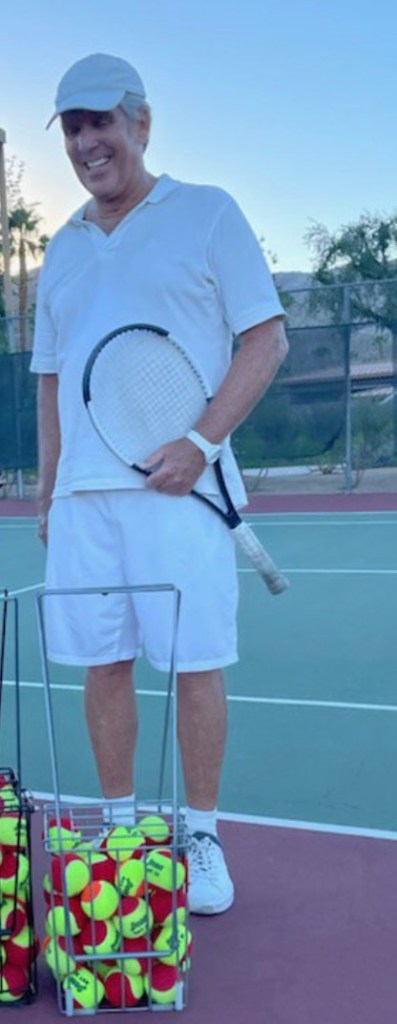
    Today I hit with Old Pete, an off and on student of Caesar.

    As we walked onto the court he said. “Listen, I like to hit hard.”

    I said, “Rock on, dude. Hit it as hard as you like.”

    And, he did.

    Chris Phelan in
    Palm Springs

    It took me about five minutes to find myself wondering what, exactly, was the point of relentlessly trying to hit the ball as Old Pete? I still do not have an answer but when I shared my experience with Chris he said: “Sad, but his loss. In the bigger picture, consistency equals a longer tennis life. Since no one enjoys self-destruction, the real fun is in developing a more versatile toolbox—one that includes a soft grip and relaxed wrist to get you out of trouble and make your opponent play one more ball, maybe one more than he’s able to return.”

    Sure, I am pointing the finger at Old Pete, and he deserves it. His style of play is neither effective nor enjoyable but if I am being honest, I’ve been guilty of something similar. It says something about me and my development as a tennis player that I didn’t get what Chris Phelan said when he said what he said back in January, in a sincere effort to help me play better tennis for longer.

    But now I do, and I’m happy about that and endlessly thankful to Chris Phelan. I can’t wait to get onto the tennis court with him again — maybe this fall. Maybe over the winter, it doesn’t matter.

    This time, I’m gonna get what he’s telling me without having to mull it over for a few weeks or a month.

    This time I will pay attention, Chris.

    I promise! Tt

  • Tennis Partners

    When I started playing tennis, MIB warned me I would find it a challenge to find suitable tennis partners. He was right. My plan, to engage in formal instruction rather than developing what I somewhat disparagingly have referred to as a park game was the right way to go—for me. The downside was that the social or networking aspect of tennis—the ability to get a game or a hit—had to be developed after I’d gotten fairly adept at hitting the ball. Connections are not always easily made. So, I want to write a bit about a few of the tennis partners I’ve shared a court with.

    Phil: I found Phil on the Tennis Players Looking for partners database at Calabasas. He was a commercial property manager. He emphasized that he only did commercial, no residential. When I asked him why he said it was because a commercial property manager didn’t have to listen to as many sob stories as a residential property manager. “You know, it’s not personal. You’re not paying. It’s time to move your business or go out of business.” It made sense. Phil was 45 I think, but his pattern of play has become well-known to me over the last year or so. Even though he was in decent shape, he didn’t move much. So, I either had to hit it right at him, preferably at his forehand, or my ball was going straight to the back fence. He did give two interesting bits of advice. First, was about two local guys who organized mixed-doubles meetups, one at CSUN and the other at Sherman Oaks Park. His other bit of advice was a good one. Phil said, “I’ll tell you what I’ve learned about doubles. Only play mixed. Taking out 50% of the testosterone out of tennis makes the game a lot more fun.”

    Stan / Johann: These guys were great fun. I started out with Stan, a mid-40s accountant. He’d been playing for years but wasn’t very good. He moved like a fit 40 year old, which I enjoyed. We were hitting once a week and chatted about the idea of playing doubles. As the birth of his daughter drew near, he was nice enough to pass me off to his buddy Johann. He was more fit but his tennis skills were a little shaky but he was such a pleasant guy. Then one day he just kind of vanished. When he surfaced again he said he’d been inundated by work and family life. I get it.

    Brisbane Stew: I was practicing my serve at The Rose Bowl, earbuds wedged into my ears, when I thought I heard someone talking to me from the court next to me. That someone was none other than Brisbane Stew. He was looking for a quick hit so we rallied for a while. Turns out he was a pilot for Qantas and found himself in Pasadena for a few days before flying back to Australia. A couple years younger, but a lot more fit, Stew gave me all I could handle. In fact, he was a big motivation in my (somewhat shaky) decision to convert to a two-handed backhand. We tried to meet up once a trip and I had gotten used to an occasional text from him saying when he would be in town. Stew has an excellent serve and likes to play angles you would expect to see in a good doubles match. Then one day Stew told me Qantas was changing planes for the BNE to LAX flight. I hope I’ve not seen the last of Brisbane Stew. He was great fun to play with.

    Pasadena Steve: The tennis gods take and then they give. Not long ago I was practicing my serve at Grant Park in Pasadena when Pasadena Steve strolled up, resplendent in his bucket hat, and asked me if I wanted to hit a few balls. Since then, we try to meet up every week or so. Steve’s a retired schoolteacher from LAUSD and is a relatively new Pasadena resident and a refugee from nearby Glendale. There’s a lot of talking during our sessions and that’s fine by me. It’s nice to blather on about politics, writing, baseball and Mexican food with someone who shares many of my same reference points. Steve plays in a long-established doubles group at the Rose Bowl that’s been going through some changes of late with one player going to the great tennis court in the sky and another threatening to move. Tennis is always about adjustment.

    MIB: I will always be able to brag that someone traveled 2,000 miles to play tennis with me, on my birthday no less. Sure, that was MIB. And, sure, he was in Los Angeles on business but he still went out of his way to extend his trip by a day so he could get all the way to hell and gone (Calabasas) on my birthday. We played during my lesson with Caesar and it was a great experience for me and one I detailed in Tennis thing the book.

    Then, last summer, following our family reunion in the QCs, we made the trip to SE Michigan to see the MIB in his own back yard. Yes, tennis was played. Yes, bourbon was sipped. Yes, LPs were played. Playing tennis with MIB was a hoot. He honored me by playing full out and I really savored the challenge. It reminded me of the movie The Rookie, where high school baseball players in a small Texas town in get better by trying to catch up with the major-league fastball of their coach, Jim Morris.

    I think you have to see high-level athletic performance to get an Idea for how close you can get to it yourself. Better than seeing is actually experiencing. I imagine some people would shrink from such experience, worried about proof beyond doubt that they could never deal whatever the athletic prowess they admire. Me? I think the experience itself can exalting, so long as one is serious, like I was when I played with MIB. Playing with MIB, even more so than Stew, gave me the sense of what I could do and what I could not. It clarified the size of the court and what it meant to actually cover it. One thing is certain, if I were lucky enough to play with MIB on a regular basis I would be a far better tennis player.

    Federer said that in tennis you could feel your opponent through contact with the ball. As soon as I heard this I nodded. The same is true in baseball. I can still remember the sense of hitting a heavy slider off some guys. My hands remember the feeling and in my brain that fragment of sense-memory connects me with those guys, even after all these years. It’s only been a few months since I played tennis with MIB but I still remember how it looked and felt.

    Lord willing, MIB and I will find ourselves on another tennis court someday soon. I’m looking forward to it.Tt

  • The art and science of warming up to serve.

    This has been bothering me for a while. How should a club player warm up to serve? My main problem is this: I tend to hit too fast too early. What’s strange to me is that the speed seems to come automatically. In other words, I am not trying to hit my serves fast or hard. Compare this to my baseball career where I found it very easy to warm up gradually. I enjoyed playing short toss before moving up to long toss before refocusing on pitching at full speed from 60 feet 6 inches. For me, properly warming up to serve would take a little more thought. At first I tried to work it out by myself but I continued to find myself at 75% with two or three serves.

    That can’t be good.

    Lexie, My tennis coach!

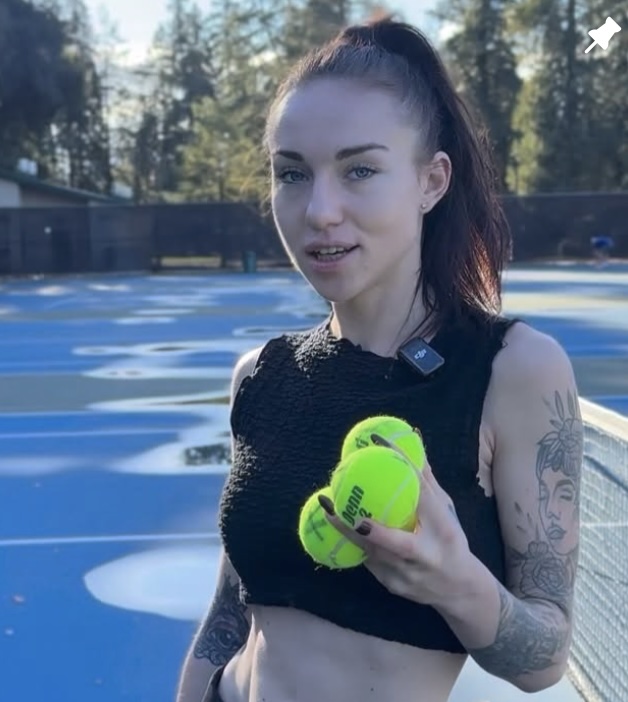
    So, I decided to reach out to two trusted experts. Coach Lexie is one of my favorite tennis coaches at Instagram. Every time she says, “I’m Lexie, your tennis coach.” I smile. It’s nice to think that I’m actually Lexie’s student and her posts always make it feel that way. When I asked her about warm up to serve she was generous enough to write this for me.

    “When I warm up the serve, I start by preparing the body and shoulder before hitting balls. I use light dynamic movements like arm circles, shoulder rolls, torso rotations, and wrist prep to open up my range of motion.

    On court, I add shadow swings and light throwing to groove the service motion and rhythm without tension. From there, I move into a progressive serving routine—starting easy to find feel, then gradually adding direction, different targets, and serve types (flat, slice, kick), always focusing on a consistent toss.

    A good serve warm-up is about rhythm and feel first—speed comes last.”

    All of that make sense to me but it’s not easy. I have tried to formalize the process as much as I can. I start by tossing along the fence (another technique Lexie shared on Instagram). My toss tends to creep lower and lower as I hit my serves faster but a fence-high toss allows me body more time to impact the ball with a nice sense of flow.

    Then, I move to the baseline and I toss and catch, another bit of advice from Lexie. This is very helpful because it gives me instant feedback about whether my toss is even in the ballpark. Sometimes it’s not.

    Then, I finally make contact with the ball. My goal for the first ball is to hit the ball as slowly as possible for at least five balls. That’s not easy for me, but I am trying. I promise. In fact, my practice goal is not to exceed 30% when I am hitting serve after serve. Hey, I’m gonna be 65 in April. Sixtyfuckingfive!

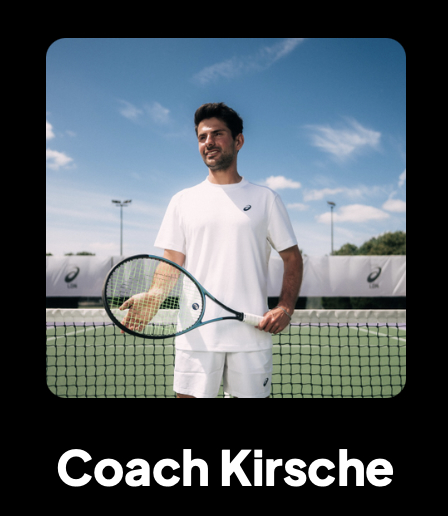
    Another Instagram coach who has helped with my warm up is Coach Kirsche. As soon as I started to follow him he came out with a warm up guide for the shoulder. Talk about timing!

    Me? I love this dynamic resistance band stuff but I have to admit that I have a hard time implementing it. Why? Did I mention I was going to be 65 in April? Thing is, every time I’ve tried any resistance band work, even light stuff, I have ended up with a shoulder that’s more sore than it would be after thirty serves. Still, I am going to dedicate myself to doing more of this. I just need to find the sweet spot between overdoing it (my style) and not doing it at all (also my style. You figure that out.

    I’d like to extend my sincere thanks and gratitude to Lexie and Kirsche. Just the feeling of having two great coaches out there who want me to improve makes me want to improve even more.

    Tt

  • Academic tennis: A Tennis thing meditation.

    As those of you who have read Tennis thing know, I owe my tennis to my brother, MIB. He was the one who told me, before even meeting me in person, “Paulie, you would love tennis.” MIB was right, as he so often is. What I doubt, though, was that MIB would have expected how long I would take my twice-a-week lessons with my coach, Caesar Schwarz. It’s been a bit over two years since I started studying tennis with Caesar. I didn’t start out studying the game, I think it became a study gradually, but it is what tennis remains for me.

    What’s the diff, you might be asking? Think back to playing dodge ball when you were a kid. How long was it between your first hearing of the word dodge and the moment when someone was chucking a ball at your head? Most games are learned as they are played. Many people, most people, likely, learn terms by playing it.

    But, I have not. I have learned to play tennis while studying it. I like to watch tennis played whether I am watching a WTA or ATP pro or a little kid with marvelous footwork.

    And, I love to hit the ball.

    What I have not focused on is competition. This is true partly because at my age I am not especially competitive. I’m not even in a competition with myself, to be honest. I want to play tennis correctly out of a motivation to master something at once new and satisfying. That’s an intoxicating combination. But, the question is does the person on the other side of the net count and is anyone keeping score? When Caesar is the guy, he matters. It’s the precision and intentionality of his play that allows me the physical and mental opportunity to learn. He has raised me since I was a 60+ year old tennis newborn and has been instrumental to everything I’ve learned. If any elements of my game are AOK, it’s because of my coach.

    But, and this is something I mused about in Tennis thing, does one need to play tennis, keep score, enter tournaments, seek the humiliation of their opponents to really play tennis?

    There’s this old broad at Calabasas who seems only to hit with whichever pro is available. I have never seen her playing with anyone other than a coach. There’s no serving and each coach tends to hit the ball directly toward the old broad. But, the old broad bashes the ball back with fierce effort and likes to collect winners. And, this brings me to this quote:

    “Some people, they keep on working with a coach, but the coach is just teeing the ball up for them. That’s no way to learn tennis. This is how you learn the game, right here.”

    The previous quote is from Brisbane Stew. He’s a Qantas pilot I met at Pasadena’s Rose Bowl tennis courts. Unlike me, he has scads of tennis experience and is quite fit for 60. Unfortunately, he just told me the Qantas Brizzy to Los Angeles route is now flown using the Boeing 787. Unless Stew changes aircrafts I won’t be seeing him soon. Bummer. Playing with him was always amusing and educational. Back to his quote. He’s not wrong. Playing with him or MIB is not as easy as playing with Caesar but there’s more to it than that.

    I have mentioned before that an example of Caesar‘s particular genius is the ability to hit shots that are consistently challenging for me, but only rarely beyond my capabilities. The other day, I was watching as he served to an elderly, but very fit student. Caesar had to abbreviate no fewer than three elements of his motion, that I could see, in order to hit a serve that was challenging to his student but not overwhelming. Now, can I imagine that I could get better faster if I consistently played with someone like Stew or MIB? I think the answer is undoubtedly, yes, especially if better is defined by advanced competitive ability. However, there’s a significant caveat. And that caveat involves the questions of form and balance. When the ball is coming too fast or bouncing too high or has been hit too wide or too shallow or too deep the kinds of corrections a beginning player like I have to make must ofetn be done in great haste. Not surprisingly, great haste, seldom results in a shot struck with good form or balance. And, there’s the rub, at least for me.

    It’s a great understatement to say that I’ve enjoyed the meditative aspects of tennis. You see, I am on the eve of cutting back on my lessons with Caesar. This change is driven solely by economics. If a small shitpile of cash were to drop onto my head, I would gladly spend it on more frequent and longer lessons with Caesar, but this does not seem likely.

    Early on, I remember Caesar saying that when he and his younger brother, Darius, were taking tennis lessons as kids their family could only afford one lesson each month. Caesar’s dad was a smart guy because he made sure that his sons actually practiced what they were taught during their lessons. That’s my plan and I will be similarly dedicated even though I will still be having four lessons a month. Still, I’m not going to be happy about it.

    When I go to sleep at night I am thinking about my footwork as I move toward a deep, high-bouncing back hand. I’m not thinking about how I can beat someone or keep them from beating me. It will be interesting to see how things differ and stay the same in 2026. Tt

  • The MIB Effect

    Yesterday, over a nice, crisp wheat ale (Rasenmäher-Bier [lawnmower beer]) at Enegren, I was waxing lyrical about how much my tennis game would improve if I was able to play with the MIB just once a week.

    My ale-sipping companion wondered if my coach, Caesar, wasn’t able to fill that roll. His question revealed the difference between playing for the sheer joy of trying to hang in there, rather like riding a bucking bronco, as opposed to the steady, incremental block-on -block approach of a tennis coach intending to help a player build a complete game.

    Outwardly, the best evidence of the kind of play that characterizes a lesson is preparation (anticipating and flowing toward the incoming ball) and executing the proper kind of stroke. It is simple, but simple is often not easy especially in tennis.

    Playing with MIB stresses my game to its limits and beyond, but is also just plain fun. A great deal can be learned just by watching him move around the court anticipating and revealing entertaining angles to create.

    Caesar would approve of the exercise but I think he’d want to both debrief and decontaminate afterward. I think I will always have the tendency to overhit in tennis, something I never did playing baseball and rarely did on the golf course. I can hear Caesar now, telling me to do all of the same things he has for the last two years. I will sometimes stop just to say that I hear him and that I appreciate what he’s saying and that I am trying my best to put his advice into effective action.

    But, the tennis racket and tennis ball contact is simply too enjoyable not to occasionally crank up to 11. Catch that ball in the middle of the racket especially when accompanied by some well-timed movement into the shot and you have an experience that’s hard for me to resist, though I usually do.

    Reading Anthony Verghese The Tennis Partner will always stand as a reminder of how rare the best tennis partners will always be. Enjoy it when you find yours.

  • Technical Tennis: Racquets, Strings, Balls, Courts, Spin And Bounce By Rod Cross & Crawford Lindsey

    I bought this book solely to take advantage of free shipping at Tennis Warehouse. Remember readers, you have to spend money to save money. The book is superb, though perhaps mostly of interest to people like me who are intrigued by the technology, or what’s represented as technology, in tennis. I’ve spent my first year and a half in tennis trying different rackets and strings (not to mention grips and overgrips). At no time have I gotten the sense a given racket made or kept me from being a better player.

    I have developed preferences that remain fairly consistent. The first is for a racket with a head size of 98 square inches. The second is for polys that are not strung too tight, always less than 50 pounds. Finally, I trend away from rackets designed to aid in power because, for all of my faults and weaknesses in tennis, I do not suffer from a lack of power.

    Back to Cross & Lindsey’s book. Check out this quote:

    TENSION AND PLAYER PERCEPTIVENESS
    Virtually every player assumes that he can tell the difference between different tensions. Some claim to be able to identify a difference of a pound or two. Tests have been performed that bring that claim into question. In a test of 41 advanced recreational players, only 11 (27 percent) could determine a difference of 11 pounds or less. In fact, 15 (37 percent) couldn’t correctly identify the difference even when the tension between two racquets varied by 22 pounds. A small number were able to discern a two-pound difference, however. Players were not allowed to touch the strings or vibrate them to guess tension, and each racquet had a vibration dampener to take away auditory cues.

    Using earplugs to further dampen auditory cues lowered the success rates even more. Players were only allowed four hits with each racquet, so the only data the player was interpreting was feel, not an accumulated history of location of ball placement that could be used to deduce string tension. Some players said that they noticed a difference, but then incorrectly chose which racquet had a higher tension.

    Auditory cues are huge but they’re not often a subject of conversation with most players so quick and confident to identify what they feel about string tension. I recall a similar test relating to golf. Many players reported that they prefered the feel of putters made from this material or that. But, when they wore earplugs they couldn’t differentiate even the most dissimilar materials or even construction techniques.

    For me the question is this: Thinking of the average player is it beneficial to believe in the benefit of this string over that string, this tension over that or this racket over another? To jump ahead, I think using the correct racket (correct as regards weight, head size, stiffness) is very important for new, especially young, players. What I’m asking concerns average adult players. My experience leads me to conclude that it can be entertaining but is largely a waste of time for recreational players to believe that the right (or wrong) racket or string will relevantly affect their games.

    With that said, identifying preferences is fine but I contend that mine have little affect on my game, and that’s Ok. I still like what I like. As they saying goes, you can either use the racket you like or the racket someone else likes. Just make sure to keep your focus on your game and not your strings and racket. By the way, I’m not done writing about this book. It’s much too interesting so stay tuned. Tt

  • A second serve…finally.

    A couple weeks back I was lucky enough to catch a couple lessons with Laura Sax at Del Norte in Sacramento. Laura is a super tennis coach. I always try to show up with a specific issue so my lessons with her can exist in kind a parallel universe to what Caesar and I continue to work on.

    As we drove from Los Angeles I tried to come up with something. What I finally came up with was my need for more consistency when I’m serving. So, Laura asked to see me hit a few serves.

    She said, “Those are kinda Ok. Lotsa pace. Now, show me your second serve.”

    I looked down at the court and sighed, “I don’t have one.”

    Laura said, “Well, show me what your second serve would look like if you actually had one.”

    I sighed again.

    Then, I hit something like a flat serve with the pace turned down. It hit the net with authority. Kind of…

    Laura said, “Ok, follow me up to the net.”

    Over the next few minutes she had me first hit the ball over the net with the edge of the frame while choking up on the racket. That’s not as easy as it sounds, by the way. Then, Laura had me hti the ball over the net with only a downward snap of the wrist. As with an overhead, this was done without the arm or torso bending forward, or following through. A secondary object of the game was to have the ball hit inside the service box, so a distinctly downward strike was in order.

    It was kinda fun. I spent much of the rest of the lesson hitting those spikes from the net and out toward the back of the service box on my side of the net. It wasn’t until Laura had me back up to the baseline that I saw the point of the entire exercise. I was hitting a slice!

    Who knew?

    As the racket snapped, it also rotated left with the ubiquitous pronation that everyone is so excited about. The force of the strike was a combination of the wrist snap multiplied by the racket’s rotational energy. The result, when the ball was struck as the racket was driving forward but still not completely open (read: flat), was a serve with rotation that curved it left (from me) a right handed player.

    I’m not very bright so it was not until that very minute that I understood what the totality of the exercise was about. As I said, Laura is a fantastic coach.

    On the long drive home I tried to reimagine the movements and, more importantly, the feelings of my two lessons with Laura. I had a fairly decent grasp of what I was trying to achieve but as with all things tennis the goal was fogged by age and lack of significant athletic ability. Still, when I got home I could still feel it although I was triyng to hit the ball too hard (don’t I always?).

    Then I remembered something else Laura said. She said that when serving the wrist should be completely at ease and the racket held with the very lightest of grip.

    Now, let me tell you why this made sense:I have always, and I mean always, since the time of my first serve, had a difficult time warming up with my serve. I can throw a baseball softly enough that a newborn could catch it with his offhand (Ok, maybe that’s an exageration) but you get the idea. In contrast, I have a very difficult time warming up to serve. My motion, and the overall pace of my early serves are, far too fast and too hard. Who knows why?

    But, when I deliberately keep my arm, wrist and elbow relaxed I can hit early serves at Speed 1 and then Speed 3 and so on. It is almost as if I can coordinate the speed better because I am managing the tension (or lack) in my serve (note that I do not write, hitting) arm. Simple, but remember that simple does not always equal easy. Perhaps it never does.

    Then, and I hope this doesn’t appear to suplant Laura’s contribution but I stumbled on this video by Patrick Mouratoglou. The looseness or softness is counterintuitive to someone like me who was born to throw a baseball (5.25 ounces at the end of the fingertips) rather than strike a tennis ball (2 ounces, plus or minus) overhead and with an added 27 inches of the racket.

    Yes, it’s still (obviously) a striking motion but a very different one.

    So, there I am and happy to be there. I have been playing tennis since September of 2023 and I now have a developing the tiny bud of a second serve. Now that wasn’t so hard, now, was it? Tt

  • The Barking Tennis Coach

    I was practicing my serve at the local park when I overheard a coach on the adjoining court tell her student something to help her feel the correct move to the trophy position.

    “Take your arm up with the racket facing somewhat forward and somewhat down. So, as you go up the lid is closed. Then, as your arm goes up, you open the lid going back and then close the lid as the racket moves forward to strike the ball.”

    The lid is closed going up…

    That, of course, reminds me of Andy Roddick. Like I wrote in Tennis thing, the book, Roddick’s motion appeals to me.

    It’s short, purposeful and has no extra movement.

    But, back to the coach. I figured it would be good to get her contact info in case I wanted to grab a lesson with someone who sees the serve like I do, so close to home. So, I sat in the bleachers editing a short story I’m working on. The coach and the student continued to work, alternating between rallying and the student serving, or trying to serve, to the pro.

    Finally, the pro said, “Let me serve to you. Go ahead and return my serve if you can but mostly I want you so watch my motion. Watch the lid open and close.”

    Then I heard what sounded like a yelping dog. Since there’s a dog park near the courts I looked up to see what happened. But, then I realized the sound came from the other way.

    It came from the coach.

    Yup, the coach barked like a dog when she served.

    Nope, she wasn’t kidding.

    Nope, I didn’t stick around to get her contact info.

    Yep, I’m glad a dog didn’t get hurt.

  • From one-handed to two-handed and probably not back.

    Those of you who’ve read Tennis thing know I started out tennis with a two-handed backhand. My coach Caesar said, “I don’t care what you do after you’ve played for a year but I’d like you to start out hitting your backhand two-handed.”

    I was game but I soon found the two-hander less than pleasant. During my third or fourth lesson I asked if I could try to hit my backhands with one hand. Caesar patiently showed me the basics (he plays a one-hander) and I soon found the whole deal more intuitive and less physically challenging. The one-hander also helped to create a more effective shot. What’s not to like?

    “You hit a natural slice, mate. And, we’re going to build on it. We’ll add the topspin backhand when the time comes.”

    Justine Henin…accept no imitations.

    I was all in and began to informally curate a collection of the best one-handers I could find. My favorites, then and now, belong to Gregor Dimitrov, Stan Wawrinka, Roger Federer and the owner of the one-handed backhand of the gods, Justine Henin. If aesthetics matter, and they always do, there’s no comparison between the one and two-hander. As a wise person on the internet once said, “The two-hander has all the elegance of a monkey wrench.”

    Then, a couple things happened in a relatively close span of time. I managed to hurt my right wrist somehow. This happened about the same time as I began to learn and practice the topspin one-hander and exactly the same time I was hitting against the wall, a lot. The cherry on the sundae was Stew From Brisbane, my sometimes hitting partner whom I know from Brookside in Pasadena.

    To me, Federer’s backhand is second only to Henin’s.

    Stew’s 60, three years younger and leaner than me. He’s played for no less than 50 years and is a very solid player. Stew also likes to hit hard pretty much from the jump, which is not my style. He means no harm and I really like him. But, his shots to my backhand, especially the deep and high balls, ate my fledgling one-hander alive in addition to taxing my already-tender wrist.

    I did a little soul searching while I had a week off from my lessons with Caesar. By the time we were back at it I had decided to make the big switch to the two-hander.

    Before I did I conferred with the MIB himself back in Michigan. “Paulie,” MIB said. “I’ve tried going two-handed at least twice but I always go back.” Various internet gurus cautioned against making the switch especially for players who are older (40+, ha!) and who took up the game later in life.

    One guess who that describes…

    But, I did it anyway and it’s been fairly brutal. For me, the two-hander is an exceptionally difficult shot. Yes, high balls are somewhat easier but in total it’s a far harder shot from a purely physical standpoint. Sometimes, when I’m tired and the ball’s out wide, I will resort to my one-handed slice. Caesar always catches me and says the same thing. “Hitting your slice is Ok but start two-handed and go one-handed as your stroke begins going forward.”

    As if I have time to do all that.

    When my baseball career was on life support I made a last ditch effort to teach myself to hit left-handed. It wasn’t a bad idea. A lefty has a little bit of a head start to first and I thought it made me look like the kind of player who would try anything to be more versatile. It changed the way I saw the ball and I found power where I didn’t from the other side of the plate and lacked power where I had it as a right-handed hitter. It was weird, just like the two-handed backhand.

    Today is the first time I’ve put the sequence of the change and the factors that informed my switch together in my head. Don’t ask me why it’s taken me so long to see the threads. But, now that I have I think I will stick it out with the two-hander for now. I keep hoping for a breakthrough. Maybe next week or next month. Anything is possible.

  • The smaller the ball the better the (sports) writing.

    I’m not sure who said that but I am fairly sure it’s true. The best sports writing is about golf, of this I think there’s little doubt. The reason for that is simple. Golf writing is either about hero worship, which never gets old, or tragedy, which also never gets old or both.

    Think about the boredom of writing about ordinary good golf:

    “And then our hero hit another ball into the middle of the fairway. Then he hit another ball into the middle of the green. Then he made another putt.”

    Now try this: “Our hero was nervous as he stood on the 10th tee, a tricky dogleg left. Memories of snap hooks into the woods bedeviled his mind as the wind swirled from right to left. He was already three shots behind the leaders with the hardest holes on the course still to be played. He hit a towering drive that was no more than ten feet left of his target line, but the wind freshened right at contact and the ball drifted left of the tree line before it vanished from view. Ten minutes later after having to strip down to his underwear in order to play his second shot from a pool of swamp water, the resulting ball miraculously caroming off a greenside tree into the center of the green, our hero unceremoniously sunk a ten-footer for birdie.”

    A tennis ball is a bit larger than a golf ball and my early reading suggests that writing on tennis is Ok, but surely not to the level of good golf writing. One problem, I think, is the nature of the action. Too little describable time passes between tennis shots to delve into a player’s mindset. But now I am getting caught on a tangent.

    I’m reading these three tennis books. In a couple weeks, I’ll review them. Technical Tennis is the most interesting, surprisingly, though the writing of David Foster Wallace’s String Theory is undeniably excellent and the story of Pancho Segura’s life in Little Pancho is as improbable as it is true.

    Tt