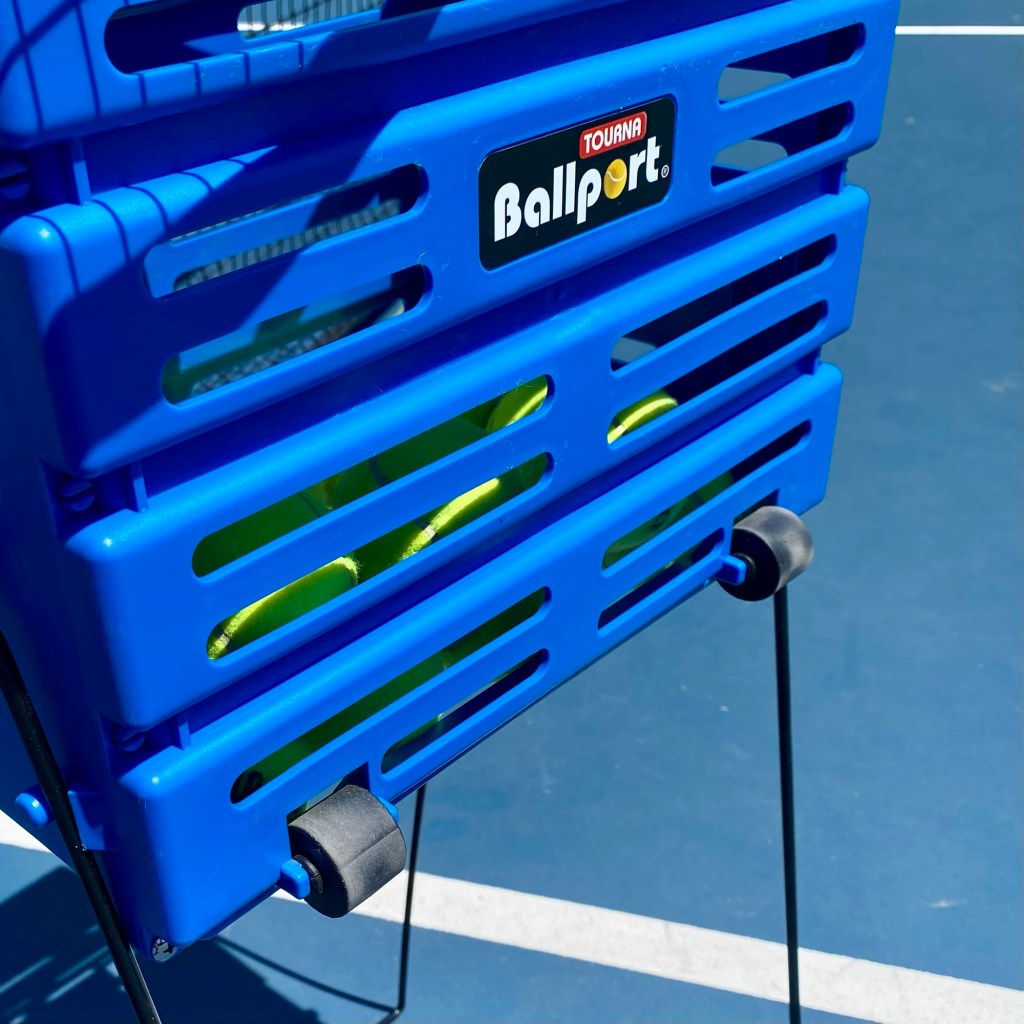
I dig the Tourna Ballport Deluxe. It’s light, holds plenty of balls (I will leave its exact capacity for my esteemed colleagues at YouTube) and has wheels. In fact, Deluxe means wheels, funky two-piece wheels to be precise. Check ‘em out:
See the little slit in the wheel? Yeah, that should work!
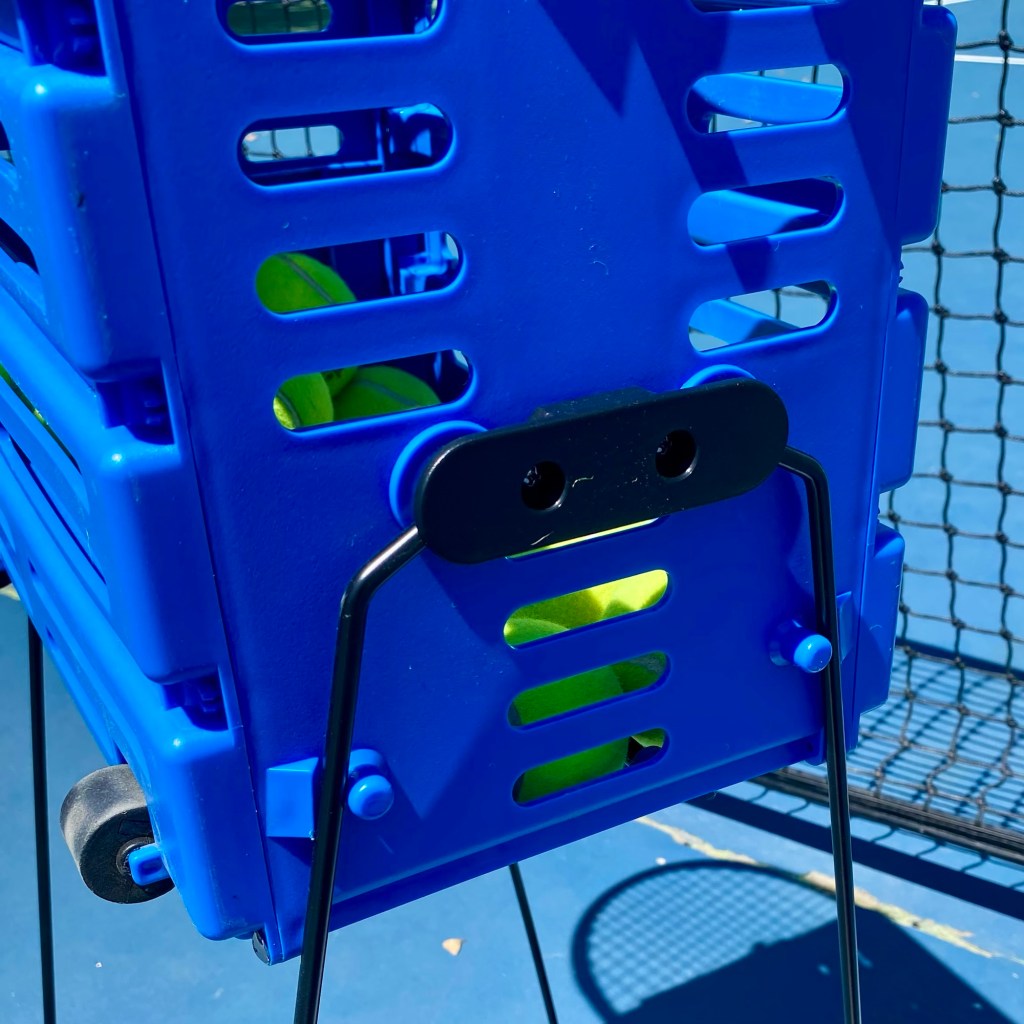
I cannot imagine making this hopper more efficiently than they have, when you consider that it’s nearly free. That said, the screws that hold it together grip only to plastic. Even the legs rely on plastic to lock open and closed.
Have a look:
Yeah, man; those legs are locked, that’s for sure!
It’s super light duty and made with cheapness firmly in front of mind, but it works as intended.
I love that phrase and it applies perfectly here. Oh wait. I do have one more niggling complaint. Every time I take the Ballport Deluxe out of the trunk one or more balls have gone rogue and made a break for it!
There goes another one! Grab it!
Two-piece wheels, all-plastic construction and escape-prone balls notwithstanding, I just loves my Ballport Deluxe.
Yesterday, over a nice, crisp wheat ale (Rasenmäher-Bier [lawnmower beer]) at Enegren, I was waxing lyrical about how much my tennis game would improve if I was able to play with the MIB just once a week.
My ale-sipping companion wondered if my coach, Caesar, wasn’t able to fill that roll. His question revealed the difference between playing for the sheer joy of trying to hang in there, rather like riding a bucking bronco, as opposed to the steady, incremental block-on -block approach of a tennis coach intending to help a player build a complete game.
Outwardly, the best evidence of the kind of play that characterizes a lesson is preparation (anticipating and flowing toward the incoming ball) and executing the proper kind of stroke. It is simple, but simple is often not easy especially in tennis.
Playing with MIB stresses my game to its limits and beyond, but is also just plain fun. A great deal can be learned just by watching him move around the court anticipating and revealing entertaining angles to create.
Caesar would approve of the exercise but I think he’d want to both debrief and decontaminate afterward. I think I will always have the tendency to overhit in tennis, something I never did playing baseball and rarely did on the golf course. I can hear Caesar now, telling me to do all of the same things he has for the last two years. I will sometimes stop just to say that I hear him and that I appreciate what he’s saying and that I am trying my best to put his advice into effective action.
But, the tennis racket and tennis ball contact is simply too enjoyable not to occasionally crank up to 11. Catch that ball in the middle of the racket especially when accompanied by some well-timed movement into the shot and you have an experience that’s hard for me to resist, though I usually do.
Reading Anthony Verghese TheTennis Partner will always stand as a reminder of how rare the best tennis partners will always be. Enjoy it when you find yours.
I’m not sure who said that but I am fairly sure it’s true. The best sports writing is about golf, of this I think there’s little doubt. The reason for that is simple. Golf writing is either about hero worship, which never gets old, or tragedy, which also never gets old or both.
Think about the boredom of writing about ordinary good golf:
“And then our hero hit another ball into the middle of the fairway. Then he hit another ball into the middle of the green. Then he made another putt.”
Now try this: “Our hero was nervous as he stood on the 10th tee, a tricky dogleg left. Memories of snap hooks into the woods bedeviled his mind as the wind swirled from right to left. He was already three shots behind the leaders with the hardest holes on the course still to be played. He hit a towering drive that was no more than ten feet left of his target line, but the wind freshened right at contact and the ball drifted left of the tree line before it vanished from view. Ten minutes later after having to strip down to his underwear in order to play his second shot from a pool of swamp water, the resulting ball miraculously caroming off a greenside tree into the center of the green, our hero unceremoniously sunk a ten-footer for birdie.”
A tennis ball is a bit larger than a golf ball and my early reading suggests that writing on tennis is Ok, but surely not to the level of good golf writing. One problem, I think, is the nature of the action. Too little describable time passes between tennis shots to delve into a player’s mindset. But now I am getting caught on a tangent.
I’m reading these three tennis books. In a couple weeks, I’ll review them. Technical Tennis is the most interesting, surprisingly, though the writing of David Foster Wallace’s String Theory is undeniably excellent and the story of Pancho Segura’s life in Little Pancho is as improbable as it is true.



 Tennis thing